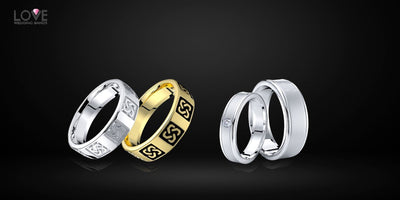
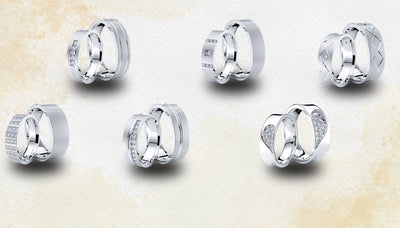
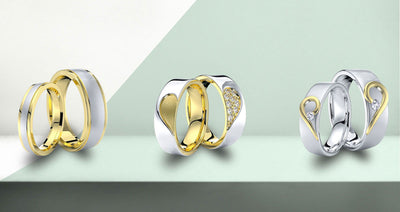
What is the best metal for his and hers wedding bands?
The best metal for his and hers wedding bands depends on three factors: her engagement ring metal, your lifestyle, and your maintenance preference. White gold (14K) is the most popular choice for couples — it complements diamond engagement rings, photographs well, and suits both masculine and feminine profiles. Yellow gold is the lowest maintenance (no plating required) and is the fastest-growing choice among couples under 35. Rose gold is the most durable gold option and the most visually distinctive. Platinum lasts a lifetime without any plating but costs 40–60% more. Tungsten and titanium are the most scratch-resistant and the best options for couples with very active lifestyles — but neither can be resized. For most couples choosing their first his and hers set, 14K white gold in coordinating widths is the safest recommendation.
WHITE GOLD HIS AND HERS WEDDING BANDS | The most popular choice for coordinated couples sets
White Gold His and Hers Wedding Bands
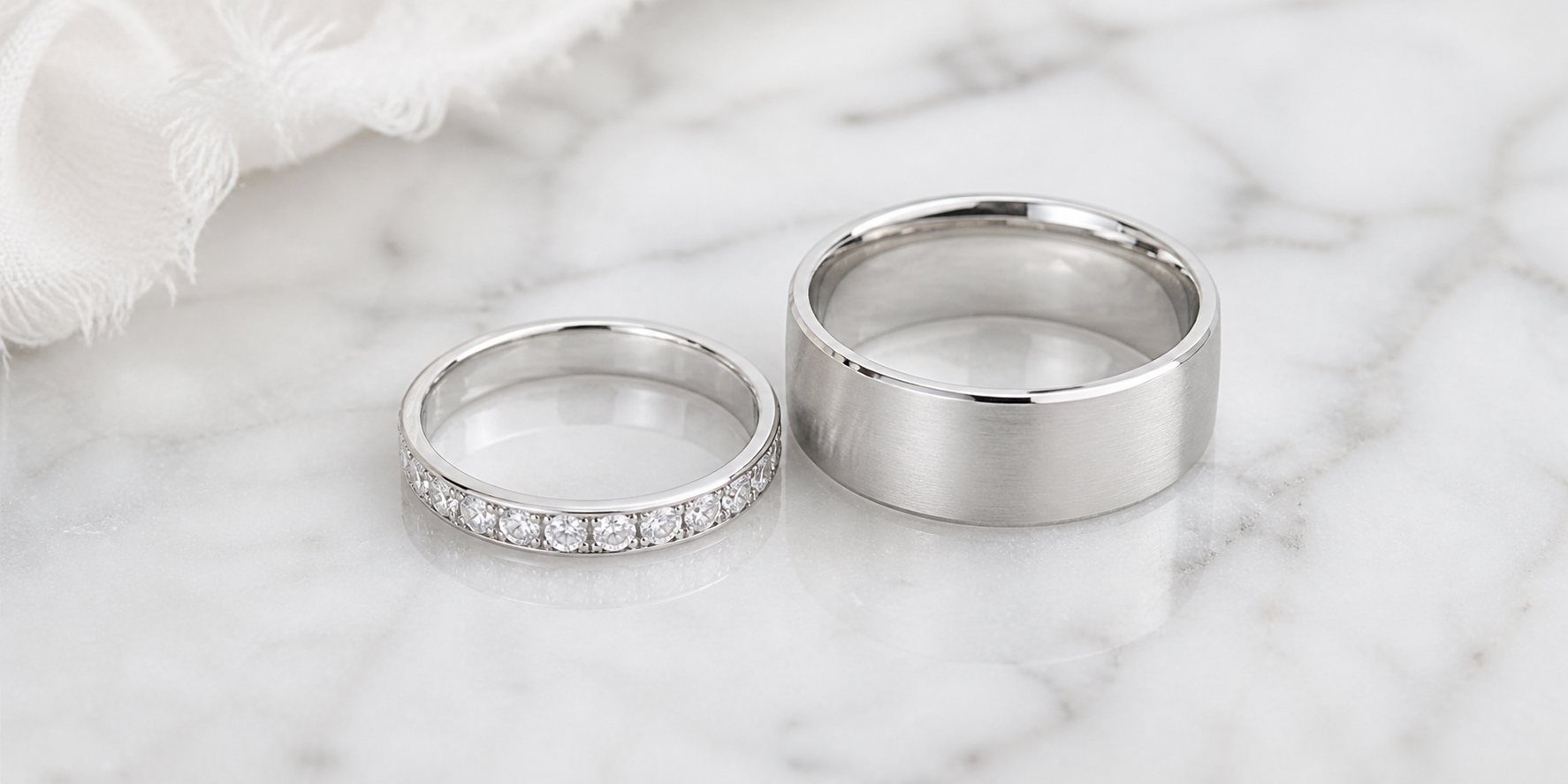
14K white gold is the most popular metal for his and hers wedding bands, and for straightforward reasons: it photographs better than any other metal in virtually all lighting conditions, it complements diamond engagement rings more naturally than any other option, and its neutral cool-white tone works equally well on masculine wider bands and feminine slimmer profiles. When both partners wear white gold, the rings read immediately as a coordinated pair regardless of how different the designs are.
How white gold looks in a his and hers set
The hallmark of white gold in a couples set is visual clarity. His band — typically 6–8mm wide — and her band — typically 2–4mm wide — in matching 14K white gold create an unambiguous visual relationship. The cool brightness of the metal doesn't compete with her engagement ring's diamond; it complements it. The white gold his and hers set is what most jewelry retailers default to recommending precisely because it works reliably across the widest range of skin tones, engagement ring styles, and wedding aesthetics.
Durability and maintenance for two rings
Both partners' white gold bands will need rhodium re-plating every 12–24 months depending on wear intensity. His ring — worn through more physical activity on average — will typically need plating sooner than hers. Plan for both rings to be serviced at the same time: it costs $30–$80 per ring, takes under an hour, and restores both bands to their original bright-white finish simultaneously. Having both done together also means they continue to match in color tone across the years.
- Maintenance: Rhodium re-plate every 1–2 years — his more frequently if active
- Durability: Excellent at 14K — harder than 18K, well-suited to daily wear for both
- Resizable: Yes — can be resized up or down by a qualified jeweler
- Best for: Most couples — especially those with diamond engagement rings or who want the most versatile 'safe' choice
- 14K vs 18K: 14K is more durable and more scratch-resistant — recommended for both partners in an active his and hers set
“White gold dominates his and hers sets for one reason that overrides everything else: the engagement ring. In probably 80% of the cases where a woman already has a diamond engagement ring in white metal, matching her wedding band to that metal is non-negotiable from a visual standpoint. White gold gives you that without the price premium of platinum. For couples choosing everything from scratch, yellow gold is giving white gold a real run — but white gold remains the default recommendation for first-time buyers.”
— Dr. Sarah Chen, GIA Graduate Gemologist, 14 years in bridal jewelry
COUPLES DATA: Based on 21,961 verified reviews at LoveWeddingBands.com, white gold his and hers sets account for the highest customer satisfaction at the 12-month mark. Most commonly cited reason: 'Both our rings still look exactly the same as the day we got them.' Second most common: 'They coordinate with her engagement ring perfectly.'
Browse white gold his and hers wedding band sets →
YELLOW GOLD HIS AND HERS WEDDING BANDS | Zero maintenance, growing fast, genuinely timeless
Yellow Gold His and Hers Wedding Bands
Yellow gold is the original wedding band metal, and it is in the middle of a significant resurgence. Among couples under 35, yellow gold is now the fastest-growing metal choice — up 31% year-over-year based on our sales data — driven by a preference for authenticity, lower maintenance, and the warmth of a metal that requires no coating, no plating, and no upkeep to look exactly as it was the day you bought it.
The zero-maintenance advantage for couples
Yellow gold's single greatest advantage for couples is what it doesn't require. White gold needs rhodium re-plating every year or two. Platinum needs professional polishing to reduce patina. Rose gold is similarly low-maintenance. Tungsten can't be resized. Yellow gold in 14K sits at a practical sweet spot: it requires nothing except an occasional buff with a soft cloth to restore its shine. For couples who want their rings to be completely maintenance-free, yellow gold is the correct choice.
14K vs 18K in a his and hers set
For his and hers wedding bands specifically, the 14K versus 18K question has a practical answer. 14K yellow gold (58.5% pure) is harder, more scratch-resistant, and better suited to daily active wear for his band. 18K yellow gold (75% pure) has a richer, deeper yellow color that looks particularly striking in wider men's bands — and is the preferred choice for couples who want the most visually saturated yellow gold look. If both partners want matching karat, 14K is the better practical choice; if appearance is the priority and both partners are careful with jewelry, 18K is the premium option.
- Maintenance: None — no plating, no coating to maintain. Polish occasionally with a soft cloth.
- Durability: Excellent at 14K; moderate at 18K (softer, scratches more readily but can be polished out)
- Resizable: Yes — the most flexible metal for resizing across all karats
- Best for: Couples who want zero maintenance; vintage or warm aesthetic; warm to olive skin tones; couples choosing both rings from scratch without a pre-existing engagement ring to match
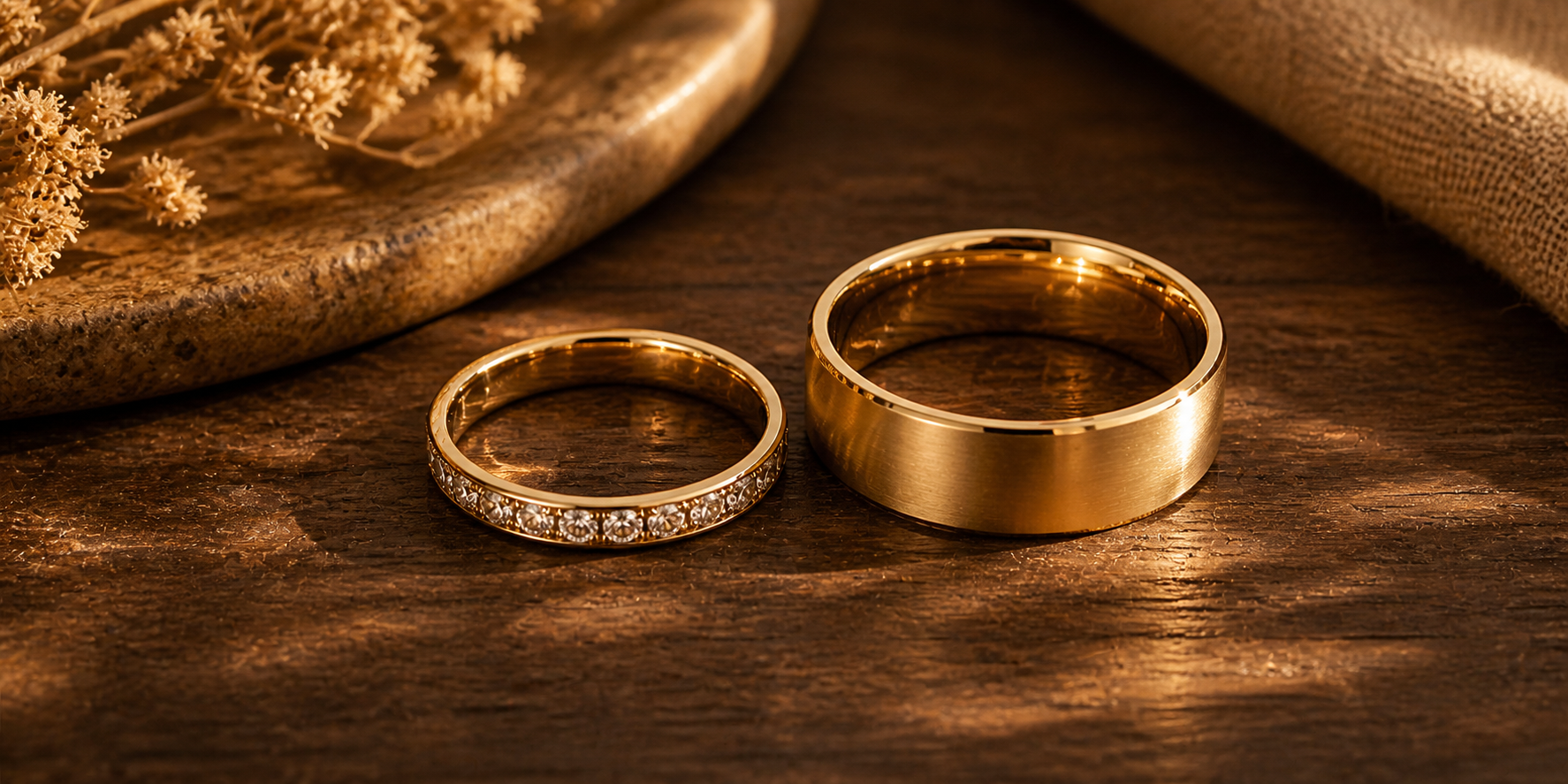
Shop yellow gold his and hers wedding bands →
ROSE GOLD HIS AND HERS WEDDING BANDS | The hardest gold, the most distinctive look
Rose Gold His and Hers Wedding Bands
Rose gold is produced by alloying yellow gold with copper. That copper content does two things: it gives rose gold its signature blush-pink color, and it makes it measurably harder and more scratch-resistant than white or yellow gold at the same karat. Rose gold is the most durable of the three gold options — a fact that surprises most couples who assume its romantic appearance comes at a durability cost.
Does rose gold work for both partners?
Yes — and more readily than most couples expect. For her band, rose gold is one of the most requested metals — its warmth and distinctiveness sets it apart from the sea of white gold bands. For his band, a wider rose gold ring at 6–8mm reads as warm, deliberate, and visually striking rather than overtly feminine. The key is width: at 6mm and above, rose gold has enough visual mass that the color becomes a bold statement rather than a soft one. For couples where he is uncertain, two-tone rings that incorporate rose gold alongside white gold or black plating offer a visual compromise.
Rose gold maintenance — the patina question
Rose gold does not require plating and does not tarnish in the way lower-quality metals do. However, the copper content can cause a very gradual, subtle deepening of the pink tone over years of daily wear — a natural patina process. This is not damage; most couples find it desirable as evidence of a life lived. A professional polish restores the original finish if preferred. Critically: his band and her band will age at similar rates if worn with similar frequency, meaning the pair maintains visual coordination over decades.
- Maintenance: Very low — no plating. Natural patina develops slowly; polishable if desired.
- Durability: Excellent+ — copper alloy makes rose gold harder than white or yellow gold at the same karat
- Resizable: Yes
- Best for: Couples who want a distinctive, romantic look; fair to medium skin tones particularly; couples who want no maintenance with a slightly warmer aesthetic than white gold
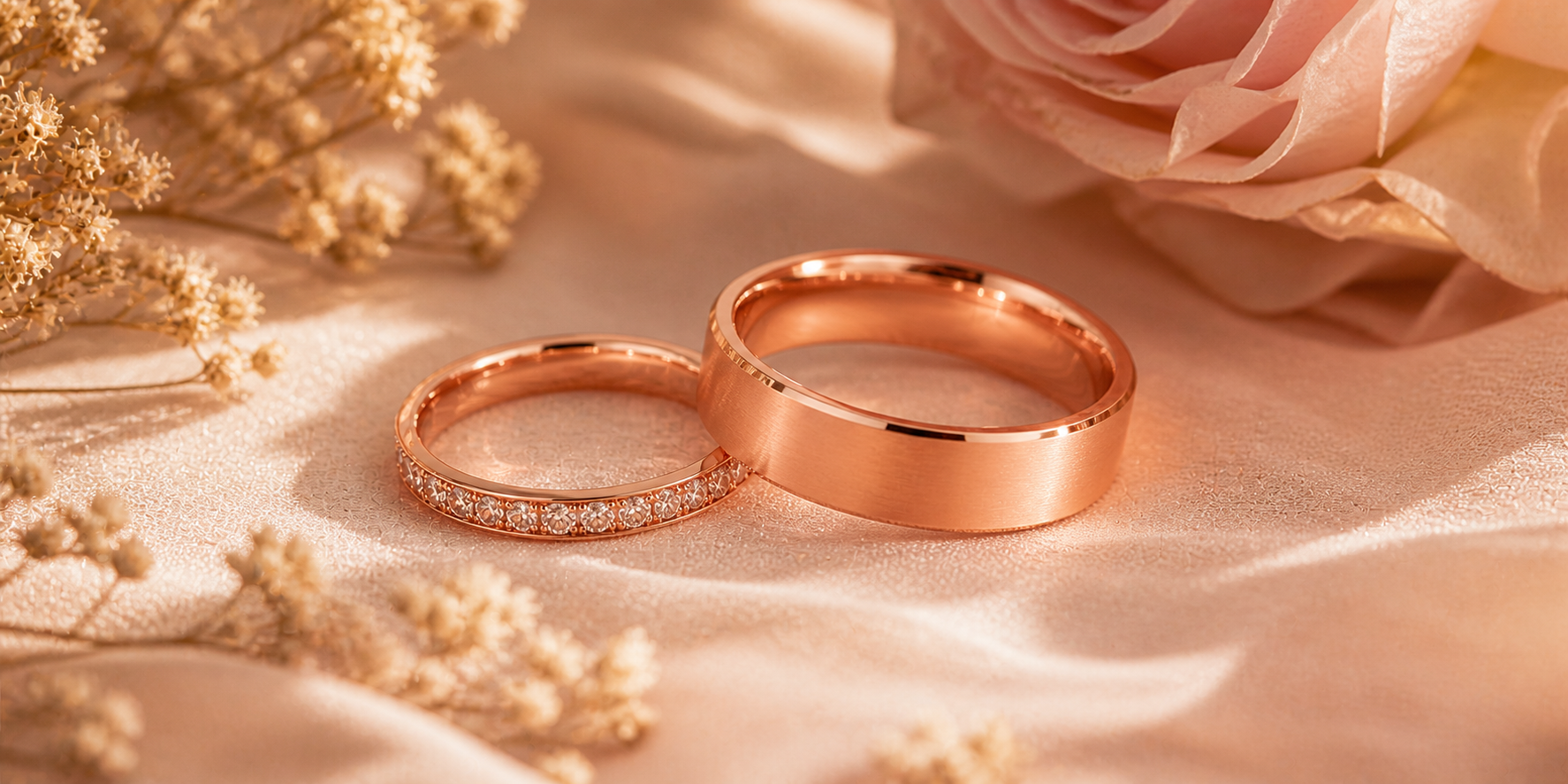
Browse rose gold his and hers wedding band sets →
PLATINUM HIS AND HERS WEDDING BANDS | The lifetime metal — no plating, no compromise, premium price
Platinum His and Hers Wedding Bands
Platinum is the only naturally white metal in common use for wedding jewelry — no rhodium plating required to achieve its cool silver-white color. It is heavier than gold (you'll feel it on your finger), more dense, and more expensive — typically 40–60% more than the equivalent gold design. What platinum offers in return: a ring that requires essentially no maintenance to retain its metal content, is hypoallergenic, and will last not just a lifetime but multiple lifetimes without structural degradation.
Platinum vs white gold for his and hers sets
The most common comparison couples make is between platinum and white gold for his and hers sets. White gold is rhodium-plated to achieve a bright white finish; that plating gradually wears and needs refreshing. Platinum is naturally white and, while it develops a matte patina over time, its metal structure remains intact. The distinction: white gold stays bright with occasional replating; platinum develops character but never loses integrity. Couples who want a premium material with absolute longevity typically choose platinum. Couples who want the brightest-possible finish maintained over years often find white gold easier to manage at a lower price point.
- Maintenance: No plating needed. Develops a natural patina (matte look) — professional polish available if preferred.
- Durability: Superior — the most durable precious metal for rings
- Resizable: Yes
- Hypoallergenic: Yes — the only major ring metal that is truly nickel-free and hypoallergenic
- Best for: Couples who want the highest-quality material; anyone with a nickel sensitivity; couples making a lifelong investment in rings they'll never replace
- Price: $$$$ — expect to spend significantly more than equivalent gold designs
“I tell every couple who asks about platinum the same thing: platinum is the correct choice if you are buying one ring for the rest of your life and you never want to think about it again. It will look slightly different in 20 years than it did on your wedding day — more worn, more lived-in — but the metal itself will be as strong as the day I made it. That's not true of any gold alloy. If that kind of permanence matters to you, platinum is worth every penny of the premium.”
— Marcus Williams, Master Goldsmith, 22 years in custom bridal jewelry
TUNGSTEN & TITANIUM HIS AND HERS BANDS | Maximum durability — with important trade-offs for couples
Tungsten and Titanium His and Hers Wedding Bands
Tungsten carbide and titanium sit in a different category from the precious metals above. They are significantly less expensive, offer different and in some ways superior durability characteristics, and are increasingly chosen by couples — particularly where he works with his hands or in environments where a gold ring is impractical. However, both come with important trade-offs that couples need to understand before committing.
Tungsten carbide — for him specifically
Tungsten carbide is the hardest metal commonly used for wedding bands — it will not scratch under normal daily wear conditions. It is also the heaviest, with a satisfying weight that many men prefer. Tungsten his and hers sets are possible, but practically speaking, tungsten is typically a his-only metal: most tungsten bands start at 6mm width and above, are far too hard for typical jewelry shaping at narrower widths, and cannot be resized. For her band, matching tungsten would typically mean a very different ring in terms of proportions and wearability. The most common configuration: his tungsten band paired with a different metal for her.
Titanium — genuinely works for both partners
Titanium is lightweight (the lightest wedding band metal by far), hypoallergenic, and available in both men's and women's widths. Unlike tungsten, titanium can be crafted at 2–3mm widths suitable for women's bands. It can also be anodized to produce a range of colors including black, blue, and grey tones. Titanium cannot be resized in the traditional sense (it requires replacement rather than adjustment), but it is one of the few alternative metals that genuinely works for both his and hers sets in coordinating widths. Cost is the other advantage: titanium his and hers sets are typically a fraction of the price of gold.
- Tungsten — best for: Active men who want a scratch-proof, heavyweight ring; couples where he needs maximum durability and her ring can be a different metal
- Titanium — best for: Couples who want maximum lightweight comfort; anyone with metal sensitivities; budget-conscious couples who want coordinating sets in alternative metals
WARNING — both tungsten and titanium cannot be resized in the conventional sense. If your ring size changes significantly (pregnancy, weight change, injury), you will need to replace the ring rather than resize it.
Emergency note: unlike gold rings which can be cut off in medical emergencies, tungsten rings must be cracked off (this is standard procedure and they are designed to do this) — not a safety concern, but worth knowing.
COUPLES CONSIDERATION: If you're choosing tungsten for his band, pair it with any precious metal for her band — white gold, yellow gold, or rose gold — in a complementary finish. Matte black tungsten pairs particularly well with a brushed white gold or rose gold women's band. The contrast can be intentional and striking.
Best Metal for His and Hers Rings by Lifestyle
Your lifestyle should inform your metal choice at least as much as aesthetics. Here's how to match metal to how you actually live:
Active couples — outdoor, fitness, manual work
If both partners lead active lifestyles, prioritize hardness and scratch resistance over surface maintenance. 14K yellow gold or 14K rose gold for her — both are harder than white gold and require no plating. 14K yellow gold or tungsten carbide for him — tungsten is essentially scratch-proof. Avoid 18K gold (too soft) and avoid white gold if either partner works with their hands frequently, since rhodium plating wears significantly faster with physical work.
Professional couples — office, medical, client-facing
For professional settings, the cleaner and more polished the ring, the more appropriate. White gold or platinum his and hers sets photograph excellently and maintain their appearance with minimal care in low-physical-wear settings. Rhodium replating, needed every 1–2 years, is perfectly manageable for professionals who wear their rings in low-impact environments. Platinum is the ultimate professional choice — maintains its appearance indefinitely with occasional polishing.
Medical or hands-on professionals
Surgeons, nurses, mechanics, electricians, and others who cannot wear metal rings at work have two options: a high-quality silicone alternative for work hours, or wearing the ring on a chain. In these cases, metal choice matters less than comfort off-duty — tungsten or titanium are popular because their hardness means the ring retains its appearance despite infrequent wear. Both partners should discuss this together before choosing, since the 'cannot resize' limitation of tungsten is more consequential for someone who only wears their ring part-time.
For the complete breakdown on which metal is right for your lifestyle, read our guide: White Gold vs Yellow Gold vs Rose Gold Wedding Bands for Couples.
Thinking about his and hers for the first time? Start with his and hers wedding band trends for 2026 — the styles and configurations most popular among couples right now.
Find Your His and Hers Set by Metal at LoveWeddingBands.com
Every his and hers set in our collection is designed as a coordinated pair — proportional widths for both partners, matching metals, comfort-fit interiors, and free ring sizing included. White gold, yellow gold, rose gold, and platinum available. Browse by metal to find the pair that's right for both of you. Shop his and hers wedding bands by metal →
Frequently Asked Questions: His and Hers Wedding Bands by Metal
Q: What is the best metal for his and hers wedding bands?
A: White gold (14K) is the most popular choice for his and hers wedding bands and works best for most couples, particularly those with diamond engagement rings. It complements diamonds, works equally well on both wider masculine and slimmer feminine profiles, and photographs well in all lighting. Yellow gold is the best zero-maintenance option and is growing fastest among couples under 35. Rose gold is the most durable gold option and the most visually distinctive. Platinum is the highest-quality and longest-lasting option but costs significantly more. The best metal for your set depends on her engagement ring, your skin tones, your lifestyle, and how much maintenance you want to do.
Q: Can you mix metals in his and hers wedding bands?
A: Yes, you can mix metals in his and hers wedding bands — but the pair needs a unifying design element to look intentional rather than accidental. The most successful mixed-metal combinations: white gold for her and yellow gold or tungsten for him, connected by matching profile shape or surface finish. Two-tone rings that incorporate both metals within each band are another effective solution. What doesn't work: choosing two completely unrelated rings in different metals with no design connection. If you want mixed metals, look for rings from the same collection designed to work as a pair, or commission matching custom engraving as the shared element.
Q: Can women wear tungsten wedding bands?
A: Women can wear tungsten wedding bands, but tungsten has practical limitations that make it a less common choice for her band. Most tungsten rings are produced in widths of 4mm and above and cannot be crafted as narrow as the 2–3mm profiles most common in women's bands. Tungsten also cannot be resized — requiring replacement rather than adjustment if size changes — and its extreme hardness makes it difficult to customize. For most couples, tungsten is recommended as his metal paired with a precious metal (gold or platinum) for her.
Q: Does white gold or yellow gold look better in a his and hers set?
A: Both white gold and yellow gold work excellently in his and hers sets — the right choice depends on her engagement ring and both partners' style preferences. White gold is better when she has a white metal diamond engagement ring, since the matching metal creates visual continuity. Yellow gold is better when both partners are choosing their rings from scratch without a pre-existing engagement ring to match, or when both prefer the warm, low-maintenance aesthetic. Yellow gold is now growing faster than white gold among couples under 35 and is equally valid for modern his and hers sets.
Q: What metal is most durable for his wedding band?
A: Tungsten carbide is the most scratch-resistant metal for a men's wedding band — it is essentially scratchproof under normal daily wear. However, tungsten cannot be resized and must be cracked (not cut) off in medical emergencies. Among precious metals, rose gold (14K) is the most durable due to its copper alloy content, followed by yellow gold (14K) and white gold (14K). Platinum is the most durable precious metal overall — it doesn't lose material when scratched, it simply displaces — but it develops a patina over time. For active men who work with their hands, 14K yellow gold or tungsten are the two best practical options.
Q: Does rose gold tarnish or fade for wedding bands?
A: Rose gold does not tarnish and does not require plating to maintain its color. Unlike white gold (which needs rhodium replating when its surface coating wears), rose gold's pink hue comes from the copper content of the alloy itself — it is the natural color of the metal, not a surface treatment. Over many years of daily wear, the copper may cause a very gradual, subtle deepening of the pink tone — a natural patina that most couples find desirable. A professional polish can restore the original finish if preferred. For his and hers sets, both rings will age at similar rates if worn with similar frequency.
Q: Is platinum worth the extra cost for his and hers rings?
A: Platinum is worth the extra cost if you are buying rings you intend to wear for life without ever replacing or significantly maintaining them. Platinum requires no plating, does not lose metal when it scratches (it displaces rather than wears away), is naturally hypoallergenic, and will maintain its structural integrity indefinitely. The cost premium is typically 40–60% over equivalent gold designs. For couples making a long-term investment in the highest-quality material and who prefer never to think about maintenance, platinum is worth it. For couples who want a great ring at a practical price point with manageable maintenance, 14K gold is the better value.
Q: Do his and hers wedding bands have to be the same metal?
A: His and hers wedding bands do not have to be the same metal — but they should share at least one unifying design element to look like an intentional pair. Same profile shape, same surface finish, same collection, or matching engraving are all effective bridges between different metals. Couples successfully pair white gold (her) with yellow gold (him), rose gold (her) with tungsten (him), and platinum (her) with white gold (him) — in all cases, the visual connection comes from design rather than matching material. If both partners genuinely prefer different metals, a skilled jeweler or a well-chosen coordinated collection can make the pair work beautifully.