Why is wearing a wedding band important?
Wearing a wedding band is important because it serves as a visible, daily symbol of the commitment made between two people on their wedding day. It communicates marital status to others, reinforces the couple's own sense of connection, and carries historical and cultural significance that spans more than 6,000 years across nearly every civilization. Beyond symbolism, wearing a wedding band — especially as part of a matching his and hers set — is a shared physical reminder of the promises made at the altar. Research consistently shows that the visible symbols of commitment in a marriage contribute to relationship satisfaction, mutual recognition, and social trust. The ring does not make the marriage — but for most couples, removing it feels meaningfully different from wearing it.
| WEDDING BAND FACTS | Context for your article intro | |
|---|---|
| 6,000+ | Years the tradition of exchanging wedding rings has been documented — originating in ancient Egypt around 4,000 BCE |
| 90%+ | Of married Americans wear a wedding band regularly, according to bridal industry surveys |
| 47% | Of men who were not wearing their wedding bands said they felt "noticeably different" without it within one week (Jewelers of America survey) |
| 21,961 | Verified customer reviews on LoveWeddingBands.com — the largest source of real couples data on ring satisfaction and wear habits |
10 Reasons Why Wearing a Wedding Band Still Matters
These are the 10 reasons — drawn from anthropology, relationship research, cultural tradition, and what we hear directly from couples — that explain why the wedding band endures as one of the most meaningful objects a person can wear.1. It Is a Public Declaration of Commitment
A wedding band communicates your marital status without a word being spoken. In every professional setting, social context, and casual encounter, your ring tells the room that you have chosen a partner and made a formal commitment. This matters more than most people realize — it removes ambiguity, reduces the likelihood of unwanted romantic approaches, and sends a social signal that your relationship is stable and established. For many couples, this public declaration is one of the most valued functions of the ring: not because of possessiveness, but because of shared pride.2. It Is a Daily Physical Reminder of Your Vows
The wedding band does something abstract symbols cannot: it is present on your body every single day. When you look at it, touch it, or notice its weight on your finger, you are brought back to the moment you made your vows. This is not trivial. Marriage researchers consistently note that physical and environmental reminders of commitment — including the wedding ring — help couples maintain relationship satisfaction during periods of stress or distance. The ring is not a lock. It is a reminder.3. It Carries 6,000 Years of Human Meaning
The tradition of the wedding ring stretches back to ancient Egypt, where couples exchanged rings made from reeds and rushes found along the Nile. They were circular because circles had no end — a physical metaphor for eternity. The ancient Romans institutionalized the iron betrothal ring. Medieval Europe added gold. Modern design added diamonds, engravings, and custom metalwork. Every couple who exchanges rings today is participating in an unbroken thread of human meaning-making that spans every major civilization on earth. Knowing this makes the object feel weightier — and it is.“The wedding ring is one of the most persistent symbolic objects in human history. The specific form — a circle worn on the body — appears independently across Egyptian, Roman, Indian, and Chinese cultures with remarkably similar meanings. That convergence across unconnected civilizations tells us something: the human desire to mark commitment with a wearable symbol is not a cultural invention. It appears to be something close to a universal instinct.”
— Dr. Priya Nair, Anthropologist and Cultural Historian, University of Edinburgh
4. The Circle Itself Is Symbolic
The ring is not just a ring. The circular shape has been used as a symbol of eternity, wholeness, and infinity across virtually every human culture independently. There is no beginning, no end, no weak point. For wedding jewelry specifically, this geometry carries an unmistakable message: this commitment is intended to be permanent. The ancient Egyptians called the empty space at the center of the ring a gateway to the unknown — to the future that two people would navigate together. That meaning has not faded.5. It Strengthens Your Sense of Identity as a Married Person
Identity is partly constructed through the objects we carry and wear. Research on behavioral psychology consistently shows that physical objects associated with commitments — including rings — reinforce the wearer's own self-concept as a committed partner. This is not about the opinions of others; it is about how you see yourself. Couples who wear their wedding bands daily report a stronger identification with their marriage as a defining aspect of their identity. Couples who rarely wear their rings report that their marital status feels more “contextual” — present in some settings, absent in others. For most marriages, the former is healthier.6. For His and Hers Sets, It Creates a Shared Visual Language
When both partners wear matching or coordinating wedding bands, the rings become a shared symbol — something that belongs to both people simultaneously. His and hers wedding band sets are designed specifically to create this effect: two rings that read as clearly related, worn on two different hands, each a visible marker of the same commitment. Many couples report that seeing their partner's ring creates a distinct emotional response — a recognition, a warmth, a quiet acknowledgment of what they chose together. This is one of the most reported reasons couples give for choosing matching sets over individual designs. Choosing the right set makes all the difference. See our full range of his and hers matching wedding bands — designed as coordinated pairs in white gold, yellow gold, and rose gold.“What strikes me most, after 18 years of making wedding rings, is how consistently couples tell me that the ring they chose became a private language between them. Not what it says to the world — what it says to each other. I've had couples come back 15, 20 years later and tell me that they still notice their partner's ring and feel something. That's not sentiment. That's what a well-chosen wedding band actually does.”
— James Okafor, Custom Bridal Jeweler, 18 years specializing in couples jewelry
7. It Matters More to Your Partner Than You May Realize
This is worth stating plainly. For most married people, seeing their partner wear their wedding band regularly is meaningful — and noticing when they don't is also meaningful. This is not about surveillance or control. It is about the small, ongoing signals that a long-term relationship is built on. Relationship counselors routinely note that inconsistent ring-wearing — particularly when one partner wears theirs and the other does not — can become a source of unexpressed tension. The ring is small and the conversation feels disproportionate to have. But over years, it accumulates.8. It Protects Your Marriage in Professional Contexts
In professional environments — particularly client-facing roles, travel, or industries with high social interaction — a wedding band sends an unambiguous signal about your availability and priorities. This is not about distrust; it is about reducing the cognitive and social load of navigating boundary-setting in professional contexts. Most married professionals report that wearing a wedding band simplifies social dynamics in ways that wearing no ring does not. It answers a question before it is asked.9. Removing It Feels Meaningfully Different
One of the strongest arguments for the importance of wearing a wedding band is what happens when you remove it. In a Jewelers of America survey, 47% of men who stopped wearing their wedding bands reported that they felt “noticeably different” within a week — more autonomous in ways they hadn't expected, but also less grounded in their commitment. Many described an unfamiliar lightness that carried its own unease. The ring's absence turns out to be as meaningful as its presence. This is precisely what a genuine symbol does: it changes the state of the person carrying it.10. It Is the Most Enduring Personal Object Most People Will Ever Own
Unlike most objects, a wedding band is designed to be worn every day for decades. It accumulates the texture of your life — small scratches, worn edges, patina built up over years of daily wear. This is not damage; it is biography. Many couples who lose a wedding band or replace it report that the new ring feels like a pale substitute — not because the metal is different, but because the accumulated meaning is gone. The original ring, worn daily for 10 or 20 or 40 years, becomes something irreplaceable. That irreplaceability is itself part of its importance.“In couples therapy, the wedding ring comes up more often than most people would expect. Not because couples fight about it directly, but because it functions as a proxy for how present and committed each partner feels in the relationship. When one partner stops wearing their ring — even for practical reasons — the other partner notices. The absence registers, often before they consciously process it. The ring is a behavioral signal, and we're wired to read behavioral signals from our partners constantly.”
— Dr. Rachel Bloom, Clinical Psychologist, specializing in couples and relationships
What Does a Wedding Band Symbolize? The Full Meaning
The wedding band's symbolism operates on multiple layers simultaneously — cultural, personal, and relational. Understanding all three helps explain why such a simple object carries such outsized emotional weight.The circle: eternity and completeness
The circular form of the ring is its primary symbol. Across ancient Egyptian, Roman, Chinese, Indian, and Celtic cultures — civilizations with almost no contact with each other — the circle independently became a symbol for eternity, wholeness, and the divine. No beginning, no end. The space at the center was seen in many traditions as the portal to an unknown future — the life a couple would build together. When you give someone a ring, you are giving them a circle: the oldest human symbol for something that lasts.The ring finger: the vena amoris
In Western tradition, the wedding ring is worn on the fourth finger of the left hand — what the ancient Romans called the 'ring finger.' The Romans believed this finger contained a vein — the vena amoris, or 'vein of love' — that ran directly to the heart. Modern anatomy has confirmed that no such dedicated vein exists, but the tradition it inspired has lasted more than 2,000 years. The meaning outlived the science: wearing the ring closest to the heart remains the most universal placement in the world, even across cultures that subsequently learned the anatomy was incorrect.The exchange: a mutual act
The exchange of rings — both partners giving and receiving — is a relatively modern development in Western tradition. For most of European history, only the bride wore a wedding ring. The shift to mutual exchange began meaningfully in the mid-20th century, particularly in the aftermath of World War II, when servicemen began wearing wedding bands as a visible reminder of their wives and homes. By the 1960s, mutual ring exchange had become standard. Today, the mutual exchange is the norm — and matching his and hers wedding bands are among the most popular ring configurations sold. Explore what today's couples are choosing: our guide to his and hers wedding band trends for 2026 covers the metals, styles, and matching configurations most popular right now.The History of the Wedding Ring: 6,000 Years in Brief
Ancient Egypt (~4,000 BCE)
The oldest known wedding rings were made by ancient Egyptians from reeds, rushes, and hemp braided into circles. Archaeological evidence from approximately 4,000 BCE shows rings exchanged as part of betrothal ceremonies. The Egyptians believed the circle represented eternity, and that the space at the ring's center was a portal to an unknown future. Gold and silver rings emerged as Egypt's wealth grew — reserved initially for royalty, then spreading to the broader aristocracy.Ancient Rome (~2nd century BCE onward)
Roman culture formalized the wedding ring tradition. The earliest Roman rings were iron — representing strength and permanence. As Roman society grew more prosperous, gold rings became the standard for wealthy families. The Romans introduced the concept of the betrothal ring given by a man to a woman as a legal pledge of marriage — and, critically, introduced the idea of wearing it on the fourth finger of the left hand, citing the vena amoris.Medieval Europe and the Renaissance
Medieval European wedding rings became increasingly ornate. The “gimmel ring” — two or three interlocking bands that were separated before the wedding and joined at the ceremony — was popular in 16th century Germany and England. Posy rings, engraved with romantic mottos, were exchanged from the 13th through 17th centuries. The Renaissance brought greater emphasis on goldsmithing craftsmanship, and diamond-set engagement rings began appearing among European nobility.The 20th century: both partners wear rings
The shift to mutual ring exchange began during World War II, when American servicemen began wearing wedding bands as physical reminders of their commitment while overseas. By the 1960s, the dual-ring ceremony was standard in America and spreading globally. The late 20th century brought an explosion of materials — platinum, white gold, titanium, tungsten — and design styles. Today, the his and hers wedding band set represents the mature form of this evolution: two rings designed as a coordinated pair, each meaningful independently and more meaningful together.His and Hers Wedding Bands: A Shared Symbol for Both of You
For most of history, the wedding ring was primarily a women's symbol. Today, the matching his and hers wedding band set is one of the most popular ring configurations, chosen by couples who want both partners to carry the same visible symbol of commitment. What makes matching sets meaningful isn't that the rings are identical — they almost never are, because men's bands are typically wider and styled differently. What makes them meaningful is that they were chosen together, designed to coordinate visually, and worn simultaneously as a shared declaration. The rings become a private language between two people that is also, incidentally, legible to everyone else.Why couples choose his and hers sets
- Both partners carry a visible symbol of the same commitment — not one person marked and the other unmarked
- The visual coordination creates a sense of intentionality — the rings look like a pair, not two unrelated purchases
- Matching sets often cost less than two individually sourced rings of similar quality
- The selection process itself — choosing together — is something couples frequently report as meaningful
- Both partners have an equal, parallel physical reminder of their vows
FROM OUR COUPLES: In post-purchase surveys across our 21,961+ verified reviews, couples who chose matching his and hers sets reported significantly higher satisfaction with their purchase at the 12-month mark than couples who purchased their rings separately. The most common reason cited: 'We both wear ours every day, and seeing it on each other means something.'
How and Where to Wear Your Wedding Band
Which hand and finger?
In the United States, United Kingdom, Canada, and Australia, the wedding band is worn on the fourth finger of the left hand — the “ring finger.” In Germany, Norway, Russia, Greece, Spain, India, and many other countries, wedding bands are traditionally worn on the right hand’s fourth finger. Jewish tradition places the wedding ring on the index finger of the right hand during the ceremony, with many couples then moving it to the ring finger afterward. There is no universal rule — tradition varies by culture, religion, and personal preference.Wedding band and engagement ring: which goes first?
In Western tradition, the wedding band is typically worn closest to the heart — meaning below the engagement ring on the same finger. The standard practice: at the wedding ceremony, the engagement ring is temporarily moved to the right hand, the wedding band is placed on the left ring finger during the exchange of vows, then the engagement ring is moved back on top. Some couples solder their bands together; others prefer to wear them as separate rings that can be removed independently.When you can't wear your ring
Some professions make daily ring-wearing impractical or unsafe: surgeons, mechanics, construction workers, and anyone working with high-voltage equipment are advised to remove metal rings before work. In these cases, most couples either wear a silicone alternative during work hours or wear the ring on a chain. Neither option diminishes the meaning of the ring itself — what matters is the intent, not the continuous physical wearing.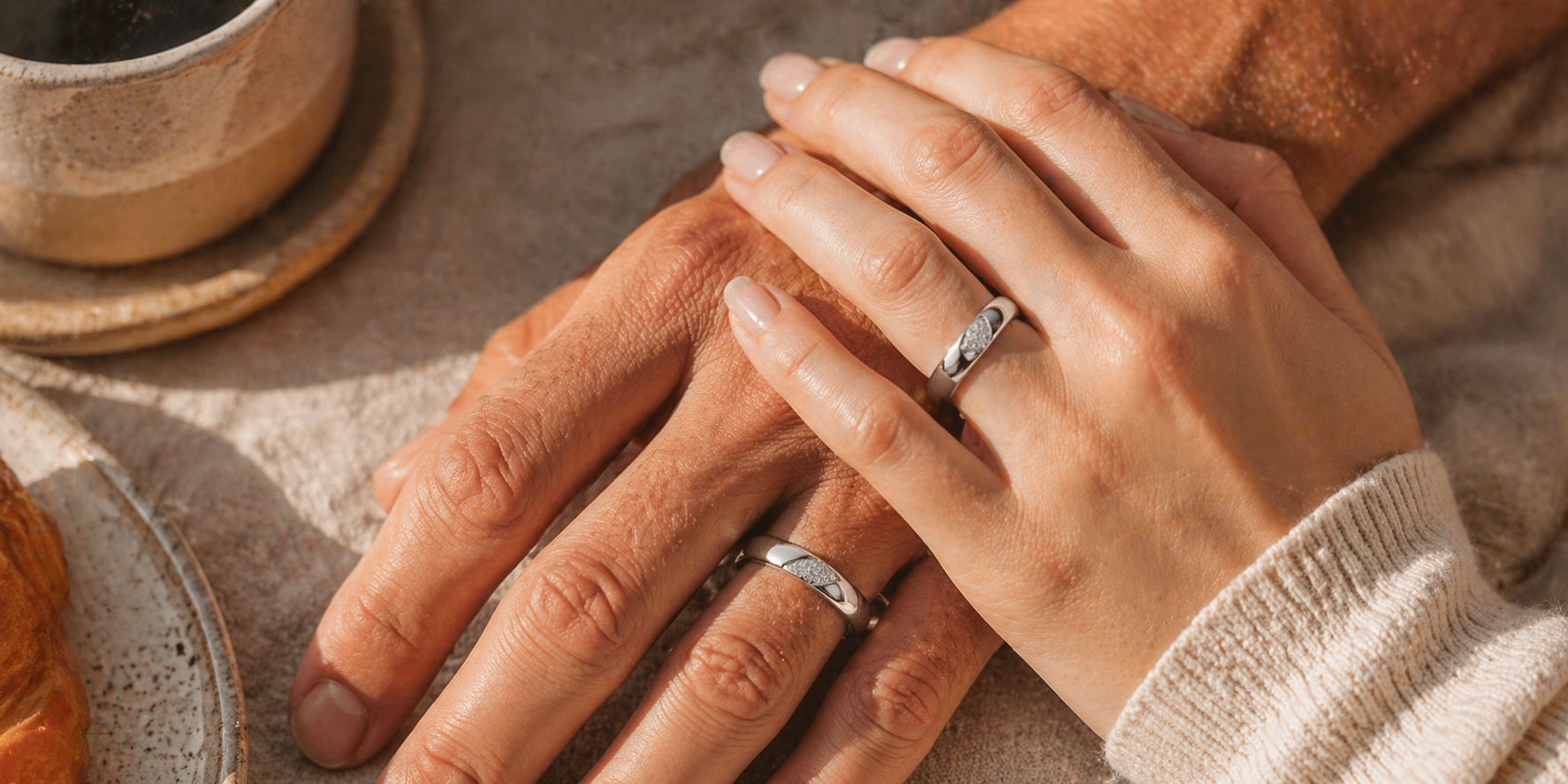 If you work with your hands, explore our men's wedding bands collection— including durable tungsten, titanium, and silicone-compatible styles designed for active wear.
For her ring, see our women's wedding bands — available in slim comfort-fit profiles in white gold, yellow gold, rose gold, and platinum.
If you work with your hands, explore our men's wedding bands collection— including durable tungsten, titanium, and silicone-compatible styles designed for active wear.
For her ring, see our women's wedding bands — available in slim comfort-fit profiles in white gold, yellow gold, rose gold, and platinum.
Still Deciding on Metal?
White gold, yellow gold, and rose gold all cost approximately the same — but they look very different and have different maintenance requirements. Before you decide, read our complete 2026 metal guide for couples. White Gold vs Yellow Gold vs Rose Gold: Which Is Right for You? →
Frequently Asked Questions About Wearing a Wedding Band
Q: Why is wearing a wedding band important?
A: Wearing a wedding band is important because it serves as a visible, daily symbol of marital commitment — communicating your status to others, reinforcing your own sense of identity as a married person, and carrying cultural and historical significance that spans more than 6,000 years. Research shows that visible commitment markers, including wedding rings, contribute to relationship satisfaction and are meaningful to both partners in a marriage. The wedding band also functions as a social signal that removes ambiguity in professional and social contexts.
Q: Do I have to wear a wedding band?
A: There is no legal requirement to wear a wedding band in any jurisdiction. Marriage is a legal and personal commitment that exists independently of whether a ring is worn. That said, most relationship experts and married couples report that the wedding band carries meaningful psychological and social functions — and that most partners notice when their spouse stops wearing one. Whether you 'have to' wear your band is a personal and relationship decision, not a legal one. For couples where wearing a ring is impractical due to work or medical reasons, silicone alternatives or wearing the ring on a chain are common solutions.
Q: Why do couples wear matching wedding bands?
A: Couples choose matching his and hers wedding bands because they want both partners to carry the same visible symbol of commitment, and because coordinating rings create a shared visual language that reads as intentional rather than accidental. Matching sets don't require identical rings — typically her band is slimmer, his is wider — but both are designed to coordinate in metal, finish, and style. Couples who choose matching sets consistently report that seeing their partner wear the ring is one of its most meaningful functions.
Q: On which finger and hand is a wedding band worn?
A: In the United States, United Kingdom, Canada, and Australia, the wedding band is worn on the fourth finger (ring finger) of the left hand, a tradition dating to the ancient Roman belief in the 'vena amoris' — a vein running from this finger to the heart. In Germany, Norway, Russia, Greece, Spain, and India, wedding bands are typically worn on the right hand's fourth finger. Jewish tradition places the ring on the index finger during the ceremony, with many couples moving it to the ring finger afterward. Which hand is correct depends on your cultural and religious background.
Q: What does the circular shape of a wedding ring symbolize?
A: The circular shape of a wedding ring symbolizes eternity, wholeness, and completeness — concepts that virtually every major civilization has independently associated with circular forms. A circle has no beginning and no end, making it a natural metaphor for a commitment that is meant to be permanent. The ancient Egyptians, who created the first known wedding rings around 4,000 BCE, believed the empty space at the center of the ring represented a portal to an unknown future. This symbolism has persisted across 6,000 years because it accurately captures what a wedding vow represents: an open-ended, infinite commitment.
Q: Should both partners wear wedding bands?
A: Yes — mutual ring exchange is the standard in Western tradition today, and most couples choose for both partners to wear wedding bands. This represents a significant shift from historical practice, where typically only the bride wore a ring. The change became widespread in the mid-20th century, particularly following World War II when American servicemen began wearing rings as visible reminders of their commitment. Today, the dual-ring ceremony — and the choice of matching his and hers wedding bands — is the norm, reflecting a more equal understanding of marriage as a mutual commitment.
Q: What happens if you don't wear your wedding band?
A: Not wearing your wedding band has no legal consequences, but it can have social and relational ones. Studies show that 47% of men who stopped wearing their wedding bands reported feeling “noticeably different” — less grounded in their committed identity — within a week. Many partners notice when their spouse stops wearing a ring, and relationship counselors note that inconsistent ring-wearing can become a source of unexpressed tension over time. If you can't wear your ring for professional or practical reasons, most couples address this by using a silicone alternative or wearing the ring on a chain.
Q: How long should you wear your wedding band?
A: Most couples wear their wedding bands every day for the duration of the marriage — it is a lifelong symbol, not a temporary accessory. With proper care, a quality gold or platinum wedding band is designed to last indefinitely. Over decades of daily wear, the band will accumulate small signs of life — minor scratches, a slight softening of edges — which many couples regard as evidence of a life lived rather than damage to be fixed. Periodic professional polishing can restore the original finish if desired. For his and hers sets, both rings aging together is itself part of their meaning.
Shop His and Hers Wedding Bands at LoveWeddingBands.com
If reading this has helped you understand why the wedding band matters — or confirmed what you already felt — the next step is finding the right ones. Our matching his and hers wedding band sets are designed as true coordinated pairs: proportional widths, shared metals, comfort-fit interiors. Every set includes free ring sizing. White gold, yellow gold, and rose gold available. Browse matching his and hers wedding bands →