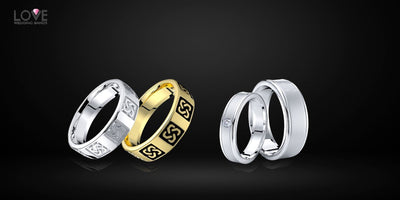
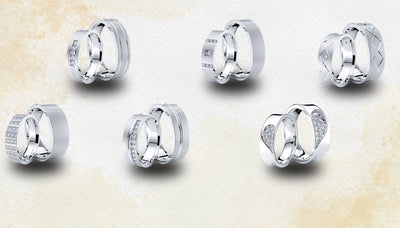
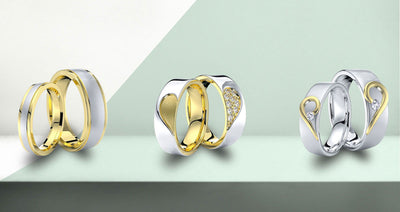
Braided his and hers wedding bands feature interlaced, twisted, or woven patterns — two-strand twist (rope), three-strand braid, four-strand complex braid, cable, or flat-woven plait — rendered in precious gold. Braided rings are among the oldest wedding band designs in history, appearing in Roman, Viking, Celtic, and Byzantine jewelry traditions. Each variation carries the same metaphor: separate strands intertwined into something stronger. LoveWeddingBands braided his and hers sets start from $840/pair in 14K yellow gold, NYC crafted.
The Technical Anatomy of Braided Wedding Bands

Two-Strand Twist (Rope Twist)
Two strands of gold wire twist around each other in a continuous helix — like a rope or a DNA double-helix. Two elements spiraling together, inseparable. Two-strand twist bands can be cast (pattern created in wax, then cast in gold — consistent but slightly less dimensional) or fabricated (actual gold wire twisted and formed into a ring — more three-dimensional depth and texture).
Three-Strand Braid
Three strands of gold wire or raised ridges interlaced in the classic over-under-over pattern of a traditional braid. More complex than the two-strand twist, with a pattern that varies as viewed from different angles. In Celtic tradition, three-strand knotwork represents the Trinity and the connection of past, present, and future.
Four-Strand and Complex Braid
More than three strands create dense, intricate surface patterns. Four-strand bands are wider and heavier — appropriate at 8mm or more for men, not typically below 6mm for women (insufficient width for legible braid pattern).
Rope/Cable Braid
Multiple wires twisted together as a cable — all twisting in the same direction, like a ship's rope. Distinct from a braid (which alternates over/under). Cable bands have a softer, more continuous look — less distinct individual strands, more organic twisted surface. Available in two-wire, three-wire, and four-wire configurations.
Flat-Woven Plait
A wider, flatter braid where interlacing creates a fabric-like textured surface. The plait pattern is horizontal (perpendicular to the ring's axis) rather than diagonal. Creates a very different visual — more of a knitted or woven-fabric appearance. Available in wider widths where the flat weave pattern can breathe.
The Symbolism of Braided Rings Across Cultures
The visual metaphor embedded in every braided ring is universal: separate strands brought together create something stronger and more beautiful than any strand alone.

| Tradition | Period | Connection to Braided Rings |
|---|---|---|
| Ancient Rome | 1st century CE | Roman betrothal rings sometimes constructed of two interlocked or twisted bands — one gold, one iron — representing the joining of the couple. |
| Viking and Norse | 793–1066 CE | Viking age personal jewelry frequently featured twisted wire work. Archaeological finds show twisted gold bands among betrothal jewelry from Scandinavian sites. |
| Celtic | Medieval | Celtic artisans used actual braided wire construction — rather than carved knotwork — to achieve the same metaphorical expression. No beginning, no end. |
| Medieval European | 11th century onward | Fede rings — sometimes featuring twisted shanks ending in joined hands — appear consistently in medieval European betrothal and wedding jewelry. |
| Modern (2026) | Contemporary | The braided ring's symbolism is more explicitly romantic than culturally specific — two lives twisting together, becoming inseparable, creating something stronger than either alone. |
Coordinating Braided His and Hers Sets
The braid scale relationship: when both rings use the same braid pattern, strand width should scale proportionally to ring width. On his 8mm band, a three-strand braid where each strand is approximately 2.5mm wide looks balanced. On her 4mm band, the same 2.5mm strands would look overcrowded. Correct execution scales the strand width (approximately 1–1.2mm on her 4mm band) to maintain the open, structured feel of the braid at smaller scale.
Coordinating different braid types: his ring in three-strand braid (more complex, more masculine in visual weight) + her ring in two-strand twist (simpler, more delicate, same design family). The relationship is clear — both are braided rings in the same metal — but the designs differentiate naturally for different hand proportions.
Metal choice: 14K yellow gold for traditional and heritage appeal — the warm tone gives braid ridges a rich, sculptural quality, and the weave undercuts fall into warmer shadow. Rose gold for a more romantic, contemporary character. White gold braided bands read as architectural and modern rather than organic and heritage-inspired.
Natural Diamonds in Braided Bands: Restraint Is Rewarded
The braided pattern is itself visually active — three-dimensional strands, crossing weave, complex light play. Adding diamonds requires restraint. Over-diamonding a braided band creates competition between two visually active elements, and neither wins.
What works beautifully: (1) Small pavé-set natural diamonds along the strand ridges — diamonds augmenting the braid's ridge structure. (2) Single-strand diamond in a three-strand braid — one strand carries channel-set natural diamonds, the other two remain plain gold. (3) A single bezel-set diamond at the braid's crown — one focused focal point amid the braid's complex surface.
What doesn't work: heavy full-surface pavé on a braided band. The pavé obscures the braid's three-dimensional structure — the very feature that makes the ring distinctive.
Sizing Braided Wedding Bands
The exterior is wider than the interior. In a fabricated braided band, strands project outward from a core band. A band specified as '7mm width' will have an outer profile closer to 8mm because of the raised strand relief.
Braided bands are among the most difficult ring designs to resize after purchase. The interlaced construction is disrupted by the metal addition or removal required for sizing. Most jewelers prefer to adjust only half a size in braided bands; some cannot be resized at all. Confirm your size carefully before purchasing, and if between sizes, size up by half a size. At LoveWeddingBands, we offer one complimentary sizing before shipment on all braided bands.

Braided Bands for Men: Why This Is One of the Most Masculine Ring Designs
The braided wedding band has a historically strong case for being one of the most genuinely masculine ring designs in fine jewelry. Viking warriors, Roman senators, and Celtic chieftains all wore twisted or braided ring designs. The visual weight of a braided ring at 7mm or 8mm communicates substance and tradition, not decoration.
Men who don't want diamonds on their rings but want a visually interesting, premium-looking ring consistently find braided bands the most satisfying answer. The ring looks distinctive and carefully made without any stones.
Frequently Asked Questions
Q: What is the difference between a braided and a twisted wedding band?
A: A twisted band (two-strand twist, rope) has two strands spiraling around each other in a helix — like a rope. A braided band has three or more strands interlacing in an over-under pattern — like a hair braid. Both are in the 'woven' design family but twisted bands are simpler and more uniform; braided bands are more complex with more distinct strand definition. The terms are often used interchangeably in retail.
Q: Can braided wedding bands be resized?
A: With difficulty and limited range. The interlaced strand construction makes sizing technically complex. Most jewelers can size a braided band up or down by half a size. Full-size adjustments risk disturbing the braid pattern at the sizing seam. Confirm ring size precisely before purchasing. If between sizes, size up by half a size. LoveWeddingBands offers one complimentary sizing before shipment.
Q: What metal is best for braided wedding bands?
A: 14K yellow gold for traditional heritage appeal — the warm tone and 14K alloy hardness make it the historic and most popular choice. The braid's raised strands catch golden warm light; the weave undercuts fall into warm shadow. 14K rose gold is a close second for a romantic aesthetic.
Q: Are braided wedding bands appropriate for active lifestyles?
A: Yes — with caveats. A solidly constructed cast or fabricated braided band is structurally sound for most daily activities. The raised strand relief can catch on fabrics more than a flat or dome profile band. For professions involving gloves or heavy equipment, the raised surface may be practically inconvenient.
Q: How do braided wedding bands hold up over time?
A: The braid pattern is the ring's structure — it does not degrade like a surface treatment does. Well-made braided bands maintain their form indefinitely. Over decades, the highest contact points (strand crossing peaks) may develop slight wear from contact with harder surfaces, softening slightly. This takes many years and reads as natural aging, not damage.
Q: Starting price for braided his and hers sets at LoveWeddingBands?
A: Braided his and hers sets start from $840 for the pair in 14K yellow gold. Natural diamond accent options begin from $980/pair. All include lifetime warranty, free engraving on inner surface, 30-day returns, and free 2-day FedEx insured shipping. Use code ESALE for 25% off. Call (800) 754-3046.
Related Reading
- Celtic His and Hers Wedding Bands: Traditional Knotwork for Modern Couples
- Hammered His and Hers Wedding Bands: Complete Guide to Texture & Craft
- Milgrain His and Hers Wedding Bands: History, Styles & How to Choose
- Yellow Gold His and Hers Wedding Bands: Everything You Need to Know
- The Best His and Hers Wedding Band Sets of 2026
- The Average Cost of His and Hers Wedding Bands in 2026