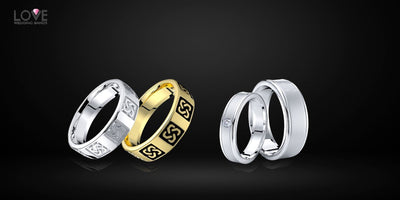
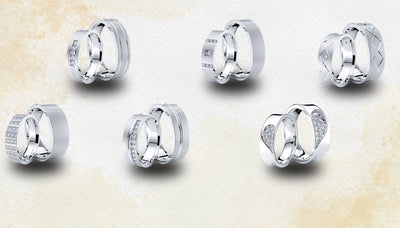
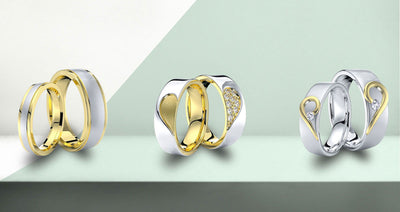
Milgrain his and hers wedding bands feature a fine row of tiny, uniformly beaded metal spheres along the band's edges — created by a specialized knurling wheel pressed against the ring's metal edge. The term 'milgrain' comes from the French for 'a thousand grains.' Most strongly associated with Edwardian (1901–1910) and Art Deco (1920–1935) jewelry. Plain milgrain his and hers sets start from $780/pair; diamond options from $920. All NYC crafted at LoveWeddingBands' 47th Street workshop.
What Milgrain Is and How It Is Made
Milgrain is a row of tiny, uniformly beaded metal spheres created along the edge of a ring using a specialized knurling wheel — a small hardened steel wheel with a pattern of evenly spaced hemispherical indentations cut into its circumference. The wheel is rolled precisely along the ring's edge under controlled pressure. As it rolls, it simultaneously presses the metal inward, forming tiny raised spheres, and spaces them evenly via its own pattern.

Metal selection is critical. Gold alloys are ideal — specifically 14K yellow gold, whose alloy hardness is optimal for the forming process. 14K yellow gold milgrain holds crisp bead shape and requires no surface treatment afterward. White gold milgrain works but requires careful rhodium plating after creation. Platinum milgrain is technically challenging and less common.
Bead size varies by design intent. Classic Edwardian milgrain used very fine beads (0.3mm–0.5mm diameter) in single rows on platinum and white gold pieces. Contemporary milgrain on gold wedding bands typically uses slightly larger beads (0.5mm–0.8mm) that remain visible at normal viewing distance and hold up better under daily wear.
Milgrain in Historical Context: From Ancient Rome to 2026
Granulation — the art of fusing tiny gold spheres to a surface — was practiced in ancient Etruscan, Roman, and Byzantine jewelry from as early as 500 BCE. This established the visual language of fine beadwork as a mark of quality craftsmanship that has persisted across every subsequent fine jewelry tradition.

Milgrain reached its peak application in the Edwardian period (1901–1910), when platinum jewelry made delicate, pierced, filigree designs possible. Every exposed edge on these extraordinary pieces was finished with milgrain — wedding rings from this period are characterized by fine milgrain on platinum or white gold bands with hand-engraved floral interiors.
Art Deco jewelers (1920–1935) retained milgrain but applied it with geometric precision — milgrain framing angular diamonds, geometric borders, and step-cut stone arrangements. The combination of milgrain edges with onyx or calibré-cut colored stones is quintessentially Art Deco.
In 2026, milgrain is experiencing its broadest mainstream appeal since the Edwardian period, driven by couples choosing vintage-cut diamonds and vintage-inspired engagement rings who naturally gravitate toward the milgrain edge's design language.
Milgrain His and Hers: Coordinating Different Designs
The shared-language principle: two rings share design language when they use the same milgrain bead scale, the same milgrain placement (both outer edges, or both inner edges), and the same metal color. Within these shared parameters, rings can differ significantly in width, profile, and additional features and still read as a coordinated set.
| His Ring | Her Ring | Shared Element |
|---|---|---|
| 7mm dome, double-edge milgrain, 14K yellow gold, plain | 4mm dome, double-edge milgrain, 14K yellow gold, plain | Metal + milgrain placement + bead scale |
| 6mm flat, single-edge milgrain, 14K yellow gold | 4mm dome, single-edge + channel diamond center, 14K yellow gold | Metal + milgrain placement |
| 7mm dome, double-edge milgrain, 14K white gold | 4mm milgrain-edge pavé band, 14K white gold | Metal + milgrain + white gold |
| 8mm flat, single-edge milgrain, 14K yellow gold | 5mm milgrain-edge eternity half-band, 14K yellow gold | Metal + milgrain |
Milgrain with Natural Diamonds: The Classic Combination
Milgrain and natural diamonds have coexisted in fine jewelry for over a century because they work together at a fundamental visual level: milgrain creates micro-sparkle through metal surface geometry; natural diamonds create macro-sparkle through faceted gemstone brilliance. The combination creates rings where every scale of light interaction is present simultaneously.
Most popular configurations: (1) Milgrain edge + channel-set center — a central row of channel-set natural diamonds bordered on each side by milgrain beading. Frames the diamonds without competing. Classic and balanced. (2) Milgrain edge + pavé surface — the band surface covered in pavé natural diamonds with milgrain serving as a border detail at the sides. (3) Plain with milgrain only — no diamonds, milgrain as the sole decoration. His and hers plain milgrain sets start from $780/pair.
Milgrain and Engraving: The Interior Design Opportunity

Traditional milgrain bands from the Edwardian period nearly always featured hand-engraved scrollwork or florals on the top surface, with milgrain borders along the edges. Contemporary milgrain bands carry this combination forward. Interior engraving (personal text inside the band) is included free on all LoveWeddingBands sets. Face engraving — hand-engraved floral, feather, vine, or geometric patterns on the exterior surface, bordered by milgrain edges — is available as a custom option. Contact (800) 754-3046 to discuss designs.
Metal Choice for Milgrain: Why Yellow Gold Is the Natural Match
Yellow gold is the historical home of milgrain wedding bands. The warm tone creates the most visually prominent milgrain effect — tiny beads catching warm light create a glowing amber micro-texture. The alloy composition is ideal for milgrain application; no surface treatment is needed afterward. Most importantly: yellow gold milgrain maintains crisp bead detail for decades without any maintenance.
Vintage milgrain rings from the 1920s in yellow gold often show milgrain as crisp as the day it was made — the most compelling evidence for this pairing.
Frequently Asked Questions
Q: What is milgrain and why is it on wedding bands?
A: Milgrain is a row of tiny, uniformly beaded metal spheres created along the edge of a ring using a knurling wheel. It has appeared on fine jewelry for over 2,000 years and became particularly associated with Edwardian (1901–1910) and Art Deco (1920–1935) wedding jewelry. It adds visual depth and craftsmanship to even the simplest bands without requiring additional materials like diamonds or colored stones.
Q: Does milgrain wear off or damage over time?
A: Milgrain is part of the ring's metal structure — it cannot fall off like a diamond or coating. Over decades, bead tips can slowly soften slightly. This is extremely gradual (most wearers notice no change over 20 years) and can be restored by a jeweler re-rolling the milgrain edge. This service costs $30–$60. At LoveWeddingBands, milgrain maintenance is covered under our lifetime warranty.
Q: Does milgrain work in white gold?
A: Yes — but white gold milgrain requires careful rhodium plating technique so the coating doesn't fill and obscure bead gaps. Yellow gold milgrain is technically superior because no plating is needed, maintaining the crispest bead detail over the longest time.
Q: What vintage period is milgrain associated with?
A: Most strongly with Edwardian (1901–1910) and Art Deco (1920–1935) jewelry, though it has been used in fine jewelry since ancient times. If you have an antique engagement ring from either of these periods, a milgrain wedding band is historically the most accurate companion.
Q: Can we get milgrain on the inside of the band?
A: Yes — interior milgrain is available as a custom option at LoveWeddingBands. Not visible when worn, but the wearer feels the texture when handling the ring. A deeply intentional private detail — craftsmanship for its own sake, not for display. Call (800) 754-3046 to discuss.
Q: How wide should a milgrain wedding band be for a man?
A: 6mm or 7mm is ideal. At this width, the milgrain edge beading takes up approximately 1mm per side, leaving 4–5mm of plain dome between the edges — enough for milgrain to read as an elegant edge detail. At 4–5mm, milgrain beads can look proportionally oversized. At 8mm+, they look appropriately fine.
Related Reading
- Hammered His and Hers Wedding Bands: Complete Guide to Texture & Craft
- Celtic His and Hers Wedding Bands: Traditional Knotwork for Modern Couples
- Yellow Gold His and Hers Wedding Bands: Everything You Need to Know
- Braided His and Hers Wedding Bands: Types, Symbolism & How to Choose
- The Best His and Hers Wedding Band Sets of 2026
- The Average Cost of His and Hers Wedding Bands in 2026