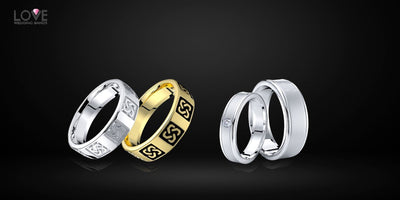
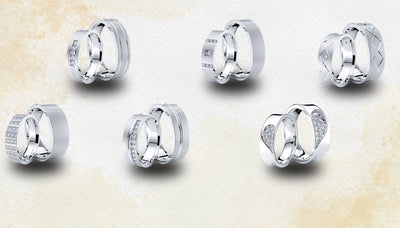
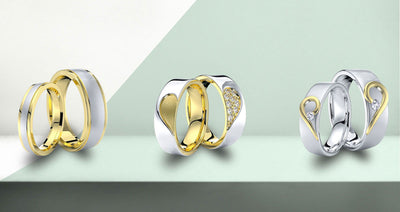
Stackable his and hers wedding bands are rings designed to be worn simultaneously on the same finger, layered to create a curated, growing ring story. The most popular configuration is a primary wedding band plus a shadow/contour band. Slim bands (2–4mm) stack best. His and hers plain sets start from $714/pair; diamond stackable sets from $905/pair at LoveWeddingBands, NYC crafted with natural diamonds only.
What Makes a Ring Stackable: Design Principles

Any ring can technically be worn in a stack, but stackable rings are designed with layering in mind. Width is the primary consideration: slim rings (2mm–4mm) stack more gracefully than wide rings (6mm+). A 7mm wedding band can be stacked, but it dominates the finger rather than participating in a layered look.
Profile shape determines how rings sit against each other. Flat-bottom rings stack flush with no gap. Dome-profile rings create a small gap at the contact point. Curved contour bands (shadow bands) are specifically designed to fit against the raised underside of an engagement ring, filling the gap that appears when a straight band sits next to a cathedral or elevated setting.
Finish coordination creates visual unity. Stacked rings don't have to match metal, but sharing at least one design element — the same finish, the same scale, the same aesthetic family — makes the stack look intentional. Width stepping (each ring slightly wider or narrower than its neighbors) creates graduated visual interest rather than a uniform tube look.
Four Stacking Strategies for His and Hers Couples

Strategy 1: The Classic Three (Most Popular)
Her stack: engagement ring (center) + curved contour/shadow band below + slim wedding band above. His stack: wedding band (primary) + anniversary band added at 5, 10, or 25 years. Three rings, one finger, three opportunities to celebrate different moments.
Strategy 2: The Metal Mixer
Start with white gold as the engagement ring metal. Add a yellow gold slim band as the first stack addition, rose gold as the second. Rule for metal mixing: all rings should share one constant element — same stone type, same finish, or same profile. The constant element creates visual unity even as metals vary.
Strategy 3: The Texture Builder
Plain polished band + hammered-finish slim band + milgrain-edge slim band. Three different surface textures, same metal color. The stack creates visual complexity through surface variation rather than stones — ideal for couples who prefer minimal or no diamonds but want an expressive ring stack.
Strategy 4: The Anniversary Layer
Start with a plain wedding band. Add a slim diamond band on the 5th anniversary. Add a second on the 10th. Add a third on the 25th. The ring stack becomes a living timeline of the marriage — each addition representing a specific passage of time. The most meaningful stacks are accumulated, not purchased all at once.
What to Buy for Wedding Day vs. What to Add Later

Wedding day essentials: the primary wedding band (the ring exchanged at the ceremony) and, if you have a raised-setting engagement ring, a curved shadow band to fill the gap and protect the solitaire's underside prongs.
Save for later: additional slim bands and eternity or anniversary bands. These are almost always more meaningful when added at a milestone than purchased speculatively. The most beautiful stacks have a quality of having been gathered over time — each ring representing something specific.
The trap to avoid: buying multiple stacking rings at the time of the wedding 'to get the look right' risks creating a stack that looks assembled rather than accumulated.
Ring Sizing for Stacked Rings
Stacks make the finger feel smaller. Multiple bands create lateral pressure, making all rings feel tighter than individually. If your wedding band is exactly right alone, it may feel tight with a second band above it. For rings intended to wear as a permanent stack, size up by half a size from your measured size.
Comfort-fit interior (the rounded inner surface) reduces cumulative pressure significantly when multiple bands are stacked. Especially important when total stack width exceeds 8mm.
His and Hers Stackable Sets: What to Choose for Him
The two-ring men's stack: a primary ring at 6–7mm (the wedding band) plus a secondary ring at 4–5mm in matching metal, worn above or below. Total width of 10–12mm reads as substantial, intentional, and masculine in visual weight.
The men's texture stack: 6mm satin-finish dome (primary) + 5mm hammered-finish dome (secondary), same metal, similar width. The satin and hammered surfaces create a subtle but interesting texture pairing without requiring different metals or added stones.
Stackable Ring Care: Managing Multiple Rings Without Damage
Metal-to-metal friction: adjacent rings contact each other constantly with micro-movements. Over time, contact edges develop slight wear — most visible on highly polished surfaces. Options: (1) embrace the wear as part of the rings' character, (2) repolish contact points periodically ($20–$40), or (3) choose satin or matte finishes that hide contact wear more gracefully than mirror polish.
Diamond-to-metal contact: if a pavé diamond band sits adjacent to a plain metal band, exposed diamond edges will eventually cause microscopic surface scratching on the plain band. A 1mm flat plain spacer ring between them prevents this entirely.
Frequently Asked Questions
Q: How many rings can you stack on one finger?
A: Practically, 3–5 slim rings (each 2–3mm wide) totaling 6–15mm width. Beyond this, comfort suffers and the visual becomes crowded. Most people find 2–3 rings totaling 5–10mm the most wearable everyday configuration.
Q: What is a shadow band and do I need one?
A: A shadow band (contour band, fitted band) is a curved wedding band designed to fit against the curved underside of an engagement ring's setting. If your engagement ring has a cathedral, halo, or raised setting, a straight wedding band creates a visible gap. A shadow band fills that gap.
Q: Can men wear stackable rings?
A: Yes — and more men do so in 2026 than at any prior point. The masculine version is typically 2 rings (not 5), with meaningful width and intentional spacing. A primary wedding band plus a significant anniversary or gift band is the most common and most wearable men's stack.
Q: Should stacking rings match the engagement ring metal?
A: Not necessarily. Metal matching creates the cleanest traditional look. Metal contrast creates a deliberately mixed aesthetic many couples find more contemporary and interesting. Both are legitimate — the key is choosing contrast deliberately rather than by accident.
Q: Are stacking rings more expensive than single wedding bands?
A: Individually, stacking rings (slim 2–4mm bands) are less expensive than a primary wedding band because they use less material. A complete stack of 3–5 rings can exceed the cost of a single primary band. Budget strategy: buy the primary wedding band for the wedding day; budget stacking additions for future milestones.
Q: Starting price for his and hers plain sets at LoveWeddingBands?
A: Plain his and hers sets start from $714 for the pair in 14K gold — ideal as stackable primary bands or anniversary additions. Diamond his and hers sets start from $905/pair. Use code ESALE for 25% off. Free engraving included on all sets.
Related Reading
- Eternity His and Hers Wedding Bands: Full & Half Eternity Guide
- Milgrain His and Hers Wedding Bands: History, Styles & How to Choose
- Hammered His and Hers Wedding Bands: Complete Guide to Texture & Craft
- Plain His and Hers Wedding Bands: Why Simple Wins in 2026
- The Best His and Hers Wedding Band Sets of 2026
- How to Choose His and Hers Wedding Bands: The Complete 2026 Guide