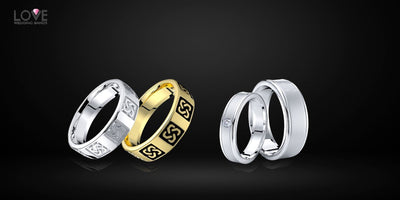
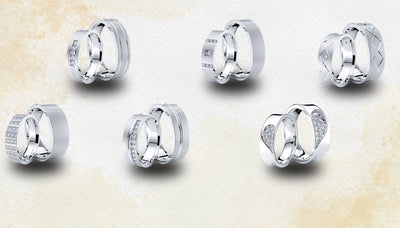
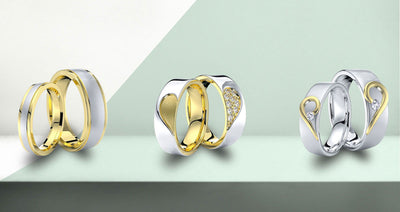
Choosing his and hers wedding bands starts with a shared metal, complementary widths (6mm for him, 4mm for her), and a matched design language — same finish, related motif. In 2026, 72% of couples choose diamond accents on at least one band. At LoveWeddingBands, matching sets handcrafted in New York start from $714 for the pair, with 150+ styles to choose from.
Step 1: Choose a Metal That Works for Both of You
This is the most consequential decision, and it's not just about color preference. Each metal has real trade-offs that affect daily wear, maintenance, and cost.
14K yellow gold
is the most popular choice for his and hers sets. It contains 58.3% pure gold — durable enough for everyday wear, warm enough to photograph beautifully, and priced more competitively than 18K. Yellow gold is also the only metal that never needs rhodium plating, making it genuinely low-maintenance over a lifetime of wear.
14K white gold
looks silver but is actually yellow gold alloyed with palladium or nickel, then rhodium-plated for brightness. It's the sleekest-looking option and our highest-volume seller. One honest trade-off: rhodium plating wears thin after 12–18 months and requires replating (typically $50–$80 at any jeweler). Our white gold his and hers wedding bands collection has the full range.
Rose gold
at 14K is 58.3% gold, 33% copper, and 8.7% silver — giving you the warm blush-pink tone that photographs beautifully in any setting. The copper alloy makes 14K rose gold slightly harder than yellow gold. The color is built into the metal, not a surface treatment, so it cannot fade or chip over time.
Platinum
is the most durable option — a naturally white metal that never needs plating, is hypoallergenic, and scores 4–4.5 on the Mohs hardness scale. It costs roughly 40–60% more than 14K gold for the same design. Worth it if either partner works with their hands, has metal sensitivities, or wants the most prestigious material.
18K gold
(75% pure) is richer in color but scratches faster than 14K. Unless you specifically want that deeper golden tone, 14K is the smarter practical choice for bands worn every single day.
| Metal | Gold Purity | Maintenance | Best For | Starting Cost (pair) |
|---|---|---|---|---|
| 14K Yellow Gold | 58.3% | None | Low-maintenance couples | $714 |
| 14K White Gold | 58.3% | Replating 12–18 mo. | Modern, sleek look | $714 |
| 14K Rose Gold | 58.3% | None | Warmth + durability | $714 |
| Platinum | 95% | None | Active couples, allergies | $980+ |
| 18K Yellow Gold | 75% | None | Richer color preference | $850+ |
Step 2: Match the Design Language, Not Just the Metal
A truly coordinated his and hers set shares at least three design elements: metal type and karat, design motif, and finish. You do not need identical rings — you need intentionally complementary ones.
Width is where couples most consistently miscalculate. His band: 6–8mm is standard. Men with larger hands or broader fingers can go to 8mm; slimmer hands look best at 5–6mm. Her band: 3–5mm is standard. Four millimeters is the most versatile — it stacks cleanly with an engagement ring and doesn't overwhelm the hand.
Expert Insight: The most important factor most couples overlook is finish. Two rings in the same polished finish read as a matched pair even with slight style differences. Two rings where one is polished and one is hammered look like they came from different stores — even if they're the same metal. When in doubt, match the finish first.
The most common buying mistake we see: couples select his and her bands individually from product photos, then put them together and discover they don't read as a set. The solution is shopping the matching sets collection directly — every set at LoveWeddingBands is designed and photographed as a coordinated pair.
Decision Tree by Lifestyle
- Work with your hands (construction, healthcare, food service) → flat or comfort-fit profile, 14K gold or platinum, channel-set over pavé
- Want the lowest-maintenance option → yellow gold, plain dome or flat profile, polished finish
- Want the most brilliance on both rings → white gold, pavé on her band, channel-set on his
- Want something romantic and distinctive → rose gold, matched widths with complementary motifs
Step 3: What the 2026 Data Says About What Couples Are Actually Buying
According to The Knot's 2026 jewelry report, 72% of couples now choose diamond wedding bands — up from 48% five years ago. Natural diamond matching sets in 14K white gold remain the top combination at LoveWeddingBands, followed by plain yellow gold dome bands and rose gold sets.
Three Budget Tiers — What Each Delivers
Under $900 for the pair — plain 14K gold bands in dome or flat profiles. Classic, durable, and genuinely beautiful — not a compromise. These are the same timeless designs couples have exchanged for generations.
$900–$2,000 for the pair — diamond accent sets enter the picture with 0.05–0.20 total carats. Channel-set and pavé options at this range add real sparkle without dominating the design.
$2,000–$4,000 for the pair — higher diamond weights (0.40–0.60+ ctw), more complex settings, or platinum metal. This is the range for couples who want both partners' bands to make a statement.
Frequently Asked Questions
Q: Do his and hers wedding bands have to match perfectly?
A: No. Matching in intent matters far more than matching in detail. The same metal, complementary widths, and a shared design element (matching finish, related motif) creates a unified look without requiring identical rings.
Q: What is the most popular metal for his and hers sets in 2026?
A: 14K white gold remains the bestseller at LoveWeddingBands. It pairs well with the majority of engagement ring styles, photographs cleanly, and is priced more accessibly than platinum. Diamond his and hers wedding bands in 14K white gold are the top-selling combination.
Q: What's the best karat for wedding bands?
A: 14K for most couples. At 58.3% pure gold, it's durable enough for daily wear, available in every color, and meaningfully less expensive than 18K. Eighteen karat (75% gold) is richer in color but scratches more readily from the same daily activities.
Q: Can we choose different metals and still have a coordinated set?
A: Yes — many of our bestselling coordinated sets feature his band in yellow gold and her band in rose gold, or his in white gold and hers in platinum. A shared design language carries the look even across different metals.
Q: How early before the wedding should we order?
A: Order 8–10 weeks before your wedding date. This allows time for production, sizing, and engraving without rushing. Rush orders are available but add unnecessary pressure before a wedding day.
Q: Does LoveWeddingBands offer free resizing?
A: Yes — one free resize per ring within 60 days of purchase, plus lifetime warranty coverage. Both rings in any matching set qualify.
Shop Our Collections
- Browse All His & Hers Matching Sets
- White Gold His & Hers Wedding Bands
- Diamond His & Hers Wedding Bands
- Rose Gold His & Hers Wedding Bands