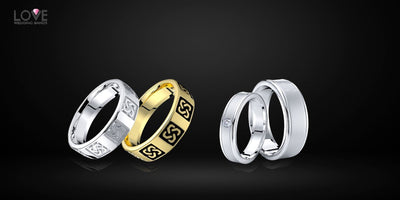
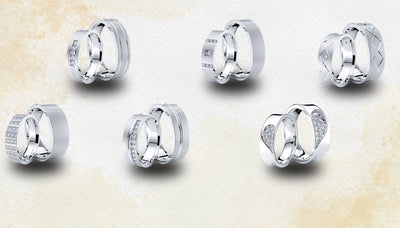
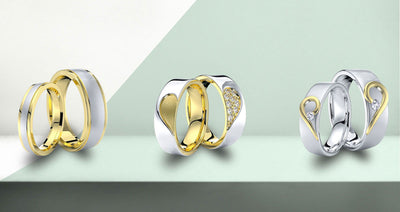
No — his and hers wedding bands do not have to match exactly. What couples actually need is rings that look intentionally coordinated, not identical. Two rings in the same metal with complementary widths and a shared finish create a unified look even if the styles differ significantly. At LoveWeddingBands, we design both perfectly matched sets and coordinated pairs — because the right answer depends on your lives, not a rule.
Matching vs. Coordinating: What These Words Actually Mean
In the jewelry world, these two terms describe the same goal — a pair of rings that look right together — but through different methods.
Matching
means both rings share the same metal, design, width proportion, and finish. Example: his 6mm polished 14K white gold dome band and her 4mm polished 14K white gold dome band from the same set. Same family, scaled to each partner’s hand. This is the classic approach and still the most popular by a significant margin.
Coordinating
means the rings share a design language but differ in at least one deliberate element. Example: his 7mm 14K yellow gold plain matte band and her 4mm 14K yellow gold pavé diamond band. Both are the same metal and karat; the design varies. Or: his in white gold and hers in rose gold, both with the same milgrain border detail. The result reads as intentional because of the shared element.
Expert Insight: What actually makes two rings look like a set isn’t matching — it’s shared logic. The eye registers proportion ratios, matching finish, and related design vocabulary. When two rings share those three things, they look like a pair even if the metals differ.
Three Coordinated Pairings Our Jewelers Recommend Most
- His in 14K yellow gold (plain dome), hers in 14K rose gold (plain dome) — two warm metals, different tones, same profile
- His in 14K white gold (flat plain), hers in 14K white gold (pavé diamond) — same metal, different surface
- His in platinum (plain comfort-fit), hers in 14K white gold (pavé) — near-identical in color, one more durable
When His and Hers Bands Should Be Different by Design
Most couples assume both partners should wear the same style. That’s often the wrong call — and here’s why.
If she already has an engagement ring, her wedding band needs to work with that ring first and with his ring second. A pavé-set halo engagement ring stacks most cleanly with a thin plain or narrow half-eternity wedding band, which may look very different from his wider plain band. That’s fine — the engagement ring and wedding band form her primary set; his and her wedding bands are a related pair, not identical twins.
If one partner works with their hands — construction, healthcare, food service, athletics — a lower-profile band in a durable metal is the practical choice for that partner, regardless of what the other wears. Comfort and safety matter more than visual symmetry when rings are worn 12 hours a day in active conditions.
If partners have genuinely different style aesthetics, the simplest solution is a shared metal with different profile choices. His carved matte band and her polished plain band in the same 14K gold read as a matched pair by metal alone.
Plain bands are the easiest to coordinate because simplicity finds common ground across almost any style divergence. Our plain his and hers wedding bands — available in every metal in dome, flat, comfort-fit, and beveled-edge profiles — make it easy to mix and still look matched.
The One Factor That Unifies Any Two Rings
There are five things that can create visual unity between two rings: shared metal, shared karat, shared motif, shared width ratio, and shared finish. You don’t need all five. But finish alone can make almost any two rings look like they belong together.
Polish is a language. If both rings are polished, they speak the same language. If both are satin or matte, same thing. The moment one ring is polished and one is hammered or brushed, the pairing loses its logic — even if both are 14K yellow gold.
This is the shortcut our jewelers use when a couple is stuck between very different styles: agree on finish first, then work backward from there.
For couples who genuinely can’t agree on a metal — one wants warm tones, one wants cool — two-tone his and hers wedding bands offer a single ring that incorporates both. A white gold band with rose gold inlay or a yellow and white gold combination gives both partners something of their preference in one design.
There is no tradition that requires his and hers wedding bands to be identical. What tradition specifies is the exchange of rings. What those rings look like is entirely yours to decide.
Frequently Asked Questions
Q: Do his and hers wedding bands have to be the same metal?
A: No. Many couples coordinate across metals — his in yellow gold, hers in white gold or rose gold, for example. A shared finish and proportional width ratio does more for visual unity than a shared metal.
Q: Can partners wear completely different wedding band styles?
A: Yes, with one condition: the rings should share at least one design element — the same metal, matching finish, or a related motif — so they look like they were chosen for each other rather than selected at random.
Q: If only one of us wants diamonds, does that break the matching set look?
A: No — and it’s one of the most common pairings we sell. Her diamond pavé band and his plain band in matching metal is a classic, intentional combination. The diamond detail reads as a feminine styling choice that complements rather than clashes with a plain men’s band.
Q: Is it bad luck for wedding bands not to match?
A: No superstition or tradition requires matching rings. The only universal custom is that both partners receive and wear a wedding ring. Style, metal, and degree of matching are entirely personal.
Q: Do matching sets cost less than buying two rings individually?
A: Yes, typically. At LoveWeddingBands, sets are priced together and represent better value than two individually-selected rings at equivalent quality. Our matching sets start at $714 for the pair.
Q: What if one partner wants a very simple band and the other wants something more elaborate?
A: Choose the same metal and finish, then vary the design. His simple flat dome in 14K white gold and her channel-set diamond band in 14K white gold is a clear set — the metal and finish tie them together. The different design levels look intentional, not inconsistent.
Shop Our Collections
- Browse All His & Hers Matching Sets
- Plain His & Hers Wedding Bands
- Two-Tone His & Hers Wedding Bands