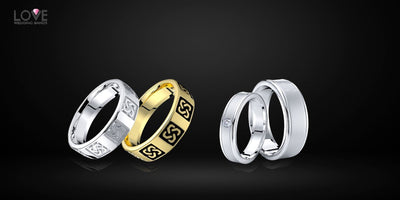
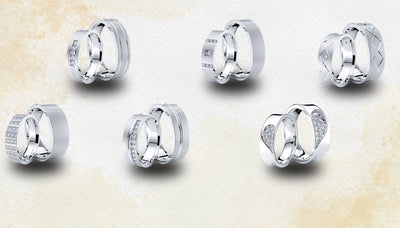
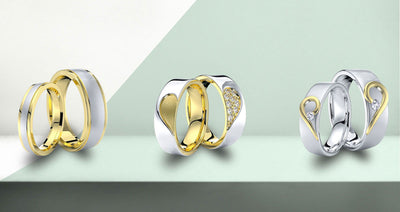
White gold his and hers wedding bands are matching sets in 14K or 18K white gold — an alloy of pure gold and white metals, finished with rhodium electroplating for crisp silver-white appearance. The most popular metal for his and hers matching sets in 2026. At LoveWeddingBands, sets start from $714/pair with natural diamond options from $905, all NYC crafted with lifetime warranty.
Ready to compare real pairs? Shop white gold his and hers wedding bands — or browse the complete his and hers wedding bands collection.
What White Gold Actually Is: Alloy Composition and Rhodium Plating
At 14 karat, white gold is 58.3% pure gold. The remaining 41.7% is where variation begins. Two alloy systems exist: palladium-white gold (palladium, silver, copper — hypoallergenic, used by LoveWeddingBands for all sets) and nickel-white gold (nickel, copper, zinc — harder but up to 15% of women have nickel sensitivity). Neither produces colorless metal on its own — both require rhodium electroplating (0.5–1.5 microns deposited via electrical current) to achieve the crisp silver-white appearance.
Rhodium wears with daily use. In most wear conditions, the coating begins thinning noticeably at 12–18 months. Replating restores original appearance ($50–$80 per replate) and is covered under our lifetime warranty.

Why White Gold Is the #1 Metal for Matching Sets in 2026
| Advantage | Why It Matters |
|---|---|
| Works with virtually any engagement ring | Most US engagement rings are platinum or white gold — seamless coordination |
| Photographs beautifully | Even light reflection across all lighting conditions |
| Greatest contrast with natural diamonds | G-H color diamonds look indistinguishable from E-F in white gold settings |
| Bridges modern and classic aesthetics | Simultaneously contemporary and timeless |
| Less expensive than platinum | Same visual result at 40–60% less cost |
14K vs. 18K White Gold: The Practical Decision
| 14K White Gold | 18K White Gold | |
|---|---|---|
| Gold content | 58.3% | 75% |
| Underlying color | Slightly warm cream-white | Slightly more yellow-toned |
| Hardness | Higher (more alloy) | Lower (more gold) |
| Price | More affordable | ~25–35% more expensive |
| Best for | Active daily wear | Those prioritizing karat prestige |
White Gold and Natural Diamonds: The Optical Partnership

Expert Insight: In white gold, all surrounding reflected light is near-colorless, meaning the diamond's own color properties dominate entirely. A G-H color natural diamond in 14K white gold looks indistinguishable from a D-F stone to virtually every observer — at significantly lower cost.
Choosing White Gold His and Hers Bands: The Framework
Step 1: Match karats across both rings. Step 2: Diamond vs. plain. Step 3: Set widths (6–8mm him, 4–5mm her). Step 4: Profile (dome = traditional; flat = modern). Step 5: Finish (polished most popular). Step 6: Match the finish across both rings — the single rule that unifies any set regardless of other design differences.

White Gold Maintenance: The Honest Timeline
Month 1–12: Full rhodium, no maintenance beyond weekly soap-and-brush cleaning. Month 12–18: Rhodium begins thinning at friction points. Month 18–36: First replating recommended ($50–$80, covered under lifetime warranty). Daily habits extending rhodium life: remove during bleach cleaning, chlorine swimming, intensive gym use, and apply lotions/perfumes before putting rings on.
Frequently Asked Questions
Q: Does white gold turn yellow over time?
A: Not internally — the rhodium plating gradually wears, revealing the underlying alloy's slightly warm tone. Replating ($50–$80) fully restores the brilliant white appearance.
Q: Is white gold or platinum better for his and hers sets?
A: 14K white gold for most couples. Visually indistinguishable from platinum when freshly plated. Platinum costs 40–60% more and never needs plating. White gold is the smarter value choice for most budgets.
Q: Can I have an allergic reaction to white gold?
A: All LoveWeddingBands white gold sets use palladium-white gold alloy — nickel-free and hypoallergenic. If purchasing elsewhere, always confirm the alloy system includes no nickel.
Q: How often does white gold need replating?
A: Lifestyle-dependent: active wear = 12–18 months; protective wear = 24–36 months. Replate when color change becomes noticeable to you.
Q: Is 18K white gold worth the extra cost?
A: In most cases, no. 14K is more durable, less expensive, and maintains appearance with equivalent care. The 18K upgrade is justified only if its richer tone is significantly more appealing after seeing both in person.
Q: What diamond weight for white gold sets?
A: Subtle: 0.05–0.10 ctw combined. Classic: 0.15–0.25 ctw. Statement: 0.40–0.60+ ctw. Most couples in the $1,200–$2,000 range land at 0.15–0.25 ctw.
See current prices and every available pair in the white gold his and hers collection.
Related Reading
- Yellow Gold His and Hers Wedding Bands: Everything You Need to Know
- Rose Gold His and Hers Wedding Bands: The Complete Guide
- Platinum His and Hers Wedding Bands: Worth the Premium?
- Two-Tone His and Hers Wedding Bands: Design Guide 2026
- Diamond His and Hers Wedding Bands: The Complete Guide
- The Average Cost of His and Hers Wedding Bands in 2026
- The Best His and Hers Wedding Band Sets of 2026
Next step: Explore the full white gold his and hers collection, or view all matching wedding band sets — handcrafted in NYC with lifetime warranty.