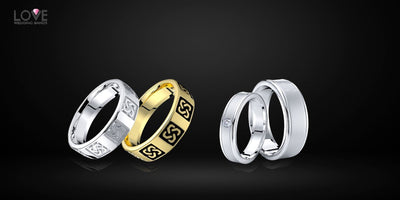
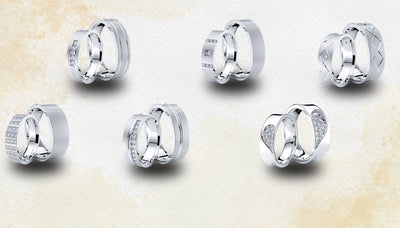
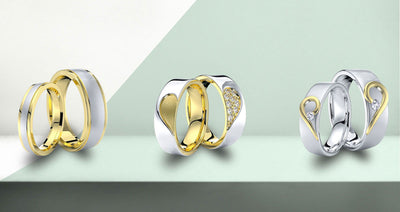
Two-tone his and hers wedding bands incorporate two different metals or metal colors within a single band design — most commonly white gold with yellow gold, yellow gold with rose gold, or white gold with rose gold. One of the fastest-growing wedding band categories in 2026. At LoveWeddingBands, two-tone sets start from $714/pair in 14K, handcrafted in New York.
Ready to compare real pairs? Shop two tone his and hers wedding bands — or browse the complete his and hers wedding bands collection.
What Two-Tone Actually Means: Three Construction Types

Type 1: Inlay construction. A channel is cut into the primary metal; contrasting metal is pressed in and finished flush. Most durable method — both metals mechanically locked at junction. Holds construction integrity indefinitely with no separation risk under normal wear.
Type 2: Two-metal casting. Ring cast with two separate metal sections fused or mechanically joined at a seam. Creates distinct half-and-half or segmented appearance. Quality of the seam junction determines long-term durability.
Type 3: Surface finishing contrast. Single-metal ring with different sections finished differently (polished vs. brushed). Technically not two-tone in strict material sense, but visual effect is similar. Most durable option — no metal-to-metal bond, only surface texture.

Critical: Both metals in a genuine two-tone ring must be the same karat (14K with 14K, 18K with 18K). Mixing karats creates different hardness levels, resulting in uneven wear over time. All LoveWeddingBands two-tone sets are matched karat throughout.
Most Popular Combinations in 2026
| Combination | Character | Best For |
|---|---|---|
| White gold + yellow gold (most popular) | Classic bridge between cool and warm preferences | Couples with different metal preferences, virtually all skin tones and engagement rings |
| Yellow gold + rose gold (second) | Fully warm, soft contrast, romantic | Couples who both love warm metals but want visual complexity |
| White gold + rose gold (third) | Maximum contrast — cool silver against warm blush | Rose gold engagement ring coordination; high visual impact |
| White gold + platinum | Subtle material difference — similar visual | One partner prefers platinum, one prefers gold; nuanced choice |
How to Choose a Two-Tone Matched Set
Step 1: Identify whether you're choosing two-tone for different metal preferences or pure aesthetic attraction. Step 2: Choose primary and accent metals (primary should coordinate with your engagement ring). Step 3: Decide symmetry (same proportion across both rings, or each ring leads with that partner's preferred metal). Step 4: Diamond or plain. Step 5: Match the finish across both rings — polished with polished, satin with satin. This creates visual continuity when metals differ.

Two-Tone Maintenance Realities
If your two-tone includes white gold: the white gold sections require rhodium replating (every 12–24 months, $60–$100 — slightly more than single-metal due to masking complexity). Inlay monitoring: inspect junction annually by feel — completely smooth with no raised edges. If you feel a raised edge, have a jeweler inspect. Rare with quality construction.
Frequently Asked Questions
Q: Do two-tone bands hold up as well as single-metal?
A: Yes — in quality construction. Inlaid two-tone designs are as structurally sound as any single-metal band because the metals are mechanically fused. LoveWeddingBands two-tone sets use high-quality inlay and casting techniques with rigorous inspection.
Q: Do both metals need to be the same karat?
A: Yes — critical. Mixing karats creates different hardness levels, resulting in uneven wear over time. A quality two-tone ring always uses matched karat throughout — 14K with 14K.
Q: Can we get sets where his ring features different metals than hers?
A: Yes — most common configuration. His might be primarily yellow gold with white gold accent; hers primarily white gold with yellow gold accent. Both contain the same two metals but each emphasizes the partner's preferred metal.
Q: Is two-tone more expensive than single-metal?
A: Yes, typically 10–20% more. Additional craftsmanship of two-tone construction adds manufacturing cost. Two-tone sets at LoveWeddingBands start from $714/pair in 14K.
Q: How do I know if two-tone looks dated or contemporary?
A: Two-tone done well looks contemporary — design is intentional and precise. Dating markers: clumsy transitions, excessive contrast, poorly proportioned sections. Look for clean seams, well-proportioned sections, and designs where the contrast serves the aesthetic.
Q: Does LoveWeddingBands offer custom two-tone configurations?
A: Some — call (800) 754-3046. Standard inventory covers white/yellow, yellow/rose, and white/rose. Custom configurations may be possible depending on the design.
See current prices and every available pair in the two-tone his and hers collection.
Related Reading
- White Gold His and Hers Wedding Bands: The Complete Guide
- Yellow Gold His and Hers Wedding Bands: Everything You Need to Know
- Rose Gold His and Hers Wedding Bands: The Complete Guide
- Plain His and Hers Wedding Bands: Why Simple Wins in 2026
- How to Choose His and Hers Wedding Bands: The Complete 2026 Guide
- Do His and Hers Wedding Bands Have to Match?
Next step: Explore the full two-tone his and hers collection, or view all matching wedding band sets — handcrafted in NYC with lifetime warranty.