The best metal for wedding bands is the one that fits your lifestyle, skin, and budget — for most couples that's 14K gold, which balances durability, color, and value, while platinum is best for sensitive skin, active hands, and diamond settings. If you have active hands, choose 14K gold or platinum for toughness. For sensitive skin, choose platinum. On a budget, choose 10K or 14K gold. And you don't both have to pick the same metal — matching two complementary metals is a stylish, popular option.
"What's the best metal?" is one of the most common questions couples ask us, and the honest answer is that it depends on you — there's no single best metal, only the best metal for your situation. So rather than crown a winner, this guide gives you clear recommendations by scenario: active lifestyles, sensitive skin, tight budgets, low maintenance, and heirloom quality. We also cover how to choose two metals that work together as a couple. For the full technical detail on each metal, our wedding band metals guide is the encyclopedic reference; this page is about matching a metal to your life.
1. The four factors that decide it
Every metal recommendation comes down to weighing four things, and knowing which matters most to you is how you'll arrive at your answer. Lifestyle — how active are your hands day to day? Skin — any history of reactions to jewelry? Budget — what feels comfortable to spend on a band you'll wear forever? And maintenance — do you want a fit-and-forget ring or don't mind occasional upkeep for a particular look?
Most couples find one or two of these dominate. If you work with your hands, durability leads; if you have a nickel allergy, skin leads; if you're saving for the wedding, budget leads. Identify your priority and the recommendation follows, as the next sections show. As a couple, you might each have a different leading factor — which is exactly why choosing two different metals can be the right call.
2. Best metal by scenario
Here's the quick-reference version. Find the row that sounds most like you and your partner, then read the fuller reasoning below.
| Your situation | We recommend | Why |
|---|---|---|
| Most couples (all-rounder) | 14K gold | Best balance of durability, color, and price |
| Active hands / manual work | 14K or 10K gold | Hard surface, low maintenance, resilient |
| Sensitive skin / allergies | Platinum | Naturally hypoallergenic |
| Diamond-set bands | Platinum | Holds stones most securely |
| Tight budget | 10K or 14K gold | Beautiful and durable for less |
| Richest color / luxury feel | 18K gold or platinum | Deepest gold color; heirloom weight |
| Lowest maintenance | Yellow gold, rose gold, or platinum | No re-plating ever needed |
| Bright white metal | Platinum (or white gold) | Permanently white vs periodic re-plating |
3. If you have active hands
If one or both of you works with your hands — trades, gardening, sport, hands-on jobs — durability and low maintenance lead the decision. Our recommendation is 14K gold, or 10K gold if you want the hardest surface of all, because lower-karat golds resist scratching well and need no plating upkeep. Platinum is also excellent for active wearers: it will show a patina, but it loses no metal and can be polished back whenever you like, so it ages gracefully under hard use.
What we'd gently steer active couples away from is 18K gold, which is softer and marks more easily, and white gold, whose plating wears faster with heavy wear and needs more frequent refreshing. If you love a white metal but live actively, platinum is the more practical choice. For more on how each metal handles daily wear, see the durability section of our gold vs platinum wedding bands comparison.
4. If you have sensitive skin
If either of you has reacted to jewelry before, skin comfort should lead, and here the recommendation is clear: platinum. It's used at high purity and is naturally hypoallergenic, so it removes the worry entirely for a ring worn every day. It's the reason so many people with metal sensitivities gravitate to platinum for their wedding band.
If you'd prefer gold, the trick is to choose a higher karat — 18K contains more pure gold and less alloy than 10K, so it's gentler — and to ask for a nickel-free white gold alloyed with palladium if you want a white tone. Yellow and rose gold rarely cause reactions, since their alloys are copper and silver based. The one to approach carefully is standard white gold, which can contain nickel. Our metals guide covers the hypoallergenic details of each option.
Shop his and hers wedding bands →5. If budget is the priority
If keeping the cost sensible matters most, gold is your friend, specifically 10K and 14K. Both deliver genuine durability and beautiful color for meaningfully less than 18K or platinum, and 14K in particular is the value sweet spot most couples land on. You can stretch a budget further still by choosing a slightly narrower band, since a thinner ring uses less metal, and by choosing a plain band over a diamond-set one.
Crucially, budget-friendly doesn't mean low quality — a 14K gold band is a true lifetime, heirloom-grade ring. If you're coordinating two rings and watching the combined total, our affordable wedding bands for couples guide shows exactly where to save across a pair without compromising on the things that matter, and our best sellers collection is full of well-priced proven styles.
6. If you want low maintenance
Some couples simply want to put the ring on and never think about upkeep. If that's you, the low-maintenance winners are yellow gold, rose gold, and platinum — none of which ever needs plating. Yellow and rose gold keep their warm color permanently with only the occasional clean; platinum needs nothing more than an optional polish if you prefer a shine over its natural patina.
The one metal that asks for periodic attention is white gold, which needs rhodium re-plating roughly every one to two years to stay bright. It's a small, affordable service and many people happily accept it for the crisp white look, but if true fit-and-forget is your goal, choose one of the three no-plating metals instead. Everyday cleaning for all of them is the same simple routine, covered in our how to clean wedding bands guide.
7. Choosing two metals as a couple
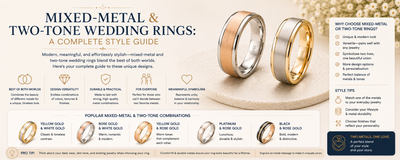
Here's the part that's unique to buying as a couple: you don't both have to choose the same metal. If one of you has active hands and the other sensitive skin, or your color tastes simply differ, choosing two different metals lets each ring suit its wearer perfectly — and mixing metals between two bands is a genuinely stylish, increasingly popular look, not a compromise.
The key to making two metals work together is a shared thread. Keep another element in common — a matching finish, profile, or a repeated motif — so the two rings still read as a coordinated pair despite the different metals. A brushed-finish yellow gold band and a brushed-finish platinum band, for instance, look intentional and connected. Our matching bands guide walks through combining metals well, and our collection of his and hers wedding bands is full of coordinated ideas to browse. When you've decided, explore by metal in our gold wedding bands and platinum wedding bands collections.
Explore his and hers wedding bands →8. Frequently asked questions
- What is the best metal for a wedding band?
- There's no single best — it depends on your lifestyle, skin, and budget. For most couples 14K gold is the ideal all-rounder; platinum is best for sensitive skin, active hands, and diamond-set bands; and 10K or 14K gold is best on a budget.
- What's the most durable metal for an active lifestyle?
- 14K or 10K gold for a hard, low-maintenance surface, or platinum, which shows a patina but loses no metal and polishes back to a shine. Avoid 18K and white gold for heavy wear.
- What metal is best for sensitive skin?
- Platinum — it's naturally hypoallergenic and the safest choice for allergies. If you prefer gold, choose a higher karat or nickel-free palladium white gold; yellow and rose gold rarely react.
- What's the best wedding band metal on a budget?
- 10K or 14K gold — both are durable, beautiful, and true lifetime rings for less than 18K or platinum. Choosing a narrower or plain band saves more. See our affordable bands for couples guide.
- Can my partner and I choose different metals?
- Yes — mixing metals is stylish and lets each ring suit its wearer. Keep a shared finish or motif so they still coordinate. See our matching bands guide and browse his and hers wedding bands.
- Is gold or platinum the better choice?
- Both are lifelong metals — gold offers more color and value, platinum is denser, hypoallergenic, and permanently white. For a full head-to-head, see our gold vs platinum wedding bands comparison.