
Buying Wedding Bands Online: Is It Safe?
Shopping, not reading?
Skip ahead and browse the full wedding band collection.
You've found the ring. Maybe you spent an hour scrolling last night, maybe your partner sent you a screenshot with three exclamation points. It's the right style, the right metal, the right price. And then the hesitation creeps in: can I really buy a wedding ring online? You can't slide it on. You can't hold it under the light and turn it in your hand. You're about to type a card number into a website for a piece of jewelry you'll wear every single day for the rest of your life, and no one is standing across a glass counter to reassure you.
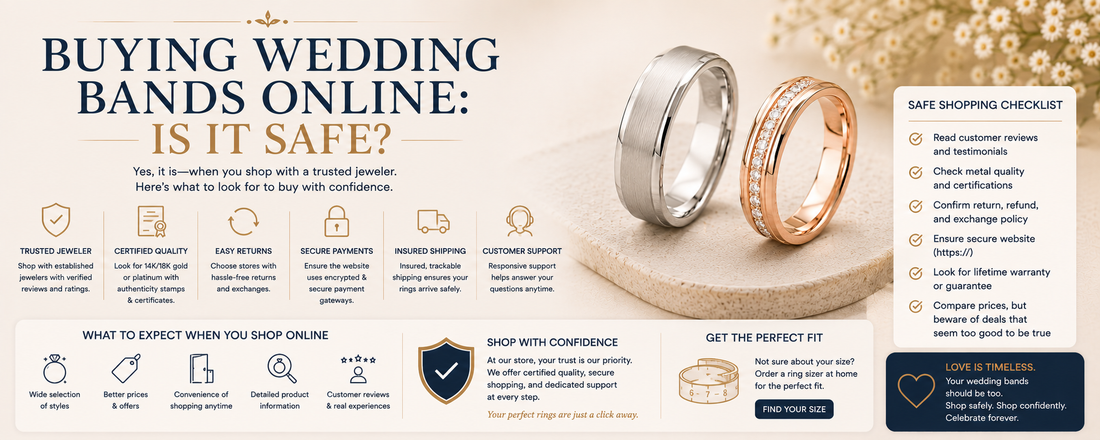
That hesitation is normal, and it's smart. Fine jewelry is one of the few purchases where the stakes feel personal rather than just financial — this ring is going to sit on your hand at your wedding, in your photos, on your finger when you're 80. It's reasonable to want proof that the business on the other end of that checkout page is legitimate, that the metal is what it claims to be, and that if something's wrong, someone will actually pick up the phone. The good news is that all of those concerns are answerable. You just need to know what to check.
Is it safe to buy wedding rings online?
Yes — buying wedding rings online is safe when you order from a jeweler with verifiable hallmarking, secure checkout (look for HTTPS and recognized payment processors), a physical business address, real third-party reviews, and a clear, fair return policy. The same due diligence that protects you at any online retailer applies here, just with a bit more attention to the details that are specific to fine jewelry.
What to Look For in a Legitimate Online Jeweler
Before you trust any store with your wedding budget, spend five minutes doing the same background check a careful shopper would do for any major purchase. A legitimate jeweler makes this easy, because they have nothing to hide.
Secure checkout and SSL
Look at the address bar. A legitimate storefront uses HTTPS (you'll see a padlock icon) and processes payments through recognized providers like Shopify Payments, PayPal, Stripe, or a major card network's secure checkout. If a site asks you to wire money directly, pay via gift card, or checkout through an unencrypted page, treat that as a hard stop, not a red flag to "think about."
A real, physical business address
Scroll to the footer. A trustworthy online jeweler lists a real address, not just a P.O. box, and that address should be easy to verify — search it, see if it corresponds to an actual office, showroom, or workshop. Many established online jewelers, including ours, will happily tell you exactly where orders ship from and where a piece is crafted.
Real customer reviews, not just testimonials
Testimonials on a brand's own site are easy to write. What's harder to fake is a review history on an independent platform — Google Reviews, Trustpilot, or verified purchase reviews tied to specific product pages, ideally with photos from real customers. Read a handful of the middling three- and four-star reviews, not just the five-star ones. Those tend to be the most honest, and they'll tell you how a company handles problems, which matters more than how they handle praise.
Clear hallmarking and purity disclosure
Every product page should state the metal purity plainly — 14K, 18K, platinum 950, and so on — not bury it in a spec sheet three clicks deep. If a listing is vague about metal content ("gold-toned," "premium alloy"), that's a sign to keep looking.
Transparent pricing
You should be able to see the full price before you reach checkout, including any customization costs, taxes, and shipping. Watch for stores that show a strikingly low "sale" price next to an inflated "original" price with no explanation — a common pressure tactic in both physical and online jewelry retail.
A quick five-minute legitimacy check
If you want to go a step further before trusting a new-to-you jeweler with a large purchase, run this short checklist: search the business name plus the word "reviews" and see what comes up outside their own website; check whether the company has been operating for more than a year or two (a "whois" lookup or simply noticing how established their social presence looks can tell you a lot); and look for an "About" page that names real people or describes an actual workshop or sourcing process, rather than generic stock language about "premium quality" with no specifics. None of these checks take more than a few minutes individually, and together they give you a much clearer picture than a single glance at the homepage.
How Ring Sizing Works When You Can't Try It On
This is usually the single biggest hesitation, and it's the most solvable one. Reputable online jewelers have built entire systems around getting sizing right without a fitting room.
Most stores offer a printable ring sizing guide you can use at home with a strip of paper or an existing ring, along with a size chart that converts your measurement to a standard US size. We've put together a full walkthrough of this exact process — see our ring sizing guide for step-by-step instructions on measuring accurately the first time, including the common mistakes that throw off a measurement by half a size.
A few things make online sizing more forgiving than people expect:
- Comfort-fit bands have built-in tolerance. A domed, comfort-fit interior — like the rounded profile on the — tends to fit true to size or even slightly forgiving, because the rounded inner edge doesn't grip the finger the way a flat-inside band does.
- Most jewelers offer a one-time free resize. If your first size is slightly off, a fair policy lets you send the ring back for a resize at no extra charge within a set window, usually 30 to 60 days.
-
Some pieces have sizing limits worth knowing up front. Eternity bands and pieces set with stones all the way around, like a full diamond eternity ring, can be harder or impossible to resize after the fact because the stones run the full circumference. If you're ordering a piece like the
 Featured pickIndira Diamond Women Eternity Ring
From $1,549.00
Featured pickIndira Diamond Women Eternity Ring
From $1,549.00
$2,386.00Shop now, it's worth double-checking your measurement carefully — or ordering a sizer kit — before you finalize the order, since resizing options are more limited on eternity styles than on plain bands.

If you've never measured a ring size at home before, it feels intimidating for about five minutes and then becomes obvious. The short version: wrap a strip of paper around the base of your finger, mark where it overlaps, measure that length in millimeters, and match it to a standard size chart — ideally at the end of the day, when your fingers are at their largest. Our full guide covers this with printable templates and photos.
Authenticity and Hallmarking: What to Expect
Every legitimate piece of fine jewelry carries a hallmark — a tiny stamp, usually on the inside of the band, that identifies the metal purity. For gold, that's typically a karat stamp like 14K, 18K, or a numeric equivalent (585 for 14K, 750 for 18K). Platinum pieces are usually stamped PT950 or Plat. This stamp is a legal requirement in most jurisdictions for anything sold as precious metal, and any wedding band you receive should have it.
Beyond the stamp itself, a trustworthy jeweler will tell you, in plain language on the product page, exactly what you're buying: the metal type and purity, whether stones are natural or lab-grown, and the carat weight and clarity grade for anything with diamonds. A diamond anniversary band, for example, should list total carat weight and typically a clarity range (such as SI1–SI2) rather than just calling the stones "sparkling" and leaving it there. If you're comparing a piece like the
 Featured pickJimena Diamond Women Anniversary Wedding Band
From $610.00
Featured pickJimena Diamond Women Anniversary Wedding Band
From $610.00
$775.00
Shop now, look for that level of specificity — it's a good proxy for how seriously a jeweler takes disclosure across their whole catalog.
Higher-value pieces, or anything with a center stone above roughly half a carat, often ship with (or can be requested with) independent grading documentation. If a listing doesn't mention certification and you feel you need it, a legitimate jeweler will answer a direct question about it before you buy — not dodge it.
Payment Security Basics
You don't need to be a security expert to shop safely; you need to check a short list of things every time:
- HTTPS and a padlock icon in the browser bar on every page where you enter payment information, not just the homepage.
- Recognized payment processors — major card networks, PayPal, Shop Pay, Apple Pay, or similar. These add a layer of fraud protection and dispute resolution that a direct bank transfer doesn't.
- A card, when possible, rather than a debit card or wire transfer, for the added chargeback protection most credit card issuers provide on large purchases.
- Order confirmation emails with real order numbers that you can reference later, plus a way to track shipping — a legitimate jeweler will give you visibility into where your ring is at every stage, since these are high-value, insured shipments.
If a "deal" only works through an unusual payment method, that's the clearest signal to walk away, regardless of how good the price looks.
Return and Exchange Policy: Red Flags vs. Green Flags
A return policy tells you more about a jeweler's confidence in their product than almost anything else on the site. Here's how to read one quickly.
| Green flags (fair policy) | Red flags (proceed with caution) |
|---|---|
| Clear return window (typically 30 days minimum) stated plainly on the product or policy page | No written return policy, or one that's vague ("contact us to discuss") |
| Free or low-cost one-time resize within a set window | Resizing fees not disclosed until after purchase |
| Refund to original payment method, not store credit only | Store credit only, with no refund option ever offered |
| Clear carve-outs for custom/engraved pieces stated up front | All sales final on every item, including standard, non-engraved stock |
| Easy-to-find contact info to start a return | Return process requires tracking down a person via social media |
Custom and engraved pieces are the one legitimate exception worth understanding. Because a personalized band can't be resold, most jewelers — including us — treat custom orders as final sale or offer a more limited exchange window. That's standard and reasonable, not a red flag, as long as it's disclosed clearly before you place the order. If you're considering a personalized set, our custom his and hers wedding bands guide walks through exactly how the design and approval process works, including where you still have room to make changes before a ring goes into production.
Customer Service Access: Can You Actually Reach a Human?
Before you buy, test the customer service, not just the product photos. Send a real question — about sizing, metal options, or turnaround time — through whatever channel the site offers, whether that's live chat, email, or phone, and see how quickly and specifically someone responds. A canned, generic reply that doesn't answer your actual question is a bad sign. A specific, knowledgeable answer from someone who clearly works with jewelry daily is a good one.
For a purchase this important, you want at least two of the following available: live chat for quick questions, a phone number you can call and reach a person, and email support with a reasonable response time (same-day to 24 hours is a fair standard). If none of those exist — if the only option is a contact form that disappears into a void — that's worth factoring into your decision, no matter how nice the ring looks in photos.
The Advantages of Buying Wedding Bands Online
Once the trust questions are settled, buying online actually offers real advantages over a mall jewelry counter — this isn't just a consolation prize for skipping the store.
-
Far larger selection. A physical jewelry store might carry a few dozen wedding band styles in limited sizes. An online catalog can offer hundreds of styles across metals, widths, and finishes, including niche options like hand-woven textures — see the
 Featured pickWilliam Hand Woven Mens Wedding Band
From $957.00
Featured pickWilliam Hand Woven Mens Wedding Band
From $957.00
$1,492.00Shop now — that a small local shop simply doesn't have shelf space to stock. - No pressure sales environment. You can compare, research, sleep on it, and read reviews without a salesperson standing over your shoulder or a limited-time-offer clock ticking on the counter.
- Better prices from lower overhead. Online jewelers don't carry the cost of prime mall real estate, a large in-store sales staff, or maintaining a full physical inventory of every size in every style. That savings typically shows up directly in the price you pay for comparable metal and craftsmanship.
- Home try-before-you-commit tools. Sizing kits, printable guides, and generous exchange windows recreate a version of the in-store fitting experience from your kitchen table, without the drive.
- Time to actually think. You can pull up a ring during a quiet evening, compare it against three others in different tabs, and make a decision without anyone watching you make it.
- Extended support hours. Many online jewelers offer chat or email support well outside a typical 10-to-6 mall schedule, which matters when you're squeezing wedding planning in around a full-time job.

None of this means every online jeweler is trustworthy by default — plenty of low-quality resellers exist alongside the good ones. It means that, once you've verified legitimacy using the checks above, the online model itself works in your favor rather than against it.
If budget is a real factor in the decision — and for most couples, it is — buying online is often where that math works most in your favor. Our affordable his and hers wedding bands guide breaks down how to get real gold and platinum quality without stretching past what a matching set should reasonably cost.
When to Consider Buying In Person Instead
Online isn't the right answer for every situation, and a good jeweler will tell you that honestly. A few scenarios where walking into a physical store still makes sense:
- Very high-value pieces. If you're spending well into five figures on a piece — a large center stone, a significant heirloom-quality setting — many people feel more comfortable seeing it in person before committing that much money, even if the online seller is completely legitimate.
- You genuinely need to compare metals side by side. Photos and even video can't fully capture the subtle color difference between white gold and platinum, or how a particular finish catches light in person. If that comparison matters enormously to you and you live near a store that carries both, an in-person look can settle it faster than any amount of online research.
- You want to try on multiple widths on your actual hand in one sitting. Online sizing guides are accurate, but trying five different band widths back-to-back on your own knuckle is a genuinely different experience than one at a time over several days.
For most people, none of these apply strongly enough to outweigh the selection, pricing, and convenience of buying online — but it's worth being honest with yourself about which category you fall into before you decide.
It's also worth saying that "online" and "in person" aren't always an either-or choice. Many couples do their real research and narrowing online — comparing metals, widths, and prices across dozens of styles from the couch — and then, if they happen to be near a jeweler who carries something similar, stop in just to get a feel for scale and weight before finalizing an order elsewhere. That hybrid approach captures most of the benefit of both worlds: the selection and pricing of online shopping, with a few extra minutes of hands-on reassurance before you commit.
In-Store vs. Online: A Side-by-Side Comparison
| Factor | In-Store | Online |
|---|---|---|
| Selection | Limited to what's in the case | Hundreds of styles, metals, and widths |
| Pricing | Higher overhead often reflected in price | Typically lower due to reduced overhead |
| Trying it on before buying | Immediate, in person | Requires a sizing guide or sizer kit; resize policy covers the gap |
| Sales pressure | Can be high, especially at commission-based counters | Low — you shop and decide on your own timeline |
| Comparing metals side by side | Easy, immediate | Harder — relies on detailed photos and descriptions |
| Research before buying | Limited to what staff tells you | Full access to reviews, specs, and comparisons |
| Return/exchange convenience | Often requires a return trip to the store | Mail-in, with policies stated up front |
| Customer service access | In person, during store hours only | Chat, phone, and email, often extended hours |
Expert Tip
Before you check out anywhere, do one five-minute test: message their customer service with a specific sizing or metal question, and see what comes back. A legitimate jeweler with real product knowledge will answer specifically — down to details like exact band thickness or resize turnaround. A storefront that's just reselling generic stock will give you a vague, copy-pasted answer, if you get one at all. This single test filters out most bad actors faster than any review site can.
It's also worth reading the metal and stone details on a couple of product pages before you buy, not just the hero photo. A jeweler who discloses carat weight and clarity in full, unprompted, is usually the one worth trusting with a purchase this personal.
Related Buying Guides
If you're still narrowing down the details, a few more of our guides cover the questions that tend to come up right around this one: how to measure your ring size at home, whether 14K gold is the right choice for a wedding ring, how to choose matching bands as a couple, and whether wedding bands hold their value over time.
Shop With Confidence
Once you know what to check — secure checkout, clear hallmarking, transparent pricing, a fair return policy, and a customer service team that actually answers — buying a wedding band online stops feeling like a leap of faith and starts feeling like what it actually is: a smart way to get better selection and pricing on one of the most meaningful purchases you'll make. Whether you're shopping for a classic men's band, a diamond-set women's style, or a matching set for both of you, take the time to check the boxes above — then shop with confidence.
Browse our full wedding bands collection, or go straight to men's wedding bands, women's wedding bands, or his and hers matching sets to see the selection for yourself.
Shop Wedding Band Collections
Explore our most-loved styles, from classic comfort-fit bands to modern two-tone designs.
All Wedding Bands
Browse our full collection of wedding bands in every metal and style.
300+ Styles
Men's Wedding Bands
Classic to modern styles built for everyday wear.
100+ Styles
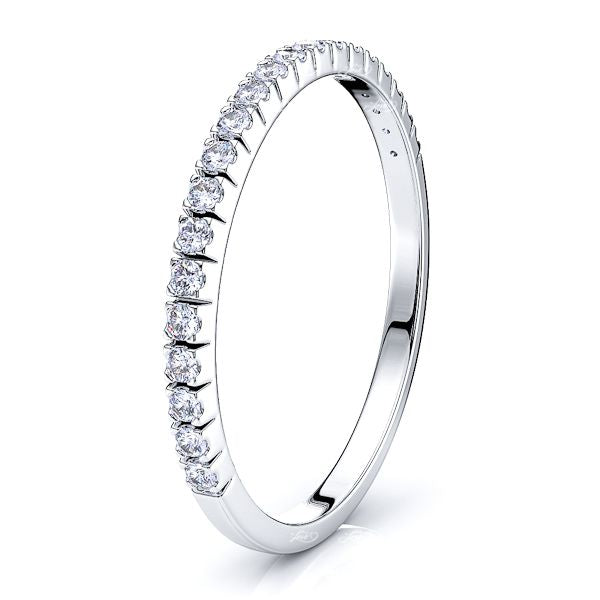
Women's Wedding Bands
Diamond, eternity, and plain bands for every taste.
150+ Styles
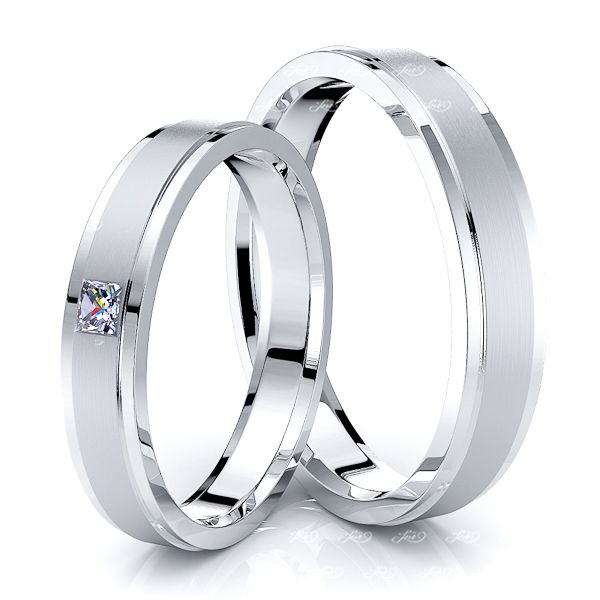
His and Hers Wedding Bands
Coordinated sets designed to be worn side by side.
50+ Sets
Bestselling His & Hers Sets
View all-
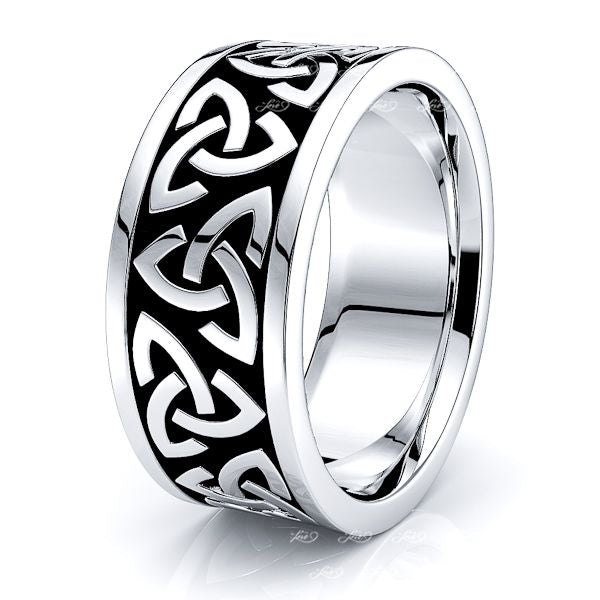
Ryan Trinity Knot Mens Celtic Wedding Band
$1,255.00From$941.25Sale -
Noah Hand Woven Mens Wedding Ring
$657.00From$492.75Sale


Talk to a Wedding Band Expert
Talk to a Wedding Band Expert
Have a question about sizing, metals, or engraving? Our specialists are happy to help — no pressure, just honest advice.
Send Us a Quick Question
Fill out the form below and one of our wedding band experts will get back to you within one business day.
Frequently Asked Questions
Is it safe to buy a wedding ring online?
How can I check my ring size without trying it on in a store?
Can I trust a custom or personalized wedding band ordered online?
How do I know the gold or platinum in an online purchase is genuine?
What does a fair return and pricing policy look like when buying online?
Does a wedding band bought online hold its value the same way as one from a store?
How do my partner and I choose matching bands when shopping online?
How do I clean and care for a wedding band I bought online?
Explore by Topic
Browse related guides, collections, and buying tips — organized to help you find exactly what you need next.