
Is 14K Gold Good for a Wedding Ring? (14K Gold Explained)
Shopping, not reading?
Skip ahead and browse the full wedding band collection.
If you've started shopping for wedding bands, you've probably noticed that almost every listing mentions a karat number — 10K, 14K, 18K — stamped somewhere inside the band. For most couples, 14K gold ends up being the default recommendation, but "default" isn't the same as "right for you." Before you commit years (or decades) of daily wear to a ring, it's worth understanding exactly what that "14K" stamp means, what trade-offs it represents, and whether it actually fits how you live, work, and take care of your jewelry.
This guide breaks down the karat system in plain language, walks through the real-world durability and skin-safety picture for 14K gold, compares it honestly against 10K, 18K, and platinum, and gives you a straightforward framework for deciding whether 14K gold is the right metal for your wedding ring — or whether you should consider stepping up or down. We'll also cover how to verify a ring is genuinely 14K, what the alloy is actually made of, and how karat choice affects what your ring is worth years down the road.
Every recommendation here reflects what our master jewelers see repairing, resizing, and re-polishing rings for real couples — not just marketing copy from a metals chart. By the end, you'll know exactly what questions to ask before you buy, and whether 14K gold, a different karat, or platinum makes the most sense for how you actually live.
Is 14K Gold Good for a Wedding Ring? The Short Answer
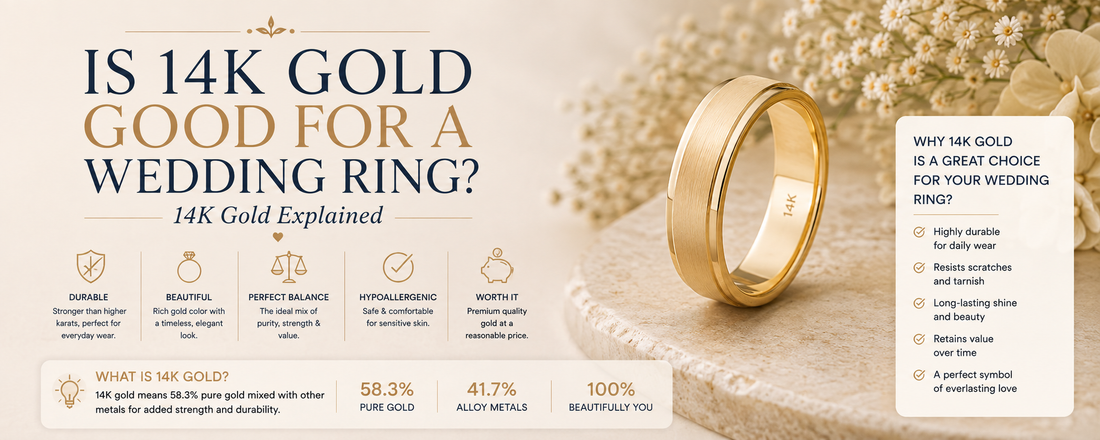
Yes — 14K gold is one of the best all-around choices for a wedding ring. At 58.3% pure gold alloyed with stronger metals like copper, silver, or palladium, it strikes the sweet spot between rich, authentic gold color and the everyday durability a ring worn 24/7 actually needs. It's more scratch- and dent-resistant than 18K gold, more affordable than platinum, and widely available in yellow, white, and rose finishes.
The Karat System Explained
"Karat" (not to be confused with "carat," which measures gemstone weight) measures gold purity on a 24-point scale, where 24K represents 100% pure gold. Because pure gold is extremely soft — too soft to hold its shape under daily friction and pressure — jewelers alloy it with other metals to add strength, and the karat number tells you how much of that alloy is actually gold versus other metals.
Here's how the most common karat options break down:
| Karat | % Pure Gold | Durability | Typical Use |
|---|---|---|---|
| 10K | 41.7% | Highest — most scratch- and dent-resistant of the gold karats | Budget-conscious buyers, very active lifestyles, tradespeople |
| 14K | 58.3% | High — the standard balance of strength and gold content | Most popular choice for US wedding bands and engagement rings |
| 18K | 75% | Moderate — softer, shows scratches and wear faster | Buyers who prioritize richer color and higher gold content over scratch resistance |
| 22K | 91.7% | Low — very soft, easily dented or misshapen | Traditional/ceremonial jewelry, less common for daily-wear bands |
| 24K | 99.9% | Lowest — pure gold, too soft for everyday rings | Investment bullion, rarely used in fine jewelry |
Notice the inverse relationship: as the percentage of pure gold goes up, durability generally goes down, because there's less of the hardening alloy metal in the mix. That trade-off is the single most important thing to understand before choosing a karat for a ring you intend to wear every day. For a deeper side-by-side breakdown of the two most popular fine-jewelry karats, see our dedicated 14K vs 18K Gold guide.
Why 14K Gold Is the Most Popular Choice for Wedding Bands in the US
Walk into almost any American jewelry store or browse any major wedding band retailer, and you'll find that 14K gold dominates the wedding band category — and it's not by accident. A wedding ring isn't occasional jewelry; it's worn against countertops, gym equipment, car doors, garden tools, dishwater, and everything else daily life throws at your hands. 14K gold was essentially engineered — through decades of jewelry-industry trial and error — to survive exactly that kind of use.
18K gold, with its 75% gold content, delivers a noticeably richer, warmer color, but that extra purity comes at the cost of hardness. Softer metal means more visible scratching, more rounding of sharp design edges, and faster loss of a polished finish. 10K gold, on the other hand, is tougher still than 14K, but its lower gold content (41.7%) gives it a paler color in yellow gold and a slightly less "substantial" feel, plus it holds less resale value per gram. 14K lands in the middle of that spectrum — gold enough to look and feel like genuine fine jewelry, hard enough to handle a lifetime of daily wear without babying it.
There's also a practical cost dimension. 14K gold typically costs meaningfully less than 18K gold (since it contains less actual gold, which is priced by weight and purity) while still costing more than 10K — giving buyers a comfortable mid-point that doesn't force a choice between "looks cheap" and "breaks the budget."
There's a regional pattern behind this preference, too. In much of Europe, the Middle East, and Asia, 18K and even 22K gold are the cultural default for fine jewelry, where rings are sometimes treated more as ceremonial or investment pieces than daily-wear objects. In the US, by contrast, wedding bands are expected to survive decades of uninterrupted daily wear — through work, workouts, and everything in between — which is precisely the use case 14K gold was refined for. That's a big part of why American jewelers, including LoveWeddingBands, default to 14K as the standard offering rather than an upgrade or downgrade.
Durability Deep-Dive: How 14K Gold Holds Up to Everyday Wear
Scratch Resistance
No gold alloy is scratch-proof — gold is inherently a soft metal relative to things like tungsten or titanium — but 14K gold's alloy content (roughly 42% copper, silver, zinc, and/or palladium, depending on the color) gives it meaningfully better scratch resistance than 18K or 22K gold. Most 14K wedding bands will develop a light, even patina of "wear lines" over years of use rather than deep, disfiguring gouges, and that patina can be polished out by a jeweler in minutes.
Everyday Wear: Hands, Tools, Gyms, and Manual Work
If your hands are in and out of tool belts, gym equipment, or manual labor all day, karat choice matters more than most buyers realize. 14K gold generally holds up well to normal daily friction — typing, driving, cooking, light yard work — but for genuinely rough manual trades, some buyers still choose to size up to a slightly thicker band or consider 10K for maximum resilience, then keep an 18K or platinum ring for special occasions. The good news is that 14K is durable enough for the vast majority of lifestyles without any special accommodation.
The Alloy Metals Behind the Strength
The specific alloy blend is what actually gives 14K gold its structural integrity and its color:
- Yellow gold alloys typically combine pure gold with copper and silver, preserving gold's natural warm tone while adding hardness.
- White gold alloys mix pure gold with white metals like palladium, silver, or (in older formulations) nickel, then usually finish with a rhodium plating for that bright white shine.
- Rose gold alloys use a higher proportion of copper, which is what shifts the color toward pink/red while also making rose gold one of the more durable 14K color options.
Because the alloy — not just the gold itself — does much of the structural work, the choice of white, yellow, or rose gold can subtly affect both the final color and the ring's day-to-day toughness.
Hypoallergenic Considerations: Is 14K Gold Safe for Sensitive Skin?
One of the most common questions we hear is whether 14K gold will irritate sensitive skin. The honest answer: it depends on the alloy, not the karat number itself. Pure gold is naturally hypoallergenic, but the metals it's alloyed with in 14K gold — especially nickel, which was historically common in white gold formulations — can trigger contact dermatitis in people with metal sensitivities.
The good news is that nickel-free 14K gold is now widely available and is what most reputable jewelers, including LoveWeddingBands, use by default. Nickel-free white gold typically relies on palladium or silver instead of nickel to achieve its white tone, which sidesteps the most common allergy trigger while still delivering the same bright, cool-toned finish. If you have a known nickel allergy, simply confirm with your jeweler that the alloy is nickel-free — yellow and rose gold rarely contain nickel in the first place, since copper and silver do the alloying work in those tones.
Compared to lower-karat gold (10K), 14K gold's higher gold percentage means proportionally less alloy metal overall, which some sensitive-skin wearers find easier to tolerate — though platinum remains the gold standard (no pun intended) for anyone with a confirmed, significant metal allergy, since it's used at 90–95% purity with hypoallergenic alloy metals.
How to Verify Your Ring Is Genuine 14K Gold
Because gold is a commodity with real resale value, it's worth knowing how to confirm that a ring described as "14K" actually is. Reputable jewelers make this easy to check:
- Look for a hallmark stamp. Genuine 14K gold jewelry is stamped "14K" or "585" (the European equivalent, referring to 58.5% purity) somewhere on the inside of the band. If a ring has no stamp at all, treat that as a red flag.
- Ask for documentation. Established retailers can provide a certificate or receipt specifying karat and gold weight — useful for insurance purposes as well as resale later.
- Understand "gold-filled" and "gold-plated" are not the same as solid 14K. Gold-filled and gold-plated items have only a thin layer of gold bonded over a base metal core, and while they may be stamped with a karat number for that outer layer, they are not solid gold through and through. Solid 14K gold is 14K all the way through, which is what allows it to be resized, repaired, and re-polished repeatedly over a lifetime.
- Buy from a jeweler who stands behind sourcing. When in doubt, a jeweler can perform an acid test or use an electronic gold tester to confirm purity before you buy.
Color Options in 14K Gold: Yellow, White, and Rose
One of the underrated advantages of 14K gold is that it's available in every major wedding band color, so choosing 14K as your karat doesn't lock you into a single look.
Yellow gold is the classic, traditional choice — warm, rich, and the color most people picture when they think "gold wedding ring." It pairs beautifully with vintage-inspired and classic band designs. Browse the full range in our Yellow Gold Wedding Bands collection.
White gold delivers a bright, modern, silvery-white finish that pairs well with platinum jewelry and diamonds, at a lower price point than platinum itself. Because it's rhodium-plated, white gold does need periodic re-plating (typically every 1–2 years with daily wear) to maintain its brightest shine.
Rose gold has surged in popularity over the past decade thanks to its warm, romantic pink hue — a byproduct of its higher copper content, which also happens to make it one of the toughest 14K color options. For a full breakdown of what makes rose gold unique, see our Rose Gold Wedding Bands guide.
All three colors are available at the same 58.3% gold purity in 14K — the color is purely a function of the alloy blend, not a difference in gold content or overall quality.
14K vs Other Karats: A Quick Comparison
If you're weighing 14K against the alternatives, here's the short version:
- 14K vs 10K: 10K is tougher and cheaper, but has noticeably less gold content, a paler color, and lower resale value. Most buyers who aren't on a tight budget prefer 14K's richer look.
- 14K vs 18K: 18K has a warmer, more saturated color and higher resale value per gram, but scratches more easily and costs more upfront. For an in-depth comparison of price, durability, and appearance, read our full 14K vs 18K Gold: Which for Your Ring? guide.
- 14K vs Platinum: Platinum is denser, naturally hypoallergenic, and doesn't need re-plating (even in white finishes), but it typically costs significantly more and develops a matte "patina" finish over time that some wearers love and others prefer to keep polished. Our Gold vs Platinum Wedding Bands guide covers this comparison in detail.
Cost Factors: What Determines the Price of a 14K Gold Ring
Several factors combine to determine what you'll actually pay for a 14K gold wedding band:
- Current gold spot price — gold is a commodity, so daily market price directly affects cost per gram.
- Band weight and width — wider, thicker bands use more gold and cost proportionally more.
- Karat — since 14K contains less gold than 18K by weight, it's generally less expensive gram-for-gram, though the difference is smaller than many buyers expect since labor and design also factor into price.
- Design complexity — hand-braided, hand-engraved, or diamond-set designs cost more in labor regardless of karat.
- Color — white gold sometimes carries a small premium due to rhodium plating, but yellow, white, and rose 14K are generally similarly priced.
If budget is a primary concern, 14K gold already represents a smart middle path — it costs less than 18K or platinum while looking and performing like genuine fine jewelry. For buyers working with a tighter budget, our Affordable His & Hers Wedding Bands Under $500 guide highlights specific styles that keep cost down without sacrificing quality.
It's also worth thinking about cost through a resale and long-term value lens, not just the sticker price at checkout. Because 14K gold contains significantly more actual gold than 10K by weight, it retains meaningfully more scrap and resale value if you ever have a ring resized down to nothing, melted, or traded in — a real consideration for an heirloom piece that might get passed down or reworked decades from now. 18K holds even more value gram-for-gram, but the gap between 14K and 18K resale value is often smaller than the gap in what you pay upfront, which is part of why so many buyers see 14K as the more sensible long-term choice. For a deeper look at how metal, craftsmanship, and karat affect what a wedding ring is worth over time, see our guide on whether wedding bands hold their value.
Who Should Choose 14K Gold — and When to Consider Platinum or 18K
Choose 14K gold if:
- You want a ring that can handle daily wear — gym, work, chores — without excessive babying.
- You want genuine gold color and value without paying platinum-level prices.
- You don't have a severe, confirmed nickel allergy (and confirm your ring is nickel-free if you have milder sensitivities).
- You want flexibility across yellow, white, or rose tones at a consistent price point.
Consider platinum or 18K instead if:
- You have a diagnosed, significant metal allergy — platinum's higher purity and hypoallergenic alloys are the safest bet.
- You strongly prioritize maximum color saturation and are willing to trade some scratch resistance for it (18K).
- You want the densest, most substantial-feeling metal and don't mind a higher price point (platinum).
- You're setting a large diamond or gemstone that benefits from platinum's superior prong security over years of wear.
Many of our most popular styles are built specifically with this durability-and-value balance in mind. The
and the
are both available in 14K gold and are built for exactly the kind of daily wear this guide describes — solid construction, comfort-fit interior, and a finish that holds up over decades. For those who want the classic-meets-modern richness of 14K in a statement design, the
 Featured pickCaden Mens Hand Braided Wedding Band
From $935.00
Featured pickCaden Mens Hand Braided Wedding Band
From $935.00
$1,456.35
Shop now shows how detailed craftsmanship still performs beautifully in 14K. And for eternity-style pieces, the
 Featured pickIndira Diamond Women Eternity Ring
From $1,549.00
Featured pickIndira Diamond Women Eternity Ring
From $1,549.00
$2,386.00
Shop now is available in 14K gold, offering durability for the metal band while the diamonds add sparkle up top. Since these pieces are fully customizable, you can select 10K, 14K, 18K gold, or platinum at checkout depending on which factors — cost, color, or maximum hardness — matter most to you.
Caring for Your 14K Gold Wedding Ring
14K gold is low-maintenance relative to plated or lower-quality metals, but a little routine care keeps it looking its best for decades:
- Clean regularly with warm water, a drop of mild dish soap, and a soft-bristled brush to remove lotion, soap scum, and everyday grime.
- Remove before heavy activity like weightlifting, yard work, or contact sports to avoid unnecessary dents or deep scratches.
- Avoid chlorine and harsh chemicals — chlorinated pools and some cleaning products can weaken gold alloys and dull the finish over time.
- Re-polish periodically — a jeweler can buff out light surface scratches in minutes, restoring the original shine.
- Re-plate white gold every 1–2 years if you want to maintain maximum brightness, since the rhodium layer wears thin with daily contact.
- Store separately from other jewelry to prevent metal-on-metal scratching in a drawer or box.
For a complete, step-by-step maintenance routine, see our full How to Clean & Care for Your Wedding Bands guide.
14K Gold at a Glance
| Factor | 14K Gold |
|---|---|
| Gold purity | 58.3% pure gold |
| Durability | High — well-suited to daily wear |
| Color options | Yellow, white, rose |
| Hypoallergenic | Yes, when nickel-free (standard on modern white gold alloys) |
| Relative cost | More than 10K, less than 18K or platinum |
| Maintenance | Low — periodic cleaning; white gold benefits from re-plating |
| Resale/value retention | Strong — higher gold content than 10K supports better long-term value |
| Best for | Most everyday wearers, active lifestyles, budget-conscious buyers |
Expert Tip From Our Master Jewelers
"When couples ask us to just pick a karat for them, we default to 14K about 80% of the time — not because it's the cheapest option, but because it's the one people are least likely to regret ten years in. The biggest mistake we see isn't choosing the 'wrong' karat, it's choosing based on a single factor like price or color without weighing how the ring will actually be worn day to day. If you work with your hands, lean toward 14K or even 10K. If you rarely take your ring off but also rarely do manual work, 18K's richer color might be worth the extra care. And if metal sensitivity is a real concern, don't guess — go platinum and skip the question entirely."
Explore 14K Gold Wedding Bands
Ready to see 14K gold in person? Our 14K Gold Wedding Bands collection features dozens of styles across yellow, white, and rose gold, from simple comfort-fit classics to detailed hand-finished designs — all fully customizable, and all built to the durability standard this guide describes. You can also browse our full Wedding Bands collection, or shop by category in Men's Wedding Bands and Women's Wedding Bands.
If you're still weighing metal options more broadly, our Best Metal for Wedding Bands: A Couple's Buying Guide compares gold, platinum, tungsten, titanium, and more side by side, so you and your partner can make the decision together with all the facts in front of you.
Bestselling His & Hers Sets
View all-
Ryan Trinity Knot Mens Celtic Wedding Band
$1,255.00From$941.25Sale -
Noah Hand Woven Mens Wedding Ring
$657.00From$492.75Sale


Talk to a Wedding Band Expert
Talk to a Wedding Band Expert
Have a question about sizing, metals, or engraving? Our specialists are happy to help — no pressure, just honest advice.
Send Us a Quick Question
Fill out the form below and one of our wedding band experts will get back to you within one business day.
Frequently Asked Questions
Is 14K gold real gold?
Is 14K gold durable enough for everyday wear?
Will 14K gold cause a skin reaction or turn my finger green?
Is 14K gold better than platinum for a wedding band?
Does 14K gold hold its resale value?
Is 14K gold more affordable than 18K gold or platinum?
How do I know what ring size to order in 14K gold?
What's the difference between 14K yellow, white, and rose gold?
Explore by Topic
Browse related guides, collections, and buying tips — organized to help you find exactly what you need next.