
Rose Gold Wedding Bands: Everything to Know
Shopping, not reading?
Skip ahead and browse the full wedding band collection.
Rose gold has gone from a niche vintage revival to one of the most requested metals for engagement rings and wedding bands in the past decade. But most shoppers researching it have the same handful of questions: What actually makes gold pink? Is it as durable as white or yellow gold? Does the color fade? And is there a meaningful difference between 14K and 18K rose gold? This guide answers all of it in plain language, drawing on what our bench jewelers see every day when they size, repair, and polish rose gold wedding bands.
What Is Rose Gold?
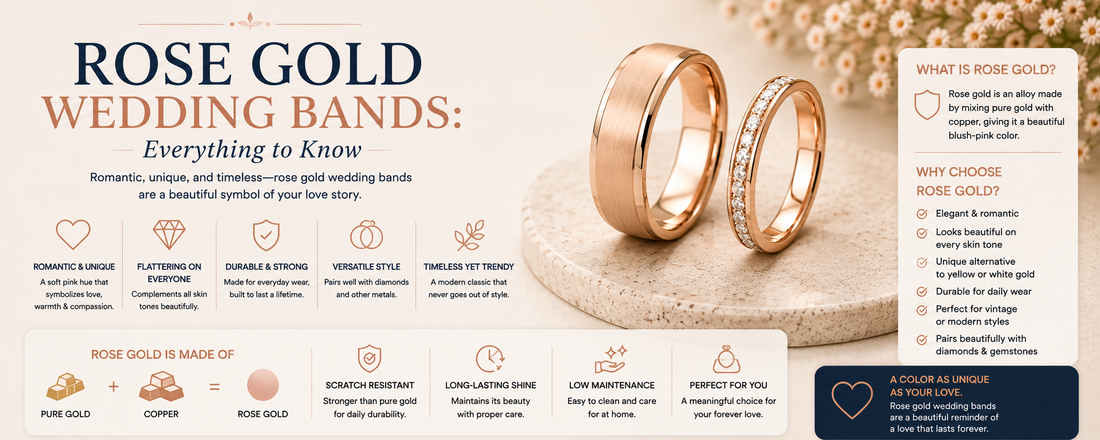
Rose gold is a gold alloy — pure gold blended with copper (and a small amount of silver) — where the copper content gives the metal its warm pink-to-red hue. The more copper in the mix, the deeper and more "rose" the color becomes. Because pure 24K gold is too soft for jewelry, all gold used in rings is alloyed with other metals anyway; rose gold simply chooses copper as the dominant alloy partner instead of the nickel, palladium, or silver used to make white or yellow gold.
The Copper Alloy, Explained
Every karat of gold sold as jewelry is a mixture. 24K gold is 99.9% pure and far too malleable to hold a ring shape or resist everyday knocks, so jewelers alloy it with other metals to add strength and, in gold's case, to shift the color. For rose gold specifically, that alloy is primarily copper. Copper has a naturally reddish-orange color, and when blended with yellow gold, it pulls the hue away from butter-yellow and toward pink, salmon, or deep rose, depending on the ratio.
A small percentage of silver is often included as well to keep the tone soft and prevent the copper from making the metal look too orange or coppery on its own. The result is a metal that is still legally and chemically "gold" — with all the same underlying value and hallmarking — but with a completely different visual character than traditional yellow gold.
Color Intensity by Karat
| Karat | Pure Gold Content | Typical Copper Alloy | Color Result |
|---|---|---|---|
| 18K Rose Gold | 75% | ~22.5% copper, ~2.5% silver | Softer, more subtle pink with a warm gold undertone |
| 14K Rose Gold | 58.3% | ~32% copper, ~9.7% silver | The classic, most popular rose hue — balanced pink |
| 10K Rose Gold | 41.7% | ~45%+ copper, remainder silver | Deepest, most reddish-pink tone; hardest of the three |
Because copper content rises as karat purity falls, 10K rose gold typically reads as the most intensely pink or coppery of the three, while 18K rose gold looks the most delicate and closest to a blush tone. 14K sits in the middle and is why it has become the default choice for most rose gold wedding bands — it delivers a clearly rose-colored ring without tipping into an overly coppery or orange appearance.
Why Rose Gold Has Surged in Popularity
A decade ago, rose gold wedding bands were a specialty request. Today they are a mainstream category alongside yellow and white gold, and a few real factors are driving that shift rather than just trend-chasing.
It flatters a wider range of skin tones. The warm pink undertone tends to complement both cool and warm complexions in a way that stark white metals or intensely yellow gold sometimes don't, which makes it a safer "universal" pick for couples shopping together.
It reads as vintage-romantic without being dated. Rose gold has strong associations with Victorian and Edwardian-era jewelry, giving modern rings an heirloom, old-world warmth that pairs beautifully with milgrain detailing, pavé settings, and antique-inspired designs like the
 Featured pickLorraine Pave Set Women Anniversary Wedding Band
From $1,057.00
Featured pickLorraine Pave Set Women Anniversary Wedding Band
From $1,057.00
$1,240.00
Shop now.
It's still less common than yellow or white gold, which appeals to couples who want a wedding band that feels personal and distinctive rather than the default choice. Choosing rose gold is often a deliberate style statement, not simply "whatever the jeweler had in stock."
It photographs beautifully. Warm pink tones tend to catch light in a soft, flattering way in engagement and wedding photography, which matters more than ever now that rings are photographed constantly for social media.
A Brief History of Rose Gold
Rose gold isn't actually a modern invention — it dates back to early 19th-century Russia, where jeweler Carl Fabergé used copper-rich gold alloys extensively in his famous decorative eggs and fine jewelry, which is why rose gold is still sometimes called "Russian gold" in older jewelry references. The look gained wider popularity through the Victorian and Edwardian eras, when warm, romantic metal tones suited the intricate, nature-inspired jewelry styles of the period.
Rose gold saw another wave of popularity in the 1920s Retro era, when copper was more readily available than other alloy metals during wartime shortages, and jewelers leaned into bold, warm-toned designs as a result. Its modern resurgence over the last decade builds directly on that heritage — today's rose gold wedding bands borrow the same warm, romantic character that made the metal a favorite more than a century ago, now paired with contemporary comfort-fit shanks and modern setting techniques.
The Durability Advantage: Why Copper Makes Rose Gold Stronger
This is the detail most shoppers never hear from a big-box jeweler, and it's genuinely useful: the copper alloy that gives rose gold its color also makes it measurably harder and more scratch-resistant than yellow or white gold of the same karat. Copper is a harder metal than the silver or palladium typically used in yellow and white gold alloys, so a rose gold ring at 14K will generally resist surface scratching and daily wear better than a 14K yellow gold ring of the same design.
This matters most for wedding bands specifically, since — unlike an engagement ring that might come off for chores or workouts — a wedding band is usually worn every single day for decades: through workouts, yard work, dishwashing, and manual tasks. A metal that starts out slightly harder has a real, practical advantage over the life of the ring. It's part of why rose gold has become a popular pick for men's wedding bands, including comfort-fit styles like the , which is built for exactly this kind of daily durability.
To be clear, no gold alloy is scratch-proof — any gold ring will show fine surface marks over years of wear, and a professional polish will always restore the shine. But among the three primary gold colors, rose gold consistently ranks as the most resistant to everyday abrasion, precisely because of its higher copper content.
Color Depth: 14K vs. 18K Rose Gold vs. "Everose"-Style Blends
Not all rose gold looks the same, and the karat you choose is the single biggest factor in how pink your ring will actually appear.
18K rose gold contains the most pure gold (75%) and the least copper of the common karats, which produces a softer, more understated blush tone. It has a gentle warmth rather than a bold pink, and some buyers feel it looks closer to a "warm yellow gold" than a true rose color in certain lighting.
14K rose gold is the industry standard for a reason: its roughly one-third copper content produces the rose tone most people picture when they hear "rose gold" — a clear, confident pink without looking coppery or costume-like. It's also the karat used across nearly all of our rose gold wedding band styles, including pieces like the
 Featured pickNeith Diamond Women Eternity Ring
From $2,570.00
Featured pickNeith Diamond Women Eternity Ring
From $2,570.00
$4,147.00
Shop now when customized to rose gold.
Proprietary "Everose"-style blends (a term trademarked by a major watch brand, though the concept applies generically) use a carefully controlled copper-to-silver ratio designed to resist fading and keep the pink tone consistent and stable over years of wear. Fine jewelers achieve a similar effect by tightly controlling alloy purity and finishing technique — the takeaway for shoppers is that alloy quality and craftsmanship matter as much as the karat number on the color you get and how well that color holds up.
In short: go 18K if you want a subtle, refined blush; go 14K if you want the richer, unmistakably rose look most people associate with the metal; 10K will read as the deepest, most reddish-pink option and is worth trying on in person before committing, since the effect can be more dramatic than photos suggest.
Skin Tone and Styling Considerations
Because rose gold's undertone sits between the coolness of white metals and the golden warmth of yellow gold, it tends to be one of the more universally flattering metal choices — but a few styling notes are worth knowing before you buy.
Warmer skin tones with golden or olive undertones typically see rose gold blend seamlessly, echoing the warmth already present in their complexion. Cooler or fair skin tones often find that rose gold provides a soft contrast that reads as flattering without the starkness of white gold or platinum against very pale skin. Deeper skin tones frequently look striking in rose gold, since the pink tone stands out as a genuine color statement rather than blending in, the way white gold sometimes can.
Beyond skin tone, rose gold pairs exceptionally well with both vintage and modern design language. Milgrain edging, pavé diamond rows, and delicate engraving all read as more romantic in rose gold, while clean, minimalist comfort-fit bands take on a warmer, more approachable look than the same design in white gold. If your personal style leans toward soft, romantic, or slightly vintage-inflected jewelry — think antique rings, warm-toned metals, layered gold jewelry — rose gold will likely feel like a natural fit rather than a departure.
Mixing Metals: Rose Gold and White Gold Two-Tone Options
One of the most practical advantages of rose gold is how well it mixes with other metals, particularly white gold. A two-tone band — rose gold as the primary body with white gold accents, or vice versa — lets couples get the warmth of rose gold and the crisp contrast of white gold in a single ring, without having to choose one over the other.
This is especially popular for couples where one partner already owns white gold or platinum jewelry (a family heirloom engagement ring, for instance) and wants a wedding band that bridges both metals rather than clashing with them. Many of our customizable styles, including pieces like the , can be finished with mixed-metal detailing or ordered in solid rose gold, depending on preference.
Rose gold also pairs comfortably with yellow gold — a rose gold band next to a yellow gold engagement ring reads as complementary rather than mismatched, since both share the same warm gold family, just with a different alloy ratio. This flexibility is a big part of why rose gold has become such a practical choice for couples who don't want their wedding band to lock them into a single metal for every future piece of jewelry.
Rose Gold and Diamonds: Setting Considerations
Rose gold's warm undertone has a subtle but real effect on how diamonds and gemstones read once set. Because the pink hue sits opposite white metals on the color wheel, it can very slightly warm the apparent color of a diamond compared to seeing that same stone in a white gold or platinum setting — a phenomenon jewelers sometimes call "color bounce." For diamonds graded in the higher color range (D through H), this effect is negligible and rarely noticeable to the naked eye. For diamonds lower on the color scale (K and below, which carry a faint yellow tint), a rose gold or yellow gold setting can actually work in your favor, since the warm metal tone helps mask any hint of yellow in the stone rather than accentuating it the way a stark white setting would.
This makes rose gold a practical choice for pavé and eternity styles where dozens of small diamonds are set closely together, since minor variations in individual stone color are far less noticeable against a warm metal background. It's part of why rose gold performs so well in diamond-set anniversary and eternity bands, where consistent, even sparkle across the whole ring matters more than any single stone's exact color grade.
Care and Tarnish: Does Rose Gold Fade or Change Color?
A common concern is whether the copper in rose gold behaves like copper does in other contexts — tarnishing, greening, or fading. In practice, rose gold used in fine jewelry is far more stable than that worry suggests, but there are a few honest nuances worth knowing.
Because rose gold contains a higher percentage of copper than white or yellow gold, it can develop an extremely slight, gradual patina over many years of wear — a subtle warming or deepening of tone, not the visible tarnish or greening associated with cheap copper jewelry or gold-plated costume pieces. This is a slow cosmetic shift, not corrosion, and it happens only after extended daily wear; many rose gold rings show no noticeable change even after a decade. A simple periodic cleaning (warm water, mild soap, and a soft cloth) keeps the color looking fresh.
Here's the genuinely good news: unlike white gold, which is typically rhodium-plated and requires periodic replating every one to three years to maintain its bright white finish as the plating wears down, rose gold never needs replating. The pink color goes all the way through the metal itself — it isn't a surface coating — so there's no plating layer to wear off and no recurring maintenance cost. Over the lifetime of a ring, this makes rose gold meaningfully lower-maintenance than white gold. For a full at-home cleaning routine, see our care and cleaning guide.
Cost: Rose Gold vs. Yellow Gold vs. White Gold
Rose gold is priced essentially the same as yellow and white gold at the same karat weight, since the price of a gold ring is driven overwhelmingly by the gold content (karat and weight) rather than which alloy metal is blended in. Copper, silver, nickel, and palladium are all inexpensive relative to gold, so swapping between rose, yellow, and white alloys at the same karat has a negligible effect on price.
Where cost differences do show up is over the ownership lifetime, not the sticker price. White gold's need for periodic rhodium replating adds a small recurring cost over years of ownership that rose gold and yellow gold simply don't have. If budget is the main driver of your decision, karat weight and ring width will affect price far more than metal color — our affordable wedding bands guide breaks down how to balance those variables under $500.
Who Should Choose Rose Gold?
Rose gold tends to be the right call if any of the following describe you:
- You want a wedding band with genuine vintage or romantic character rather than a strictly modern look.
- You're drawn to a metal color that's warm without being as bold or bright as traditional yellow gold.
- Durability against everyday scratching is a priority — rose gold's copper content gives it a real edge here.
- You want to avoid recurring maintenance costs, since rose gold never needs replating the way white gold does.
- You want a band that feels a little less common than the standard yellow or white gold options most people default to.
- You're planning to mix metals — rose gold pairs easily with both white and yellow gold pieces.
It may be less suited to buyers who specifically want the cool, bright-white look of platinum or white gold, or who plan to exclusively wear white-metal jewelry going forward and want every piece to match precisely.
Shopping Tips: What to Ask Your Jeweler
Because color and alloy quality vary between manufacturers, a few targeted questions will help you compare rose gold options accurately when you're shopping, whether in person or online:
- What karat is the rose gold, and can I see it next to a different karat? Seeing 14K next to 18K side by side makes the color difference far more obvious than reading a description.
- Is the color solid through the metal, or is this a plated finish? True rose gold wedding bands are solid alloy throughout; some costume and fashion jewelry uses a thin rose-colored plating over a different base metal, which will wear off over time. All of our rose gold pieces are solid alloy, not plated.
- What's the ring's width and profile? Wider bands and rounded comfort-fit profiles show off metal color more prominently than thin, flat styles — worth considering if the rose hue itself is a priority for you.
- Can this style be custom-ordered in rose gold if it isn't a standard option? Many band styles that ship primarily in yellow or white gold can be custom-made in rose gold on request — always worth asking before assuming a design isn't available.
Rose Gold vs. Yellow Gold vs. White Gold: Quick Comparison
| Factor | Rose Gold | Yellow Gold | White Gold |
|---|---|---|---|
| Primary alloy metal | Copper (+ silver) | Copper, zinc, silver | Nickel or palladium |
| Color | Warm pink to rose | Classic golden yellow | Bright silvery white |
| Scratch resistance | Highest of the three | Moderate | Moderate |
| Replating needed? | Never | Never | Every 1-3 years (rhodium) |
| Price at same karat | Comparable | Comparable | Comparable (plus replating cost over time) |
| Best for | Vintage-romantic style, low maintenance, durability | Traditional, classic look | Bright white contrast, cool-toned styling |
Expert Tip From Our Jewelers
"When customers ask us to help them decide between 14K and 18K rose gold, we always recommend trying both on in natural daylight, not just under jewelry store lighting. The difference between an 18K blush tone and a 14K rose tone is subtle in photos but noticeable in person — and since a wedding band is worn every day for the rest of your life, that's a decision worth making with your own eyes, not just a spec sheet." — LoveWeddingBands Master Jewelers
Explore Rose Gold Wedding Bands
If you're ready to see rose gold in person, our full Rose Gold Wedding Bands collection includes solid rose gold styles as well as customizable designs. Popular starting points include the Solid Flat Park Avenue Comfort Fit Wedding Band and Solid Flat Milgrain Comfort Fit Wedding Band for classic comfort-fit bands with confirmed rose gold color options, while the Lorraine Pavé Set Anniversary Band and Neith Diamond Eternity Ring can be customized to rose gold for a diamond-set anniversary or eternity style.
If you're still comparing metals more broadly, our Yellow Gold Wedding Bands and Women's Wedding Bands collections are good places to compare styles side by side, or browse the full Wedding Bands collection to see every metal and style we offer.
Ready to Find Your Rose Gold Band?
Rose gold offers a rare combination in fine jewelry: a genuinely distinctive, romantic color, a real durability advantage from its copper alloy, and none of the recurring maintenance cost that comes with white gold. Whether you're drawn to the deep hue of 14K or the subtle blush of 18K, our master jewelers are ready to help you find — or customize — the right rose gold wedding band for your marriage. Browse the full collection or reach out to our team for a personal recommendation.
Bestselling His & Hers Sets
View all-
Ryan Trinity Knot Mens Celtic Wedding Band
$1,255.00From$941.25Sale -
Noah Hand Woven Mens Wedding Ring
$657.00From$492.75Sale -
Eliana Mens Diamond Wedding Ring
$2,158.00From$1,618.50Sale


Talk to a Wedding Band Expert
Talk to a Wedding Band Expert
Have a question about sizing, metals, or engraving? Our specialists are happy to help — no pressure, just honest advice.
Send Us a Quick Question
Fill out the form below and one of our wedding band experts will get back to you within one business day.
Frequently Asked Questions
What is rose gold made of?
Is rose gold real gold?
Does rose gold fade or change color?
Is rose gold more durable than white gold or yellow gold?
What's the difference between 14K and 18K rose gold?
Does rose gold suit all skin tones?
Can rose gold be mixed with white gold in the same ring?
Is rose gold more expensive than yellow or white gold?
Explore by Topic
Browse related guides, collections, and buying tips — organized to help you find exactly what you need next.