
14K vs 18K Gold: Which Is Right for Your Wedding Ring?
Shopping, not reading?
Skip ahead and browse the full wedding band collection.
Choosing a wedding band metal comes down to one recurring question for most couples: 14K or 18K gold? Both are solid, real gold. Both come in yellow, white, and rose finishes. And both will look beautiful the day you say "I do." But the ring you wear every single day for the next fifty years needs to survive dishwashing, gym workouts, gardening, and the occasional accidental knock against a doorframe — and that's where the differences between 14K and 18K gold really start to matter.
At LoveWeddingBands.com, we cut, cast, and hand-finish wedding bands in both karats every week, and we field this exact question from nearly every couple who walks through our design process. It's rarely about which karat is "better" in the abstract — it's about matching gold purity to how a specific ring will actually be worn. A primary wedding band and an occasional-wear anniversary piece have very different jobs, and the right karat often differs between them.
This guide breaks down the real, practical differences — purity, durability, color, hypoallergenic properties, price, and resale value — so you can make the choice that's right for your ring, your skin, and your lifestyle.
What's the Difference Between 14K and 18K Gold?
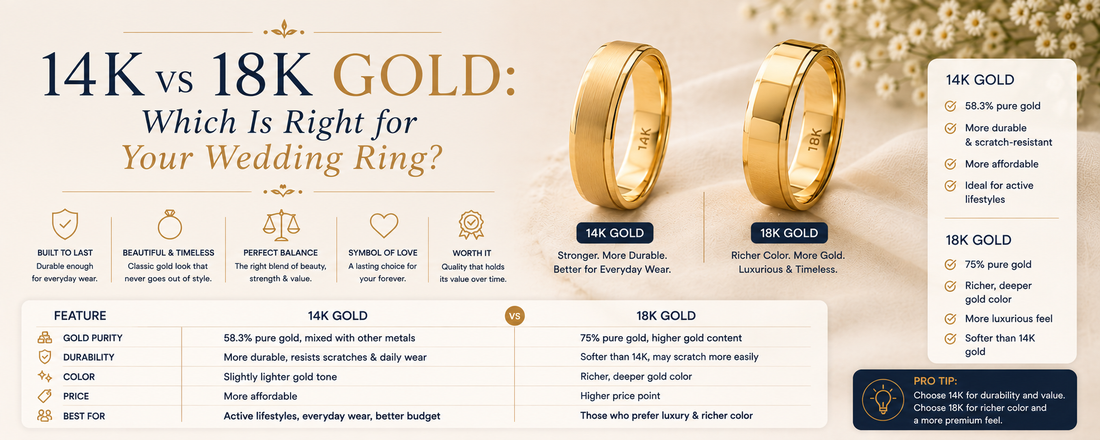
The difference between 14K and 18K gold is purity. 14K gold is 58.3% pure gold (14 out of 24 parts), alloyed with metals like copper, silver, and zinc for strength. 18K gold is 75% pure gold, with less alloy mixed in. That means 18K has a richer, warmer color and is more hypoallergenic, while 14K is harder, more scratch-resistant, and better suited to daily wear — which is exactly why most jewelers recommend 14K for wedding bands.
Purity Breakdown: What "Karat" Actually Means
Gold in its purest form — 24K — is too soft to hold its shape in a ring meant to be worn every day. It scratches, bends, and wears down quickly under normal use. That's why virtually all fine jewelry is alloyed: mixed with other metals like copper, silver, palladium, or zinc to add strength, adjust color, and make the metal workable for a jeweler's bench.
The karat number tells you how many parts out of 24 are pure gold. The rest is alloy. Here's exactly how 14K and 18K break down:
| Karat | Gold Purity | Alloy Content | Common Marking |
|---|---|---|---|
| 24K | 99.9% pure gold | ~0.1% | 999 |
| 18K | 75.0% pure gold | 25% alloy | 750 |
| 14K | 58.3% pure gold | 41.7% alloy | 585 or 583 |
| 10K | 41.7% pure gold | 58.3% alloy | 417 |
Every LoveWeddingBands piece is stamped with its karat purity, so you always know exactly what you're wearing. The takeaway: 18K gold contains roughly 29% more pure gold than 14K gold by weight. That single fact is the root cause of nearly every other difference between the two — color, softness, hypoallergenic behavior, and price.
How to Verify Karat: Reading Hallmarks and Stamps
Every piece of legitimate fine jewelry sold in the United States should carry a hallmark stamp indicating its karat purity, usually found on the inside of a ring's shank. You'll typically see either the karat number itself (14K or 18K) or the equivalent millesimal fineness number (585 or 583 for 14K; 750 for 18K). Some pieces also carry a maker's mark alongside the purity stamp.
If you're ever shopping secondhand, at an estate sale, or comparing a family heirloom against a new purchase, checking this stamp is the fastest way to confirm what karat you're actually looking at — color alone isn't a reliable indicator, since alloy formulations vary between manufacturers and can make a well-made 14K piece look nearly as rich as a poorly alloyed 18K one. Every ring we craft at LoveWeddingBands is hallmarked clearly for exactly this reason: so you always have a permanent, verifiable record of what your ring is made of.
Durability: Which Gold Holds Up Better for Daily Wear?
This is the single most important factor for a wedding band specifically, because unlike a pair of earrings or a pendant you wear occasionally, a wedding ring gets worn 24 hours a day — through workouts, dish washing, yard work, typing, and everything in between.
Because 14K gold contains more alloy (41.7% versus 18K's 25%), it is measurably harder and more scratch-resistant. On the Vickers hardness scale, 14K gold typically measures in the range of 150-180 HV, while 18K gold — with less structural alloy — usually falls closer to 120-150 HV depending on the specific alloy mix and gold color. In practical terms, that means:
- Scratch resistance: 14K resists surface scratching and micro-abrasion better than 18K over years of daily contact with countertops, tools, and gym equipment.
- Dent resistance: A harder alloy structure means 14K is less likely to dent or deform from an accidental knock — important for anyone who works with their hands.
- Long-term shape retention: 14K bands tend to hold their profile and edge definition (like a knife-edge or milgrain detail) longer between professional re-polishes.
- Prong and setting security: For eternity bands or rings with channel-set stones, 14K's added hardness helps prongs and settings resist bending out of place.
18K gold isn't fragile — it's still a durable, wearable precious metal that will last generations with reasonable care. It simply scratches and shows wear marks somewhat more readily than 14K because there's less hardening alloy in the mix. Most fine jewelry scratches over time regardless of karat; the difference is how quickly those marks accumulate and how often you'll want a professional re-polish.
Color and Richness: Why 18K Looks Different
The higher gold content in 18K produces a noticeably deeper, warmer, more saturated yellow than 14K yellow gold. Side by side, 18K yellow gold has an almost buttery, antique richness, while 14K yellow gold appears a touch brighter and lighter — still unmistakably gold, just with more alloy influencing the tone.
In white gold, the difference is subtler since both karats are alloyed with white metals like palladium or nickel and then rhodium-plated for that bright white shine. In rose gold, 14K often actually shows a slightly more pronounced pink-copper hue than 18K, because rose gold's blush color comes from copper content in the alloy — and 14K rose gold has proportionally more alloy (and therefore more copper) than 18K rose gold.
Neither color is objectively "better" — it's a matter of personal taste. Some people specifically seek out 18K yellow gold for its old-world, heirloom warmth. Others prefer the crisper, slightly lighter tone of 14K. If color depth is your top priority for a yellow gold band, 18K will deliver a visibly richer result.
Hypoallergenic Properties: Which Is Better for Sensitive Skin?
If you have sensitive skin or a known metal allergy, this is one of the more important practical differences between the two karats. Because 18K gold contains 75% pure gold and only 25% alloy, there's simply less alloy metal in contact with your skin. Since gold itself is naturally hypoallergenic and reactions are almost always triggered by alloy metals (most commonly nickel), 18K gold is generally the better choice for people prone to skin irritation, redness, or contact dermatitis from jewelry.
14K gold, with a higher proportion of alloy, carries a somewhat higher risk of triggering a reaction in people with nickel sensitivity — though most reputable jewelers, including LoveWeddingBands, use nickel-free alloy formulations in 14K white gold specifically to minimize this risk. If you've had a reaction to jewelry in the past, ask about the specific alloy composition before ordering, or consider platinum, which is hypoallergenic at any purity level. For a deeper look at how gold compares to platinum on this front, see our Gold vs Platinum Wedding Bands guide.
Price Difference Explained
18K gold costs more than 14K gold — often 25-40% more for an identical design — and the reason is straightforward: gold content. Gold is priced by weight on the global commodities market, and 18K contains significantly more of it (75% pure gold vs. 58.3%) than 14K in the same size ring. You're not paying more for better craftsmanship or a "premium" designation — you're paying for the extra grams of actual gold in the alloy.
This is worth understanding clearly because it reframes the decision: choosing 14K over 18K isn't a compromise on quality, craftsmanship, or authenticity — every LoveWeddingBands piece, in either karat, is solid gold, hallmarked, and hand-finished to the same standard. It's a decision about how much pure gold weight you want to carry on your finger and pay for, balanced against the durability trade-off outlined above.
Couples working with a defined budget often find that 14K lets them get a heavier band, a wider profile, or added diamond detail for the same price point where 18K would force compromises elsewhere. This price gap also widens or narrows with the live gold market price — during periods of high gold prices, the dollar difference between 14K and 18K on the same design becomes more pronounced, since 18K's extra gold content is worth proportionally more. If budget is a central factor in your decision, our Affordable His & Hers Wedding Bands Under $500 guide is a useful companion read.
Which Should You Choose for a Wedding Band?
For a ring you intend to wear every day, indefinitely, most jewelers — including our own bench team — recommend 14K gold as the smarter default. Here's why:
- A wedding band takes more physical abuse than almost any other piece of jewelry you'll own. It's on your hand during workouts, chores, cooking, and manual work.
- 14K's added hardness means fewer visible scratches between professional polishes, better edge retention on detailed profiles, and a lower long-term risk of dents from daily knocks.
- 14K offers a meaningfully lower price point without sacrificing authenticity, allowing more budget flexibility for width, diamond accents, or a matching set.
- For active lifestyles — manual trades, gym-goers, outdoor work, parents chasing after kids — 14K's resilience noticeably reduces how often the ring needs professional attention.
Our own 14K Gold Wedding Bands collection is built around exactly this logic: everyday-durable designs in yellow, white, and rose gold that hold up to real life without losing their shine. For a deeper dive specifically on whether 14K is the right purity for your ring, read our companion guide, Is 14K Gold Good for a Wedding Ring?
A great example of a daily-wear-ready design is the Solid Euro Dome Comfort Fit Mens Wedding Band, available from $684 and offered in both 14K and 18K gold at checkout — a heavier, domed profile that showcases exactly how 14K's added hardness pays off on a band worn daily.
When 18K Makes Sense
18K gold isn't the wrong choice for a wedding band — it's simply the better choice in specific situations. Consider 18K if:
- You have sensitive skin or a mild nickel allergy and want the lowest-alloy option short of platinum.
- Color depth is your top priority and you love the richer, warmer tone of high-purity yellow gold.
- The ring will see lighter daily wear — for example, an anniversary band, eternity ring, or statement piece you'll wear on occasions rather than around the clock.
- You want maximum gold content as part of the piece's long-term intrinsic value, independent of design considerations.
This is exactly why many of our clients choose 18K for eternity bands and diamond-forward pieces rather than the primary wedding band itself. The Neith Diamond Women Eternity Ring, from $2,955, is a popular 18K choice — a piece meant to be treasured and worn with intention rather than subjected to the daily grind a primary wedding band endures.
 Featured pickNeith Diamond Women Eternity Ring
From $2,570.00
Featured pickNeith Diamond Women Eternity Ring
From $2,570.00
You'll find more options built for richer color and detail in our 18K Gold Wedding Bands collection.
Resale and Long-Term Value
Because 18K gold contains more pure gold by weight, it generally carries a higher intrinsic scrap or resale value than an equivalent 14K piece — gold buyers pay based on purity and weight, so an 18K ring will typically fetch more per gram melted down. That said, resale value for wedding bands is a nuanced topic: most jewelry, regardless of karat, sells for a fraction of its retail price on the secondary market, since resale valuations are driven by gold content and current market price rather than craftsmanship or brand.
For couples specifically weighing karat as a "value investment" decision, it's worth noting that the price premium you pay for 18K upfront (25-40% more) doesn't necessarily translate to a proportionally higher resale return — you're paying retail for craftsmanship and design in both cases, and reclaiming only the melt value of the gold itself if you ever resell. It's also worth remembering that most couples never intend to resell a wedding band at all — sentimental value tends to far outweigh melt value for a ring this personal, which is part of why we encourage buying the karat that fits how you'll actually wear it, rather than the one that theoretically resells for more. We cover this topic in much more depth, including realistic expectations for what wedding bands are worth over time, in Do Wedding Bands Hold Their Value?
Care and Maintenance Differences
Both karats benefit from the same basic care routine — but 18K generally needs it slightly more often due to its softer alloy composition:
- Cleaning: Warm water, mild dish soap, and a soft brush work well for both karats. Avoid chlorine and harsh chemicals, which can damage gold alloys and, in white gold, degrade rhodium plating faster.
- Professional polishing: 18K pieces may show light surface scratching sooner and benefit from a professional buff every 12-18 months; 14K pieces often go 18-24 months between polishes under normal wear.
- Removal for high-impact activity: We recommend removing any gold ring, in either karat, before heavy lifting, contact sports, or activities involving repeated impact against hard surfaces.
- Rhodium plating (white gold only): Both 14K and 18K white gold are typically rhodium-plated for a bright white finish; this plating wears at a similar rate regardless of underlying karat and should be refreshed every 1-2 years.
For a complete, step-by-step maintenance routine — including what to avoid, how often to get professional cleanings, and how to store your rings safely — see our full How to Clean & Care for Your Wedding Bands guide.
One More Factor: Fit Matters as Much as Karat
Karat purity gets most of the attention in this decision, but how a ring fits your finger has just as much impact on how it wears over the years, regardless of whether you choose 14K or 18K. A band that's slightly too loose shifts constantly against countertops, tools, and steering wheels, accelerating scratches on either karat. A band that's too tight puts uneven pressure on the metal at the point of stretch, which can gradually distort softer 18K alloys faster than 14K. Getting an accurate size before you order — and rechecking it against the specific comfort-fit or standard-fit profile of the style you choose — protects your investment no matter which purity you land on. Our step-by-step How to Measure Your Ring Size at Home guide walks through exactly how to get an accurate reading before you order.
14K vs 18K Gold: Full Comparison Table
| Factor | 14K Gold | 18K Gold |
|---|---|---|
| Gold purity | 58.3% | 75.0% |
| Alloy content | 41.7% | 25.0% |
| Hardness / scratch resistance | Higher — best for daily wear | Moderate — softer, scratches more readily |
| Color saturation | Brighter, slightly lighter tone | Deeper, richer, warmer tone |
| Hypoallergenic rating | Good (nickel-free alloys recommended) | Better — less alloy content overall |
| Typical price vs. equivalent design | Baseline / lower cost | 25-40% higher |
| Best for | Wedding bands, daily-wear rings, active lifestyles | Eternity bands, anniversary pieces, occasional-wear jewelry |
| Recommended polish interval | Every 18-24 months | Every 12-18 months |
| Resale / melt value | Lower per gram | Higher per gram |
Expert Tip From Our Bench
"When couples ask us which karat to choose, we always bring the conversation back to lifestyle first, aesthetics second," says our LoveWeddingBands bench team. "A contractor, nurse, or gym regular will feel the difference between 14K and 18K within the first year of daily wear — 14K simply holds its finish longer under real-world conditions. But if you're choosing a piece for its color and you're not worried about daily impact, 18K's richness is genuinely stunning. The honest answer for most primary wedding bands is 14K; the honest answer for a special-occasion eternity band or anniversary gift is often 18K. Neither is 'better' in the abstract — the right karat is the one that matches how the ring will actually be worn."
This same lifestyle-first thinking applies across metal choice more broadly, not just gold purity. If you're still deciding between gold, platinum, or alternative metals entirely, our Best Metal for Wedding Bands: A Couple's Buying Guide walks through the full decision framework.
Explore 14K and 18K Gold Wedding Bands
Whichever karat fits your lifestyle, LoveWeddingBands offers our full range of styles in both 14K and 18K gold, customizable at checkout. A few popular starting points:
The Solid Knife Edge Comfort Fit Mens Wedding Ring, from $485, is a clean, tailored profile available in either karat — a great entry point if you're comparing the two side by side.
For couples who want intricate detail without sacrificing durability, the Alexander Mens Hand Braided Wedding Ring, from $1,705.25, is frequently ordered in 14K for exactly the scratch-resistance reasons outlined above.
 Featured pickAlexander Mens Hand Braided Wedding Ring
From $1,346.00
Featured pickAlexander Mens Hand Braided Wedding Ring
From $1,346.00
- Browse our dedicated 14K Gold Wedding Bands and 18K Gold Wedding Bands collections to compare full design ranges side by side.
- Prefer classic yellow gold specifically? Our Yellow Gold Wedding Bands collection spans both karats.
- Or start from our full Wedding Bands hub to filter by metal, width, and price across the entire catalog.
The Bottom Line
14K and 18K gold are both genuine, hallmarked, high-quality choices for a wedding ring — the decision isn't about quality, it's about fit. If your ring needs to survive daily life — work, workouts, chores, and everything in between — 14K's added hardness makes it the more practical, longer-lasting choice for the vast majority of wedding bands, and it comes at a meaningfully lower price point. If you're prioritizing maximum color richness, have sensitive skin, or you're choosing a piece for lighter, occasional wear, 18K delivers a warmer tone and higher gold content worth the premium.
Still not sure which is right for you? Our design team can walk you through both options side by side, in person or virtually, and help you compare weight, finish, and price before you commit. Explore our full Wedding Bands collection or reach out to start designing your ring in the karat that fits your life.
Bestselling His & Hers Sets
View all-
Ryan Trinity Knot Mens Celtic Wedding Band
$1,255.00From$941.25Sale -
Noah Hand Woven Mens Wedding Ring
$657.00From$492.75Sale


Talk to a Wedding Band Expert
Talk to a Wedding Band Expert
Have a question about sizing, metals, or engraving? Our specialists are happy to help — no pressure, just honest advice.
Send Us a Quick Question
Fill out the form below and one of our wedding band experts will get back to you within one business day.
Frequently Asked Questions
What's the difference between 14K and 18K gold?
Is 18K gold better than 14K for a wedding ring?
Which is more durable, 14K or 18K gold?
How much more does 18K gold cost than 14K gold?
Is 18K gold hypoallergenic?
Does 14K or 18K gold hold its resale value better?
What karat gold do most jewelers recommend for a wedding band?
How can I tell if my ring is 14K or 18K gold?
Explore by Topic
Browse related guides, collections, and buying tips — organized to help you find exactly what you need next.