
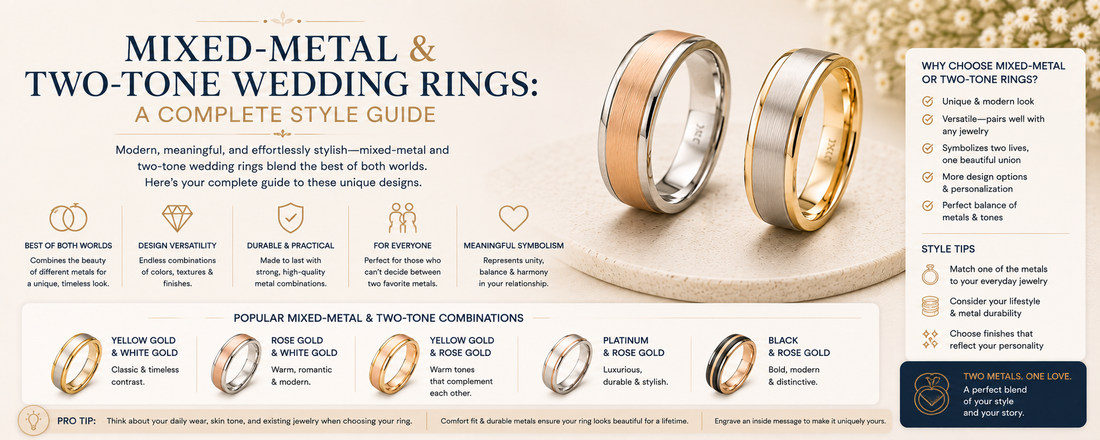
Mixed-Metal & Two-Tone Wedding Rings: A Complete Style Guide
Shopping, not reading?
Skip ahead and browse the full wedding band collection.
Walk into any jewelry counter today and you'll notice a shift: rings that once came in a single, uniform metal color are increasingly being replaced by pieces that combine two — sometimes three — tones in one band. White gold rails flanking a yellow gold center. A rose gold inlay set into a white gold surface. A Celtic knot carved in warm yellow against a cool white gold background. This is the mixed-metal and two-tone wedding ring, and it has become one of the fastest-growing categories in bridal jewelry for a simple reason: it solves a real problem that single-metal rings never could.
For decades, the conventional wisdom was that you had to "pick a lane" — decide whether you were a gold person or a platinum-and-white-gold person, and then buy every future piece of jewelry to match. Mixed-metal wedding rings throw that rule out. By combining warm and cool tones in a single piece, they let you wear your wedding band with literally anything else in your jewelry box, from your grandmother's yellow gold locket to a sleek white gold tennis bracelet, without a single piece ever feeling out of place. That versatility, paired with a genuinely distinctive look that single-tone rings can't replicate, is why searches for two-tone and mixed-metal bands have climbed steadily among engaged couples, grooms, and brides alike.
This guide is a comprehensive look at mixed-metal and two-tone wedding rings — what the terms actually mean, the techniques jewelers use to combine metals, the most popular color pairings and what each one communicates stylistically, the craftsmanship and durability questions you should ask before you buy, and how to choose a combination that will genuinely work with the jewelry, engagement ring, and skin tone you already have. Whether you're shopping for a men's band, a women's band, or a matching his-and-hers set, the goal here is to give you enough real, practical knowledge that you can walk into a decision with confidence rather than guesswork.
What Is a Mixed-Metal Wedding Ring?
A mixed-metal wedding ring combines two or more metal colors — such as white and yellow gold, or rose and white gold — in one piece, using techniques like soldered rails, inlay work, or contrasting engraving. The result is a band that visually pairs with both your warm-toned and cool-toned jewelry at once, rather than matching only one.
What "Mixed-Metal" and "Two-Tone" Actually Mean
"Two-tone" and "mixed-metal" are often used interchangeably, and for most shoppers they describe the same thing: a ring made with two (or more) distinct metal colors. Technically, two-tone usually refers to a ring built from exactly two metal colors, while mixed-metal is the broader umbrella term that can include tri-color designs or unconventional combinations. In practice, both terms point to the same craftsmanship challenge — joining metals of different colors into one cohesive, durable piece — and jewelers achieve this in a handful of distinct ways.
Split-Shank and Rail Construction
The most common technique, especially in men's bands, is split-shank or rail construction, where the ring is built with a center section in one metal color flanked by two outer rails in a contrasting color. A yellow gold center step between two white gold rails is a classic example — you get a bold central stripe of color framed by a cooler, more neutral edge. This construction is popular because it's structurally sound: the metals are joined along long, flat seams that solder cleanly and hold up well over decades of wear.
Inlay Work
Inlay techniques set one metal into a recess carved or milled into the other, similar to how wood or stone inlay works in furniture. A rose gold inlay in a white gold band, for instance, creates a smooth, flush surface where the two metals meet rather than a raised or stepped profile. Inlay work requires precise machining and a snug fit between the two metals, since any gap will trap dirt, weaken the bond, or eventually let the inlay shift.
Milgrain and Contrasting Edge Detail
A more subtle approach to mixing metals is to keep the main body of the ring in a single color and add a fine decorative edge — often a milgrain (a beaded, textured border) — in a contrasting metal along the outer rim. This gives you a hint of two-tone styling without committing to a bold, high-contrast look, and it's a popular choice for brides who want something delicate rather than dramatic.
Engraved or Carved Motifs in Contrasting Color
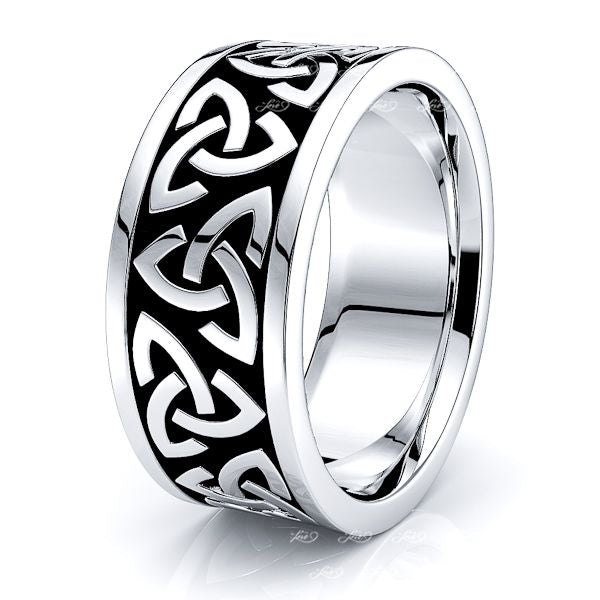
Design elements like Celtic knots, filigree, or floral engraving are frequently rendered in a contrasting metal color to make the pattern pop against the base band. This is especially popular in Celtic wedding bands, where a yellow gold trinity knot or braided pattern set against a white gold background gives the carving far more visual depth than a single-tone version could achieve. The
 Featured pickRohan Trinity Knot Mens Celtic Wedding Ring
From $1,255.00
Featured pickRohan Trinity Knot Mens Celtic Wedding Ring
From $1,255.00
$2,176.00
Shop now is a good example of a design built for exactly this kind of two-tone treatment, where the knotwork is meant to be seen, not blended in.
Why Mixed-Metal Wedding Rings Are Trending
There are a few concrete reasons two-tone rings have moved from a niche specialty item to a mainstream bridal category, and they go beyond simple aesthetics.
Genuine Versatility With Existing Jewelry
This is the practical benefit that drives most of the demand. Most people's jewelry collections aren't monochrome — you might have a white gold watch, a yellow gold chain from a family member, rose gold earrings from a recent gift, and a silver bracelet you wear daily. A single-tone wedding ring only "matches" a portion of that collection. A mixed-metal ring, by definition, contains both a warm and a cool tone, so it visually connects with whatever else you're wearing that day. You stop having to think about whether your wedding ring clashes with your other jewelry, because it's built to pair with both palettes at once.
A Genuinely Unique, Distinctive Look
Because most wedding bands on the market are still single-tone, a well-made two-tone ring stands out immediately. The contrast between light and dark, warm and cool, gives the eye more to register than a flat, uniform color field. For couples who want a band that photographs well and reads as more considered or custom, that visual complexity is a meaningful selling point.
The "Best of Both" Compromise
Two-tone rings also solve a common relationship negotiation: one partner loves the warmth of yellow or rose gold, the other prefers the cool, modern look of white gold or platinum. Rather than one person "winning," a mixed-metal band lets both preferences live in the same piece. This is a genuinely useful angle for couples shopping together and unable to agree on a single metal, and it's part of why mixed-metal designs are increasingly popular in matching his-and-hers sets.
Common Mixed-Metal Color Combinations
Not all two-tone pairings read the same way. Each combination has its own visual temperature and tends to suit different preferences, skin tones, and existing jewelry collections.
White Gold + Yellow Gold
This is the most classic and most commonly requested two-tone pairing. It reads as timeless rather than trendy, largely because white-and-yellow combinations have been used in fine jewelry for well over a century. It's an easy, safe choice if your jewelry collection is a genuine 50/50 mix of silver-toned and gold-toned pieces, and it tends to suit a very wide range of skin tones since it isn't leaning warm or cool overall — it's literally both. The is a confirmed example of this pairing, available in a genuine Yellow-White two-tone colorway with a flat step profile that gives the two metals a clean, architectural division.
White Gold + Rose Gold
A softer, more contemporary pairing, white-and-rose combinations feel modern and slightly romantic without being overly traditional. Rose gold's warm, pinkish hue against crisp white gold creates a gentler contrast than the yellow-white pairing, which makes it a popular choice for brides who want something distinctive but not bold. It also tends to flatter fair and rosy skin undertones particularly well.
Yellow Gold + Rose Gold
This is a less common but increasingly popular combination — both metals sit on the warm end of the spectrum, so instead of a hot-and-cool contrast, you get a rich, layered warmth with subtle tonal variation. It works especially well for people who know they prefer warm metals overall but still want the visual interest of a two-tone design, and it pairs beautifully with warm-toned gemstones like garnet, citrine, or champagne diamonds.
Tri-Color (White, Yellow, and Rose Gold)
Tri-color bands combine all three golds in a single piece, often in alternating rails, a braided design, or a layered stack look. This is the boldest and most maximalist option on this list — it guarantees the ring will coordinate with literally any other jewelry tone you own, but it's also the most visually busy option, so it tends to suit people who already gravitate toward statement jewelry rather than minimalist pieces.
Durability and Craftsmanship: Why Soldering Quality Matters
This is the part of two-tone shopping that gets glossed over most often, and it's arguably the most important. A mixed-metal ring isn't simply two rings glued together — it's two (or three) separate pieces of metal, each with its own melting point, hardness, and expansion characteristics, joined permanently by a jeweler through soldering, fusing, or precision machining and pressing.
Done well, this is a genuine craftsmanship skill. A properly soldered two-tone ring has a seam that is invisible to the eye and to touch, holds up to years of daily wear including gym sessions, dishwashing, and temperature changes, and won't separate, discolor unevenly at the joint, or develop a visible seam line over time. Done poorly — with mismatched alloys, insufficient heat control, or a rushed bond — the seam can become a weak point. It may show as a faint discoloration line, catch on fabric, or in worst cases, separate under stress.
A few practical questions are worth asking any jeweler before you buy a two-tone piece:
- How is the two-tone effect achieved? Soldered rails, milled inlay, and plated overlay are not the same thing, and they don't wear the same way. A soldered or inlaid two-tone ring made from solid metals throughout will outlast a ring where one color is simply a thin plated layer over a base metal, since plating wears off with polishing and daily friction.
- Are both metals solid gold (or the stated metal) rather than plated? A genuinely solid two-tone piece, like the two-tone colorway on the , means every part of the ring — not just the visible surface — is the metal it appears to be, which matters enormously for resizing, repair, and long-term durability.
- Can the seam be re-polished without disturbing the color division? Over years of wear, any ring needs occasional professional polishing. A well-constructed two-tone ring can be re-polished by a skilled jeweler without blurring the line between the two colors; a poorly constructed one can have that division degrade with each polish.
The takeaway is simple: two-tone construction is a genuine skill, and it's worth buying from a jeweler who can speak confidently and specifically about how their pieces are made, not just what they look like in a product photo.
Styling Versatility: The Practical Case for Mixed Metals
Beyond the aesthetics, the single most practical advantage of a mixed-metal wedding ring is how effortlessly it integrates with the rest of your jewelry, regardless of what tone that jewelry happens to be. A single-tone white gold band will always look slightly disconnected from a yellow gold necklace or bracelet; a single-tone yellow gold band will do the same next to white gold or silver pieces. A two-tone ring sidesteps that problem entirely.
This matters more than it might initially seem, because most people don't buy all their jewelry at once, from one brand, in one metal. Jewelry collections accumulate over years — gifts, heirlooms, pieces bought on different occasions in different metals. A mixed-metal wedding ring is, in effect, future-proofed against that accumulation. It will still make visual sense next to whatever you add to your collection in five or ten years, warm-toned or cool-toned, without ever needing to be "the ring that doesn't quite match today."
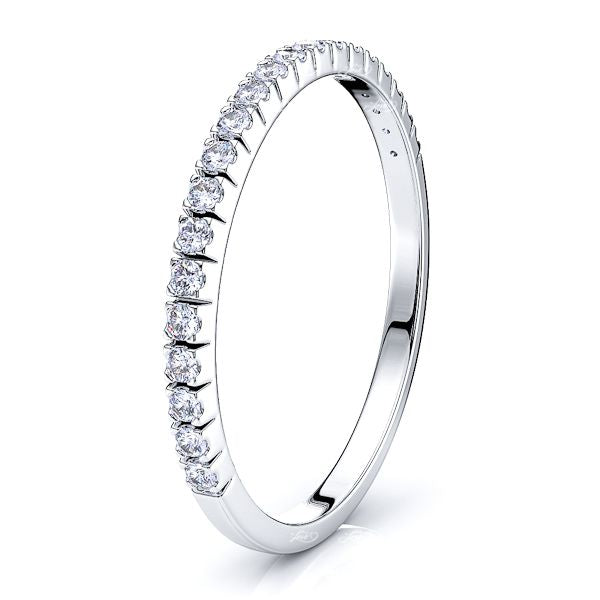
This is also why mixed-metal designs pair so naturally with layered stacking looks, where a wedding band is worn alongside an engagement ring and one or more stacking or eternity bands. A two-tone band gives you a built-in bridge between a white gold engagement ring and a yellow or rose gold stacking piece, for instance, letting the whole stack read as intentional rather than mismatched. The
 Featured pickNeith Diamond Women Eternity Ring
From $2,570.00
Featured pickNeith Diamond Women Eternity Ring
From $2,570.00
$4,147.00
Shop now, available in a range of customizable metal options, is a strong example of a piece that can be built to bridge exactly this kind of stack.
Mixed-Metal Rings for Men, Women, and Couples
Mixed-Metal Wedding Bands for Men
Two-tone designs are especially well established in men's wedding bands, where the split-shank rail construction — a center stripe of one color flanked by rails of another — has been a category staple for decades. It reads as classic and understated rather than flashy, which suits the general preference in men's bridal jewelry for clean, architectural lines. Comfort-fit profiles pair particularly well with this construction, since the rounded interior keeps the ring easy to wear all day despite the more complex metal structure. The is a good example of a men's profile built to support a customized two-tone treatment, and men who want a more ornate look often gravitate toward Celtic-inspired two-tone pieces from the men's Celtic wedding band collection, where knotwork patterns are traditionally rendered in a contrasting metal for depth and legibility.
Mixed-Metal Wedding Bands for Women
For women, two-tone treatment tends to show up in more delicate applications — a milgrain edge in a contrasting color, a thin inlay line, or a two-tone eternity band where alternating stones or sections shift between metal tones. Because women's engagement rings are more likely to already be a specific metal (a white gold or platinum halo setting, for example), a mixed-metal wedding band is a particularly smart way to introduce a second tone into the stack without having to replace or reset the engagement ring itself.
Mixed-Metal Matching Sets for Couples
For couples who want coordinated but not identical rings, mixed-metal sets are an increasingly popular solution. Each partner's band can use the same two metal colors in different proportions or arrangements — more yellow gold in his, more white gold in hers, for example — so the set reads as a matched pair without being literally identical. This also solves the classic scenario where one partner strongly prefers warm gold and the other prefers cool white metals: a shared two-tone palette lets both preferences show up in both rings.
Caring for Two-Tone and Mixed-Metal Pieces
Two-tone rings don't require dramatically different care from single-metal rings, but a few extra considerations are worth keeping in mind specifically because of the metal transition points.
- Clean gently and regularly. A soft brush, mild soap, and warm water is sufficient for routine cleaning. Pay particular attention to the seam or inlay line where the two metals meet, since dirt and soap residue can accumulate there more than on a smooth single-tone surface.
- Avoid harsh chemical dips at home. Some at-home jewelry cleaning solutions are formulated for a single metal type and can react differently with two different alloys in the same piece. When in doubt, stick to soap and water, or have the ring professionally cleaned.
- Have the ring professionally inspected annually. A jeweler can check that the bond between the two metals remains sound, that the seam hasn't developed any separation, and that any stones remain secure. This is a good habit for any wedding ring, but it's especially useful for two-tone pieces where the join is the one component that a home inspection can't fully evaluate.
- Be mindful of professional polishing. Because re-polishing a two-tone ring risks blurring the color division if done carelessly, make sure any jeweler doing maintenance work on the ring understands two-tone construction specifically, rather than treating it like a standard single-metal polish job.
For a broader rundown of daily-wear care practices that apply to every wedding band regardless of metal, the store's dedicated care and cleaning guide covers general maintenance in more depth.
Cost Considerations for Mixed-Metal Rings
Two-tone construction typically adds a modest premium over an equivalent single-metal band, and it's worth understanding why. Combining two metals means a jeweler is working with two separate material stocks rather than one, and the soldering, inlay, or machining work required to join them cleanly takes more skilled labor than producing a single-tone band of the same design. That said, the premium is usually incremental rather than dramatic — you're paying for the additional craftsmanship step, not for double the material, since the total metal weight in a two-tone ring is comparable to a single-tone ring of the same size and profile.
Where cost can vary more significantly is in the metal purities and the specific combination chosen. A two-tone piece built from two different 14K gold colors will typically cost less than a comparable design mixing platinum with gold, since platinum carries a higher per-gram price than gold across the board. If budget is a primary consideration, a solid 14K two-tone gold band offers the visual benefit of mixed metals at a more accessible price point than a platinum-inclusive combination, and 14K gold is a genuinely durable, practical everyday choice — the store's guide on whether 14K gold is good for a wedding ring goes into more detail on why this purity is such a common recommendation for daily-wear bands.
How to Choose Your Mixed-Metal Combination
With several combinations available, narrowing down the right one comes down to three practical factors: your engagement ring metal, your existing jewelry collection, and your skin tone.
Start With Your Engagement Ring
If you already have an engagement ring, it's usually the anchor point for your wedding band decision. A white gold or platinum engagement ring pairs naturally with a white-gold-forward two-tone band (white and yellow, or white and rose), keeping the dominant tone consistent while still introducing a secondary accent color. If your engagement ring already features a two-tone or mixed setting, matching that same combination in your wedding band keeps the whole hand looking cohesive.
Look at What You Actually Wear Daily
Rather than guessing, it's worth doing a quick, honest inventory of the jewelry you reach for most: your watch, your everyday necklace, your go-to earrings. If that collection leans heavily toward one metal tone with only occasional pieces in the other, a combination that's dominant in your everyday tone with a secondary accent in the other will feel the most natural. If your collection is genuinely split down the middle, a balanced white-and-yellow or white-and-rose pairing will serve you best.
Consider Your Skin's Undertone
As a general (not absolute) guideline, cooler, pink-based undertones tend to be flattered by white gold and platinum, while warmer, golden or olive undertones tend to be flattered by yellow and rose gold. A mixed-metal ring gives you a built-in way to hedge this decision — rather than committing fully to one temperature, you get a touch of both, which is part of why two-tone rings are frequently recommended to people who are unsure which single metal suits them best.
Don't Overlook Customization
Many wedding band styles that aren't sold as two-tone by default can be custom-built into a mixed-metal combination, particularly in profiles designed with a stepped or multi-surface structure. If you have a specific combination in mind that isn't shown as a standard listing, it's worth asking directly — a significant share of two-tone pieces are made to order for exactly this reason. For couples designing a fully custom matching set from scratch, the custom his and hers wedding bands guide walks through the process of specifying metal combinations, widths, and finishes as a coordinated pair.
Combination Comparison Table
| Combination | Overall Look | Best For |
|---|---|---|
| White Gold + Yellow Gold | Classic, timeless, high contrast | Balanced jewelry collections; traditional style preference |
| White Gold + Rose Gold | Soft, modern, romantic | Fair/rosy undertones; contemporary bridal style |
| Yellow Gold + Rose Gold | Rich, warm, layered | Warm-metal lovers who still want tonal contrast |
| Tri-Color (White, Yellow, Rose) | Bold, maximalist, statement | Statement-jewelry wearers; matching any future piece |
| Contrasting Milgrain Edge | Subtle, delicate accent | Those wanting a hint of two-tone without heavy contrast |
Expert Tip
When evaluating a two-tone ring in person or in photos, run your fingertip across the seam where the two metals meet rather than just looking at it. A well-executed solder or inlay join should feel completely smooth, with no ridge, gap, or catch under your nail. If you can feel a transition, that's a sign of either a design choice (an intentional stepped profile) or a construction shortcut — ask your jeweler which one it is before you buy, since the answer tells you a lot about how the piece will hold up over years of daily wear.
Related Collections and Products
If you're ready to start browsing, the full range of styles — including two-tone and customizable options — lives in the Wedding Bands collection. Men can browse dedicated Men's Wedding Bands, including two-tone Celtic designs in the Men's Celtic Wedding Bands collection, while women can explore the Women's Wedding Bands collection for eternity styles and delicate two-tone accents.
For further reading on metal choices generally, the guides on Gold vs Platinum Wedding Bands, Rose Gold Wedding Bands, and White Gold vs Platinum each go deeper into the individual metals that make up the most popular two-tone combinations, and the Best Metal for Wedding Bands: A Couple's Buying Guide is a useful next stop if you and your partner are still weighing metal options together.
Final Thoughts
Mixed-metal and two-tone wedding rings aren't a passing trend so much as a practical response to how people actually wear jewelry: mixed, layered, and accumulated over years rather than bought all at once in a single tone. Whether you're drawn to the classic contrast of white and yellow gold, the softer pairing of white and rose, or a bold tri-color statement, the combination you choose should ultimately come down to what you'll wear daily, what your engagement ring already establishes, and a jeweler who can speak confidently about how the piece is actually constructed. Done well, a two-tone ring is one of the few wedding band styles that genuinely gets more versatile, not less, as your jewelry collection grows.
Shop Wedding Band Collections
Explore our most-loved styles, from classic comfort-fit bands to modern two-tone designs.
All Wedding Bands
Every style, metal combination, and price point in one place.
500+ Styles
Men's Wedding Bands
Two-tone, Celtic, and classic men's styles.
200+ Styles
Women's Wedding Bands
Delicate two-tone accents and eternity styles.
150+ Styles
Men's Celtic Wedding Bands
Knotwork and braided designs, many finished in two-tone.
40+ Styles
Bestselling His & Hers Sets
View all-
Ryan Trinity Knot Mens Celtic Wedding Band
$1,255.00From$941.25Sale -
Noah Hand Woven Mens Wedding Ring
$657.00From$492.75Sale


Talk to a Wedding Band Expert
Talk to a Wedding Band Expert
Have a question about sizing, metals, or engraving? Our specialists are happy to help — no pressure, just honest advice.
Send Us a Quick Question
Fill out the form below and one of our wedding band experts will get back to you within one business day.
Frequently Asked Questions
Can you mix metals in a wedding ring?
What is the most popular mixed-metal combination?
Do two-tone rings tarnish or discolor at the seam?
Is a two-tone wedding ring more expensive than a single-metal band?
Can a two-tone wedding ring be resized?
What's the difference between mixed-metal and two-tone?
Do mixed-metal wedding bands work for men?
Can couples get matching mixed-metal wedding bands?
Explore by Topic
Browse related guides, collections, and buying tips — organized to help you find exactly what you need next.