To choose matching wedding bands, agree on one shared element — metal, finish, or a repeated design detail — then scale each ring to suit the wearer's hand rather than making the two rings identical. Decide together how closely you want them to match, pick a common thread, choose proportional widths (typically narrower for her, wider for him), and size each ring individually. Matching is about harmony between two bands, not making them the same.
Matching wedding bands are a beautiful way to carry a shared symbol of your marriage, but "matching" trips a lot of couples up: does it mean identical rings, or just rings that go together? This guide gives you a clear decision framework — the questions to ask, the elements you can coordinate, and how to handle the practical details of widths and sizing — so you and your partner can choose a pair you'll both love for a lifetime. When you're ready to browse pairs designed to coordinate, start with our collection of his and hers wedding bands. And if you'd like more visual inspiration and real pairing examples, our companion piece on matching wedding bands for couples is full of styling ideas.
1. What "matching" actually means
The first thing to settle is a definition, because couples often arrive with different pictures in their heads. "Matching" wedding bands fall on a spectrum. At one end are truly identical rings — the same metal, width, and design, scaled only by finger size. In the middle are coordinated pairs that share one or two obvious elements, such as the same metal and finish, but differ in width or detailing. At the far end are complementary bands that simply feel like they belong together through a subtle shared thread, even though they look quite different.
None of these is more correct than another. Identical bands make a bold statement of unity; complementary bands let each person's taste shine while still connecting the two rings. The goal of this guide is to help you find your own place on that spectrum. If you're still weighing whether a coordinated set is right for you at all — versus two entirely independent rings — our comparison of his and hers vs regular wedding bands lays out the pros and cons side by side.
2. A 5-question decision framework
Rather than starting from styles, start from these five questions. Answer them together and your shortlist narrows itself dramatically.
How closely do you want to match? Identical, coordinated, or just complementary? This single answer sets the tone for everything else. If your tastes differ a lot, aim for complementary; if you love the symbolism of sameness, go identical.
What's your shared thread? Pick one non-negotiable element you'll both carry — most often the metal. A shared metal is the easiest and most elegant way to make two very different rings read as a set.
Do your lifestyles differ? If one of you works with your hands and the other doesn't, you may want different metals or finishes for durability, while keeping another element in common. Function can override pure symmetry, and that's fine.
What's your combined budget? Buying two rings at once changes the maths. Decide the total first, then split it — the two rings don't have to cost the same. Our affordable wedding bands for couples guide shows where to save across a pair.
Do you want them to be obviously a set, or a private connection? Some couples want anyone glancing at their hands to see a matched pair; others prefer a subtle link only they know about, like a shared engraving or hidden detail. Neither is right — it's about what the rings mean to you.
3. The elements you can coordinate
Once you know how closely you want to match, these are the levers you can pull. You don't need to coordinate all of them — in fact, sharing just one or two usually looks more sophisticated than matching everything.
| Element | How it coordinates two rings | Match level it suits |
|---|---|---|
| Metal | The strongest unifier — same metal instantly reads as a set | All levels |
| Finish | Matte, polished, brushed, or hammered — a shared finish ties different shapes together | Coordinated, complementary |
| Profile | Both flat or both domed keeps the silhouettes in harmony | Identical, coordinated |
| Motif or detail | A repeated groove, milgrain edge, or accent stone echoed across both | Coordinated, complementary |
| Engraving | Matching dates, coordinates, or a phrase split across the pair | All levels (often hidden) |
For engraving inspiration that works beautifully across a pair — split phrases, shared coordinates, matching dates — see our wedding band engraving ideas guide.
Shop his and hers wedding bands →4. His and hers widths and proportion
The most common way matched bands differ is width, and getting the proportion right is what makes a pair look intentional rather than mismatched. As a general guide, women's bands often sit between 2 and 4 mm and men's between 5 and 7 mm, but the principle matters more than the numbers: each band should be proportional to the hand that wears it.
A useful trick is to keep the ratio consistent — if her band is on the slimmer end, a moderately wider band for him will look balanced, whereas an extremely wide men's band next to a very fine women's band can look disconnected. If you want them to feel more identical, narrow the gap in widths. If you want each to suit its wearer, let the widths diverge but keep the metal and finish shared so the connection stays obvious. Width also affects comfort and engraving room, which our main wedding band buying guide covers in detail.
5. Popular matching pairings
If you'd like a few tried-and-true starting points, these are pairings we see couples choose again and again because they simply work.
Same metal, different widths. The classic. A 3 mm and a 6 mm band in matching 14K yellow gold reads unmistakably as a set while flattering each hand. This is the safest, most timeless choice.
Shared finish, different metals. Both bands in a matte finish, one white gold and one yellow, links them through texture while letting each person have their preferred color. A sophisticated, modern look.
Matching motif, individual bands. A repeated design detail — a single groove, a milgrain edge, a hidden accent stone — echoed across two otherwise different rings. Subtle and personal.
Truly identical. The same ring in two sizes, for couples who love the symbolism of sameness. Simple, unified, and increasingly popular with those who want a genuinely shared symbol.
You'll find versions of all of these in our collection of his and hers wedding bands, curated as coordinating pairs.
6. Coordinating without being identical
If you and your partner have different tastes, don't force a compromise that leaves neither of you happy. The most successful matched sets often aren't identical at all — they're two rings that each person genuinely loves, connected by one deliberate shared element. Let one of you have the bold textured band and the other the sleek polished one; unify them with the same metal, and they'll still read as a pair.
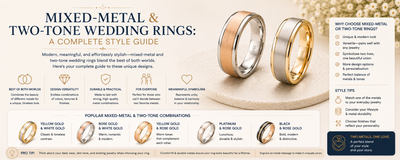
Mixing metals between two bands is stylish and increasingly common, and there's no rule that says a couple must wear the same color of gold. The key is intentionality: choose a shared thread on purpose rather than leaving the two rings to relate by accident. For a deeper look at combining two metals well — including which colors sit beautifully together — see our best metal for wedding bands guide, and for the full metal comparison our wedding band metals guide.
7. Sizing two rings
One practical reality of buying a pair: you need two accurate sizes, and they'll almost always be different. Measure each finger separately at the end of a normal day, when fingers are at their typical size, and take a couple of readings to be sure. Don't guess a partner's size from your own — ring sizes vary far more than people expect.
Remember too that comfort-fit bands often measure about half a size smaller than standard-fit rings because of their domed interior, so size each ring against the exact style you're ordering. Our step-by-step how to measure ring size at home guide and printable ring size chart make measuring two fingers straightforward. Order early — around 8 to 12 weeks before the wedding — so there's time to resize either ring if the first fit isn't perfect.
Explore his and hers wedding bands →8. Frequently asked questions
- Do matching wedding bands have to be identical?
- No. Matching sits on a spectrum from truly identical to simply complementary. Most couples share one or two elements — usually the metal and finish — while varying width or detailing so each ring suits its wearer.
- What's the easiest way to make two bands match?
- Share the metal. A common metal is the strongest and most elegant unifier, instantly making two otherwise different rings read as a coordinated set. Browse coordinating pairs in our his and hers wedding bands collection.
- Can we choose different metals and still match?
- Yes. Link the two bands through a shared finish, profile, or motif instead. Mixing metals is stylish and popular — see our best metal for couples guide for combinations that work well together.
- What widths should his and hers bands be?
- Women's bands are commonly 2–4 mm and men's 5–7 mm, but proportion to the hand matters most. Keep the ratio balanced so the pair looks intentional rather than mismatched.
- How do we size two rings correctly?
- Measure each finger separately at the end of the day, and size against the exact style — comfort-fit bands run about half a size smaller. Our ring sizing guide walks through it.
- Should we buy our bands as a set or separately?
- Buying as a coordinated set makes matching metal, finish, and proportion simple, and helps with budgeting for two. If you're deciding between a matched set and two independent rings, compare his and hers vs regular wedding bands.