Matching wedding bands for couples range from identical pairs to subtly coordinated designs — the most popular looks share a metal or finish while differing in width to suit each wearer. Beautiful pairings include same-metal bands in his-and-hers widths, a shared matte or hammered finish across two colors of gold, or a repeated motif on two otherwise individual rings. Below are styling ideas and real pairing inspiration for every kind of couple, whatever your taste or budget.
There's something quietly romantic about two rings that clearly belong together. If you and your partner love the idea of a matched look, this guide is your inspiration board: popular set pairings, styling ideas by couple type, ways to coordinate metals and finishes, and beautiful examples to spark ideas. It's the visual companion to our step-by-step how to choose matching wedding bands guide — so once an idea catches your eye here, that guide helps you make the decision. When you're ready to see real pairs, our collection of his and hers wedding bands is designed exactly for this.
1. Popular set pairings
Some pairings simply work, chosen again and again because they look intentional and flatter both hands. Use these as beautiful starting points, then make them your own.
- Same metal, his-and-hers widths. A slim band for her, a wider one for him, both in matching 14K yellow gold — the timeless classic.
- Shared matte finish, two gold colors. One white gold, one yellow, linked by an identical brushed finish.
- Twin diamond details. A row of pavé on hers echoed by a single flush-set diamond on his.
- Matching milgrain edges. The same delicate beaded border on two different widths.
- Identical bands, two sizes. The same design for couples who love true symmetry.
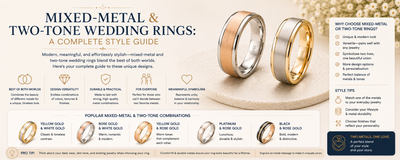
- Mixed-metal twist. Both bands two-tone, combining the same pair of metals in each.
2. Styling ideas by couple
Different couples suit different looks. Find the description that sounds like you both for a tailored starting point.
The classic couple. Timeless and understated — matching plain domed bands in yellow or white gold, same metal, different widths. Elegant, never dated, and endlessly flattering.
The modern couple. Clean and contemporary — flat-profile bands with a matte or brushed finish, perhaps in platinum or white gold, with a subtle shared detail like a single groove.
The couple with different tastes. Individuality with a link — let each choose their own style, then unify with one shared element (the metal, or a matching finish). Two very different rings that still read as a pair.
The sentimental couple. Meaning built in — a split engraving across both bands, matching coordinates, or the same date in each other's handwriting. Our engraving ideas guide is full of ways to do this.
The adventurous couple. Distinctive and personal — mixed metals, a bold texture like hammered or bark finish, or a hidden pop of color echoed on both rings.
Shop his and hers wedding bands →3. Coordinating metals
Metal is the most powerful way to make two bands feel like a set, and there are three lovely approaches. The simplest is a shared metal — the same yellow gold, white gold, rose gold, or platinum on both, which instantly reads as a pair no matter how the widths differ. The second is complementary metals — two different colors of gold, or gold and platinum, linked by a common finish so the contrast looks deliberate rather than accidental. The third is two-tone on both — each band combining the same two metals, echoing one another beautifully.
Mixing metals is a celebrated, current look for couples, not a compromise, so don't feel you must match exactly. For the practical side of combining two metals — and which colors sit well together — our best metal for wedding bands guide and the full metals guide are helpful companions.
4. Coordinating finishes and details
When two rings share a finish or a small detail, they feel connected even if everything else differs — which is the secret to coordinating without matching identically. A shared finish is the easiest: both matte, both high-polished, both hammered, or both brushed ties two shapes together instantly. A repeated detail works just as well — a milgrain edge, a single groove, a beaded border, or an accent stone echoed across both bands.
These subtle links are what make a pair look thoughtfully designed rather than coincidentally similar, and they let each partner keep a ring suited to their taste and hand. It's the styling principle behind almost every set in our his and hers wedding bands collection — one shared thread, two individual rings.
5. Personal touches for two
The loveliest matched sets carry something personal that's shared between the two rings. A split engraving — a phrase divided so each band holds half — means the pair only feels complete together. Matching coordinates of where you met or married turn both rings into a private map. The same date engraved in each other's handwriting is deeply personal, and a hidden shared detail — a birthstone or a splash of color set inside both bands — is a secret only the two of you know.
These touches are what elevate a matched pair from coordinated to meaningful, and they're a beautiful way to express your relationship in the rings themselves. Browse our wedding band engraving ideas guide for split phrases and coordinate ideas designed for pairs.
6. Budgeting for a pair
Buying two rings together has a lovely practical upside: you can plan a single combined budget and balance the spend to suit each of you. The two bands don't have to cost the same — a common approach is to share the metal (which also keeps them coordinated) while varying the width or detailing so each ring sits at its own price point. Matched sets are also often sold together at better value than two separately chosen rings.
You can absolutely achieve a beautiful coordinated look on a sensible budget — a matching pair of 14K gold bands is affordable and heirloom-quality. For where to save across two rings without compromising, see our affordable wedding bands for couples guide, and when you're ready to browse coordinated pairs, our collection of his and hers wedding bands spans every budget.
Explore his and hers wedding bands →7. Frequently asked questions
- What are the most popular matching wedding bands for couples?
- The most popular looks share a metal or finish while differing in width — for example, same-metal bands in his-and-hers widths, or a shared matte finish across two colors of gold. Identical pairs and repeated-motif designs are also favorites.
- Do our wedding bands have to match exactly?
- No — the most stylish couples' sets are coordinated, not identical, linked by one shared element like the metal or finish. For the full decision framework, see our how to choose matching wedding bands guide.
- Can we mix two different metals and still look like a set?
- Yes — mixing metals is a celebrated look for couples. Link the two bands with a shared finish or detail so the contrast reads as deliberate. See our best metal for couples guide.
- How can we personalize a matching set?
- Split a phrase across both bands, engrave matching coordinates or the same date, or set a hidden shared birthstone in each. Our engraving ideas guide has options designed for pairs.
- Do both rings in a set have to cost the same?
- No. With a combined budget you can vary width or detailing so each ring sits at its own price while sharing a metal to stay coordinated. See our affordable bands for couples guide.
- Where can we see matching wedding band sets?
- Our his and hers wedding bands collection is curated as coordinating pairs across metals, styles, and budgets.