
Women's Wedding Bands: Styles & How to Choose
Shopping, not reading?
Skip ahead and browse the full wedding band collection.
Standing at a jewelry counter with a hundred women's wedding bands sparkling under the glass, most brides feel the same flicker of overwhelm: plain or pave? Channel-set or full eternity? Do you match the engagement ring exactly, or let the wedding band have its own personality? The good news is that once you understand the handful of style families that every women's band falls into, the choice gets much easier — and much more fun. This guide breaks down every major style, explains how each one wears in real life, and walks through the practical questions (lifestyle, engagement ring pairing, budget, metal, sizing) that turn a wall of options into one confident decision.
We wrote this as a style-and-education guide, not a product page, because we think you make a better decision when you understand why a pave band throws more light than a channel-set one, or why a full-eternity ring needs to be resized differently than a half-eternity one. There's no single "right" style — the best women's wedding band is the one that fits how you actually live, complements the ring it will sit beside every day, and feels like you when you catch it in the mirror. Some brides want a band that vanishes into the background; others want a piece that could stand entirely on its own. Both instincts are valid, and both are represented across the styles below. When you're ready to browse, you can browse our Women's Wedding Bands collection at any point — every style discussed below is represented in it.
The short answer: how to choose a women's wedding band style
Most women choose between plain/solid, pave, channel-set, eternity, milgrain, two-tone, or vintage-carved bands. Pave and eternity styles maximize sparkle and pair beautifully with a solitaire engagement ring; channel-set and plain bands suit active hands and everyday durability; two-tone and carved styles add personality. Match the style to your lifestyle, your engagement ring, and your budget, then confirm sizing before you order.
Women's wedding band styles, explained
Unlike men's bands, which are mostly differentiated by metal and finish, women's wedding bands are defined largely by how — and how much — diamond is set into them. Understanding the setting styles below is the fastest way to find a band you'll love wearing for decades. Think of these seven families as a spectrum: plain sits at one end with zero stones, full eternity sits at the other with diamonds circling the entire ring, and pave, channel-set, milgrain, two-tone, and vintage-carved fill in the space between with their own trade-offs between sparkle, durability, and character.
Plain and solid bands
A plain or solid band is exactly what it sounds like: a smooth, unadorned ring in gold or platinum with no stones at all. It's the quietest, most versatile choice, and it's the one style that will never clash with an engagement ring, a stack of other rings, or a change in taste ten years from now. Plain bands are also the lowest-maintenance option — there are no prongs to check, no channels to clean, and no risk of a stone loosening over time. If you want a wedding band that simply disappears into your daily life and lets your engagement ring do the talking, start here. Many brides also choose a slim plain band specifically to stack against a more elaborate engagement ring, which is a look we cover in more depth in our thin and dainty wedding bands guide.
Pave bands
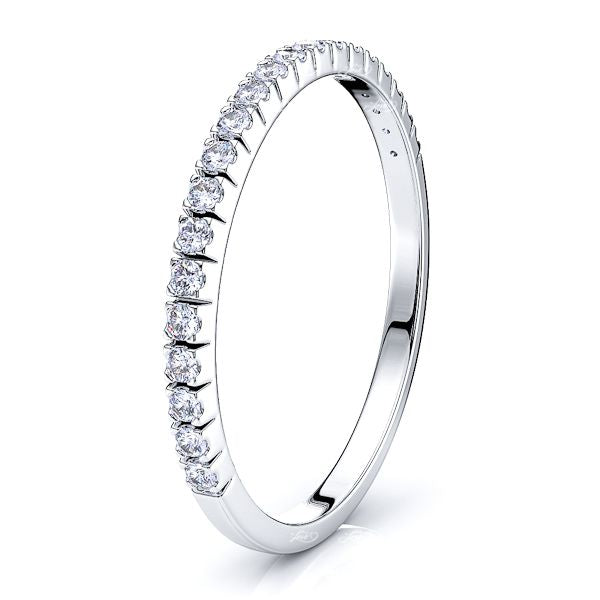
Pave (pronounced pah-VAY, French for "paved") sets a continuous field of small, closely placed diamonds so densely that very little metal shows between them — the effect is a band that looks "paved" in light. Because the diamonds are small and set low, pave bands are comfortable for daily wear and throw a remarkable amount of sparkle for their size, which is why they're one of the most requested unique wedding bands for women who want more shine without a bulky profile. Pave is also one of the most forgiving styles to stack: it reads as a delicate line of light rather than a competing centerpiece, so it pairs naturally with almost any engagement ring shape.
 Featured pickLorraine Pave Set Women Anniversary Wedding Band
From $1,057.00
Featured pickLorraine Pave Set Women Anniversary Wedding Band
From $1,057.00
The Lorraine Pave Set Women Anniversary Wedding Band above is a good example of the style at its most delicate — a fine, comfort-fit shank with a continuous row of pave diamonds that catches light from every angle without adding visual weight to the hand.
Channel-set bands
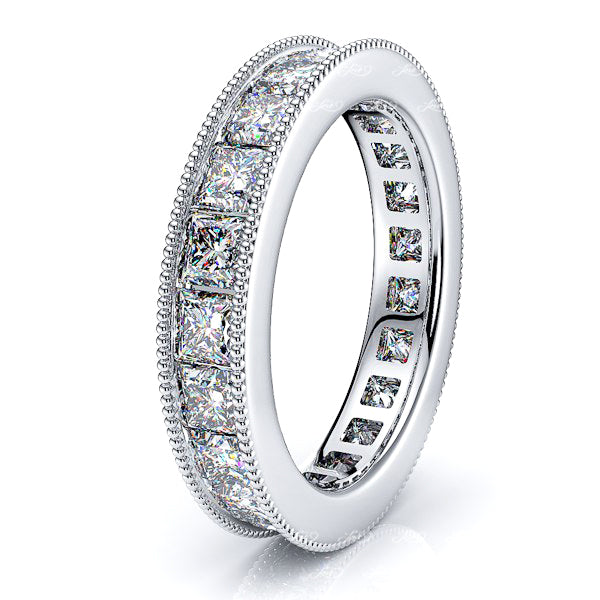
Channel-set bands hold diamonds between two parallel walls of metal, with no prongs exposed on the top of the ring. That construction has a real practical benefit: there's nothing for a sweater, a pocket, or a bar of soap to snag on, which makes channel-set styles a favorite for women with active hands or hands-on jobs. Visually, channel setting gives a clean, architectural line of diamonds — slightly more structured and geometric than the softer glow of pave — and it's especially popular in thinner band widths, since the channel protects the stones even when the metal around them is slim.
 Featured pickBrunhild Channel Set Wedding Women Eternity Band
From $2,309.00
Featured pickBrunhild Channel Set Wedding Women Eternity Band
From $2,309.00
The Brunhild Channel Set Wedding Women Eternity Band shown here demonstrates why the style works so well as a thin, everyday-durable option: the diamonds are fully protected within the channel, so the ring keeps its line and its sparkle through years of daily wear. See more of this family in our Women's Channel Set Wedding Bands collection.
Eternity and full-eternity bands
An eternity band sets diamonds all — or nearly all — the way around the ring, rather than only across the top. "Half eternity" bands set stones across the front half (the part that shows above the hand), while "full eternity" bands continue the diamonds all the way around the shank, so the sparkle is visible from every angle, even when your hand is closed around a coffee cup or a steering wheel. Full-eternity styles read as the most luxurious and symbolic of the style families — the unbroken circle of stones is often read as a literal symbol of everlasting commitment — but they do come with one practical trade-off worth knowing up front: a full-eternity band generally cannot be resized after the fact, because there's no plain metal left to stretch or compress, so accurate sizing matters more here than with any other style. We go deep on this trade-off, plus half- versus full-eternity comparisons, in our dedicated eternity bands guide.
 Featured pickFortuna Diamond Women Eternity Band
From $6,175.00
Featured pickFortuna Diamond Women Eternity Band
From $6,175.00
The Fortuna Diamond Women Eternity Band is a refined example of the style — diamonds set continuously around a comfort-fit shank for maximum sparkle from every angle. For those who want to go even bolder, the following full-eternity design increases both stone size and presence:
 Featured pickDemeter Diamond Women Eternity Wedding Band
From $5,654.00
Featured pickDemeter Diamond Women Eternity Wedding Band
From $5,654.00
The Demeter Diamond Women Eternity Wedding Band is a genuine statement piece — larger stones and a fuller profile for a bride who wants her wedding band to be as striking as her engagement ring. Browse the complete range in our Eternity collection or the broader Women's Diamond Wedding Rings collection.
Milgrain bands
Milgrain refers to a decorative edge of tiny beaded metal detail, traditionally applied along the border of a band or around a setting. It originated in Edwardian and Art Deco jewelry, and today it's the fastest way to give a simple band a vintage, hand-finished character. Milgrain can be added to a plain band, a pave band, or an eternity band alike — it's a finishing technique rather than a stone-setting style — so it's worth asking about even if you've already settled on one of the styles above and want to add a touch more texture and heritage detail to the edge.
Two-tone bands
A two-tone band combines two colors of gold — most often white and yellow, or white and rose — within a single ring, sometimes as a braided pattern, sometimes as a two-color pave edge, sometimes as a contrasting inner and outer rail. Two-tone is a smart solution for a bride who can't choose between metal colors, and it's also a popular way to visually bridge two different-colored rings: a two-tone wedding band can pick up both the white metal of a platinum engagement ring and the warmth of a yellow gold family heirloom, tying a mixed-metal stack together instead of leaving it looking mismatched.
Vintage and carved bands
Vintage-inspired and carved bands borrow detail from earlier eras — hand-engraved scrollwork, filigree, Celtic knotwork, floral motifs, or milgrain edging combined into a single ornate design. These styles are the most distinctive and personal of the group; no two carved bands read quite the same way, which is exactly the appeal for a bride who wants a band with real character rather than a straight line of diamonds. Because the detail is engraved or cast into the metal itself rather than set with stones, carved bands also tend to be lower-maintenance than heavily stoned styles. We cover this family in full, including how carved detail pairs with a plain versus diamond engagement ring, in our braided, Celtic, and carved wedding bands guide.
How to choose a style
With the style families in mind, three practical questions narrow the field fast: how you live day to day, what your engagement ring looks like, and what you want to spend. Answer those three honestly and you'll usually find that two or three styles rise to the top on their own, which makes the final decision — the one about which specific design you fall for — a much smaller and more enjoyable choice.
Match your lifestyle
If your hands are busy all day — gardening, cooking, working with tools, or wrangling small kids — lean toward channel-set or plain bands. The absence of exposed prongs means fewer snags and less risk of catching a stone on fabric or hard surfaces. If your daily life is lower-impact and you want maximum sparkle, pave and eternity styles are built for exactly that. Comfort matters too: a comfort-fit interior, which rounds the inside of the band so it slides more smoothly over the knuckle, is worth requesting on any style if you've never worn a ring for extended periods before, or if you plan to wear your wedding band every single day without taking it off.
Pair with your engagement ring
Your wedding band is going to sit against your engagement ring every day, so consider the pairing, not just the band in isolation. A solitaire engagement ring leaves room for a bolder wedding band — pave, eternity, or even a two-tone design — because there's no competing detail to clash with. A busier, halo, or vintage-style engagement ring often looks best with a slimmer, quieter wedding band, like a plain or thin channel-set style, so the two rings complement rather than compete. If you're building a matched set from scratch, or coordinating your band with a partner's, our unique matching wedding bands guide has more on getting the pairing right, and our his & hers vs. regular wedding bands guide explains when a coordinated set makes sense versus two independently chosen rings.
Set a budget
Price is driven mostly by diamond quantity and total carat weight, then by metal choice. A plain band is the most affordable starting point; pave and channel-set bands with modest total carat weight sit in the middle; full-eternity bands with larger stones sit at the top of the range. If you're working with a defined budget, our affordable wedding bands guide shows where to spend and where to save without sacrificing quality, and it's worth reading before you fall in love with a style that's outside your range — because a similar look is almost always achievable at a lower price point with a smaller total carat weight or a half- instead of full-eternity setting.
Metal options
Every style above can be made in your choice of metal, and the metal you choose affects both the look and the long-term care of your band. Platinum is the most durable and naturally hypoallergenic option, and it holds pave and channel-set diamonds especially securely, which is part of why it's the traditional choice for eternity bands. White gold delivers a similar bright, cool tone at a lower price point, though its rhodium plating benefits from a refresh every few years. Yellow and rose gold bring warmth and are increasingly popular for both plain and stone-set styles, and rose gold in particular has become a favorite for milgrain and vintage-inspired bands because the warm tone flatters antique detailing. If you're deciding between the two most common heirloom-quality options, our gold vs. platinum wedding bands guide compares durability, price, and maintenance in detail, and our best metal for wedding bands guide walks through every option side by side, including how metal choice interacts with skin sensitivity and daily wear.
One more practical note on metal and setting: the metal you choose can also affect how securely small pave and channel-set diamonds are held over time. Platinum's density makes it especially resistant to the gradual prong wear that can loosen very small stones after years of daily wear, which is one reason it's often recommended for pave and full-eternity styles specifically, even though gold remains a completely durable and popular choice for the same designs.
A note on width and sizing
Style isn't the only variable that changes how a band feels on the hand — width matters just as much. A thinner band (under 2mm) reads as delicate and stacks easily, while a wider band makes more of a statement and can showcase more diamond detail, particularly in eternity and channel-set styles. If you already know you're drawn to a slimmer profile, our thin and dainty wedding bands guide is the natural next read, and our general wedding band width guide breaks down how width interacts with hand size and stacking.
Sizing deserves extra care with several of the styles above. Full-eternity bands, because diamonds run the entire circumference, typically cannot be resized after purchase — so an accurate measurement matters more than with a plain or half-eternity band, which usually can be adjusted within a size or so. Comfort-fit interiors, discussed above, also tend to measure roughly half a size smaller than a standard-fit band in the same nominal size, so always confirm sizing against the specific style you're ordering rather than assuming your usual number applies universally. For a full breakdown of comfort-fit versus standard-fit construction, see our comfort-fit vs. standard-fit bands guide. And if you need to measure your size from home before you order, our step-by-step how to measure your ring size at home guide walks through every method, including a printable, size-converting chart.
Style comparison at a glance
Here's a quick side-by-side of the style families covered above, including who each one tends to suit best and roughly where it falls on price. Use it as a starting shortlist rather than a final answer — the exact price within each range still depends heavily on diamond quality, total carat weight, and metal choice, so treat the dollar signs as relative rather than absolute.
| Style | Best for | Typical price range |
|---|---|---|
| Plain / solid | Everyday wear, active hands, stacking with a bolder engagement ring | $ |
| Pave | Maximum sparkle in a delicate, low-profile band | $$ |
| Channel-set | Durable everyday sparkle with no exposed prongs | $$ |
| Milgrain | Vintage detail added to any of the styles above | $-$$ |
| Two-tone | Bridging two metal colors, mixed-metal stacks | $$ |
| Half eternity | Strong sparkle from the front with easier resizing | $$$ |
| Full eternity | Maximum sparkle from every angle, symbolic "unbroken circle" | $$$-$$$$ |
| Vintage / carved | Distinctive, heirloom character and personal detail | $$-$$$ |
Mistakes to avoid when choosing a style
- Choosing full eternity before confirming your size. Because a full-eternity band typically can't be resized, order this style only after you've measured carefully — ideally in person, at the end of a normal day.
- Picking a heavily set style for a hands-on job. If you work with your hands constantly, a channel-set or plain band will hold up far better day to day than exposed-prong pave, which is more delicate.
- Ignoring the engagement ring pairing. A wedding band chosen in isolation can look wrong once it sits beside your engagement ring. Try them on together before you decide.
- Assuming your usual ring size applies to every style. Comfort-fit bands, wider profiles, and eternity settings can all fit differently at the same nominal size — always confirm sizing against the specific style.
- Overlooking maintenance. Pave and channel-set styles benefit from an annual prong and setting check; our wedding band care guide covers cleaning and inspection by style and metal.
Frequently asked follow-up questions we hear at the counter
Beyond the core style decision, a few related questions come up again and again as brides narrow their choices. Can a wedding band be resized after the wedding if your finger changes size over the years? For plain, pave, and channel-set styles, generally yes, within a size or two. Does a wedding band need to match the engagement ring's metal exactly? Not necessarily — a tastefully chosen two-tone or contrasting metal can look intentional rather than mismatched, especially when a shared design detail like milgrain ties the two rings together. Should you buy your wedding band and engagement ring from the same jeweler? It isn't required, but it does make it easier to try the two rings on together before you commit, which is the single best way to confirm a pairing works in person rather than in a product photo.
Expert tip
If you're torn between two styles, think about how your hand actually moves through your day rather than only how the ring looks in a photo on the counter. A style you'd love in a still photograph — a wide full-eternity band, say — can feel different once you're typing, cooking, or shaking hands for a living. Our advice: try on your top two or three choices, go run errands or do a normal workday task with each on if the jeweler allows it, and pay attention to which one you forget you're wearing. That's usually the right answer. And if you love the sparkle of eternity but worry about the resizing trade-off, a half-eternity or channel-set band gives you most of the shine with more flexibility down the road.
Where to shop next
Now that you know the style families and how to choose between them, the best next step is to see them in person. Start with our complete Women's Wedding Bands collection, or narrow in on the style that caught your eye: the Eternity collection for full sparkle, Women's Channel Set Wedding Bands for a durable everyday line of diamonds, Women's Thin Wedding Bands for a delicate stacking profile, or Women's Anniversary Rings if you're shopping for a milestone rather than a wedding date. If you'd like a second opinion on custom detail — engraving, a bespoke milgrain edge, or a fully custom design — our custom wedding bands guide walks through the process from sketch to finished ring. Every band is handcrafted in New York with a lifetime warranty and 30-day returns, so exploring styles never means committing before you're ready.
Shop Wedding Band Collections
Explore our most-loved styles, from classic comfort-fit bands to modern two-tone designs.
Women's Wedding Bands
Every style, metal, and width in one place.
300+ Styles
Eternity Bands
Sparkle from every angle, half and full eternity.
Shop Eternity
Channel Set Bands
Protected diamonds, durable everyday sparkle.
Shop Channel Set
Thin & Dainty Bands
Delicate profiles that stack beautifully.
Shop Thin Bands

Anniversary Rings
Celebrate a milestone with a new diamond band.
Shop Anniversary
Bestselling His & Hers Sets
View all-
Petrona Pave Set Women Anniversary Wedding Band
$805.00From$603.75Sale -
Nephele Diamond Women Eternity Band
$1,467.00From$1,100.25Sale -
Valerie Diamond Women Anniversary Wedding Ring
$2,103.00From$1,577.25Sale -
Ambre Prong Set Women Anniversary Wedding Ring
$1,734.00From$1,300.50Sale


Talk to a Wedding Band Expert
Talk to a Wedding Band Expert
Have a question about sizing, metals, or engraving? Our specialists are happy to help — no pressure, just honest advice.
Send Us a Quick Question
Fill out the form below and one of our wedding band experts will get back to you within one business day.
Frequently Asked Questions
How do I make sure my wedding band size is right before I order?
Should I choose gold or platinum for my wedding band?
How do I clean and care for a diamond wedding band?
What if I want a thinner, more delicate wedding band?
What's the difference between half eternity and full eternity?
Does my wedding band need to match my partner's?
How much should I expect to spend on a women's wedding band?
Which wedding band style holds up best to daily wear?
Explore by Topic
Browse related guides, collections, and buying tips — organized to help you find exactly what you need next.