
Eternity Bands Guide: What They Are and Do Men Wear Them Too?
Shopping, not reading?
Skip ahead and browse the full wedding band collection.
What Is an Eternity Band, Really?
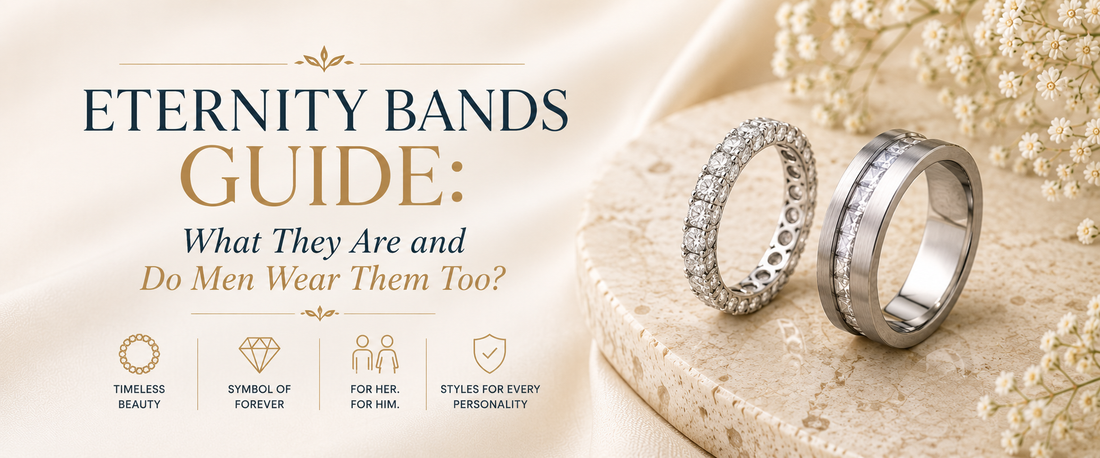
Walk into any jewelry counter and ask what makes an eternity band different from a regular diamond ring, and you'll often get a vague answer about "sparkle all the way around." That's true, but it's only half the story. An eternity band is defined by continuity — a ring where stones circle the entire band with no visible break, symbolizing a bond that has no beginning and no end. Understanding the construction, the setting styles, and the practical trade-offs behind that continuous line of stones will help you buy smarter, whether you're shopping for a wedding band, an anniversary gift, or — increasingly — a men's ring.
What is an eternity band? An eternity band is a ring set with stones, usually diamonds, that continue uninterrupted around the entire circumference of the band. Unlike a solitaire or a ring with a single focal stone, an eternity band has no "front" — it looks the same from every angle, which is exactly the point. The unbroken circle of stones is meant to represent everlasting love, making it a popular choice for wedding bands, anniversary rings, and stacking pieces.
Full Eternity vs. Half Eternity vs. Three-Quarter Eternity
Not every ring marketed as an "eternity band" is set the same way. The amount of the band covered in stones affects the look, the comfort, the price, and — importantly — how easily the ring can be resized later. Here's how the three main styles break down.
Full Eternity Bands
A full eternity band has stones set completely around the ring, including the portion that sits against your palm when your hand is closed. This gives you maximum sparkle from every angle and a ring that looks identical whether it's right-side up or spinning on your finger. The trade-off is practical: because there are stones the entire way around, a full eternity band is difficult or sometimes impossible to resize without disturbing the setting. It's the boldest, most symbolically "complete" version of the style, and it's a favorite for those who want a ring that reads as finished and continuous no matter how you look at it.
Half Eternity Bands
A half eternity band sets stones across roughly the top half of the ring — the portion visible when you're wearing it and looking down at your hand — while the bottom half (against the palm) remains plain metal. This is by far the most practical choice for everyday wear. You get nearly all of the visual impact of a full eternity band, but because the back half of the shank is bare metal, a jeweler can cut, stretch, or resize the ring far more easily. Comfort improves too, since the plain metal underside won't have prongs or stone edges pressing into your palm when you make a fist.
Three-Quarter Eternity Bands
Sitting between the two, a three-quarter eternity band extends the stone-set portion further around the shank than a half eternity style but stops short of a full circle, typically leaving a small plain-metal segment at the very back. This style is a compromise: more brilliance than a half eternity ring, but with slightly more resizing flexibility than a full eternity band. It's a smart middle ground for buyers who want a ring that looks continuous from nearly every viewing angle without fully sacrificing the ability to adjust the size down the road.
If you're comparing full eternity pieces side by side, the Eternity collection is the best starting point — every band in it is built around this continuous-stone philosophy, ranging from budget-friendly single-row designs to elaborate multi-gem statement rings.
The Symbolism and History Behind Eternity Bands
The idea of a ring with no beginning or end long predates modern jewelry catalogs. Circular rings themselves have symbolized eternity since ancient Egypt, where the circle represented a cycle with no starting or stopping point. The eternity band as we know it today — a continuous line of gemstones circling the band — became a recognizable wedding jewelry category in the 20th century, often given as an anniversary gift to mark a milestone year, most traditionally the tenth. A husband would present his wife with a diamond eternity band as a renewal of the wedding vow: unlike an engagement ring, which marks a promise, or a wedding band, which marks a commitment made on one day, an eternity ring is meant to say the commitment has continued, unbroken, ever since.
That symbolism is precisely why the unbroken circle of stones matters more than it might first appear. A ring with a single diamond, or even several diamonds clustered at the top, still has a "front" and a "back" — a visible focal point and a plain reverse. A true eternity band eliminates that distinction entirely. There's no side that's "more finished" than another, which is why the style is so often chosen specifically to represent a love that doesn't have a favored side, a beginning, or an end.
Who Traditionally Wears Eternity Bands?
Eternity bands show up in a few distinct roles, and understanding them helps clarify what you're actually shopping for.
As a wedding band: Many brides choose a diamond eternity band as their actual wedding ring, either worn alone or stacked with an engagement ring. The continuous sparkle pairs beautifully with a solitaire engagement ring, and because eternity bands are traditionally slimmer than statement rings, they sit flush against most engagement ring settings. Our Women's Wedding Bands collection includes both eternity styles and simpler designs if you're comparing options.
As an anniversary gift: This is the classic use case — a milestone anniversary marked with a ring that literally represents continuity. Because eternity bands are graduated in price by carat weight and stone count, they scale naturally with the significance of the anniversary being celebrated, from a modest half-eternity band for a fifth anniversary to a full eternity showpiece for a twenty-fifth.
As a stacking or fashion ring: Increasingly, eternity bands are bought simply as a wearable, versatile piece — stacked with other rings, worn on a different finger, or worn as a statement piece on their own, independent of any wedding milestone.
By men: This is the fastest-growing use case, and one that deserves its own detailed answer, because it's one of the most common questions we get asked in-store and online.
Do Men Wear Eternity Rings?
Yes — men absolutely wear eternity rings, and the category has grown significantly over the past several years. While the word "eternity band" still conjures an image of a thin, dainty women's ring in most people's minds, the underlying construction — stones set continuously or near-continuously around a band — has been adapted into styles that read as unmistakably masculine, and demand for them has climbed right alongside men's growing interest in diamond wedding jewelry generally.
The key to understanding men's eternity-style rings is the setting, not the concept. A traditional claw-prong full eternity band, with stones perched high above the shank, does look distinctly feminine — that silhouette isn't what men are buying. What men are buying, and what jewelers are increasingly designing, are channel-set and pavé diamond bands where the stones are set flush or nearly flush with the metal surface, creating a continuous line of brilliance without any raised, delicate-looking prongs. Channel setting in particular has become the dominant choice for men's diamond eternity-style bands, because the diamonds sit protected between two metal walls, flush with the top of the band — durable enough for a working hand, low-profile enough to wear daily without snagging on gloves, tools, or gym equipment, and still delivering that continuous, symbolic sparkle around the entire ring.
Why the growth? A few reasons converge. First, more men are choosing diamond-set wedding bands generally, moving away from the assumption that diamonds belong exclusively on women's rings. Second, the symbolism translates just as powerfully for men — an unbroken circle of stones representing a marriage with no beginning or end is not a gendered idea, and plenty of grooms specifically request it for that reason. Third, the practical setting styles that make eternity bands work for men — flush channel settings, low-profile pavé, sturdy bezels — happen to be some of the most durable diamond-setting methods available, which appeals to men shopping for a ring meant to survive decades of daily wear, manual work, and an active lifestyle.
If you're a man considering this style, or shopping for one, start with the Men's Diamond Wedding Bands collection, which is built specifically around these channel-set and pavé constructions — full diamond coverage, masculine profiles, and finishes designed for daily durability rather than delicate showcase wear. It's the single best place to see how the eternity concept has been reworked for men's hands and men's lifestyles without losing what makes the style meaningful.
Stone Setting Types — and How They Affect Durability and Resizing
The setting style used in an eternity band isn't just an aesthetic choice. It determines how secure the stones are, how the ring wears day to day, and — critically — whether the ring can be resized later without a full re-set. Here are the four settings you'll encounter most often.
Prong Setting
Small metal claws (usually four per stone, sometimes shared between adjacent stones) hold each diamond in place, allowing maximum light to enter from the sides and creating the most brilliance of any setting style. Prongs sit slightly above the band, which means they can snag on fabric or hair and are the most vulnerable setting to catching an edge on a hard surface. They also wear down over years of friction and need periodic inspection and re-tipping. Prong-set eternity bands are generally the most difficult of all to resize, since stretching or cutting the shank puts direct stress on the claws holding each stone.
Channel Setting
Diamonds are set into a groove between two parallel walls of metal, with no prongs at all. The stones sit flush or nearly flush with the surface of the band, protecting the girdle of each diamond from everyday knocks. This is the most popular setting for men's eternity-style bands specifically because of its durability and low profile, and it's a strong choice for anyone with an active or hands-on lifestyle. Channel-set rings are moderately resizable in small increments, but because the channel is a continuous structural element, larger resizes still typically require a jeweler experienced with eternity construction.
Bezel Setting
Each stone is encircled by a thin rim of metal that holds it fully in place, protecting the entire edge of the diamond rather than just the girdle. Bezel settings are the most protective and durable option on this list, essentially eliminating the risk of a stone catching or chipping, though they slightly reduce brilliance since less light enters from the sides compared to a prong setting. Bezel-set eternity bands are among the more resizable options since the smooth metal rims flex more predictably than prongs during a resize.
Shared-Prong Setting
A hybrid approach where adjacent stones share a single prong between them rather than each stone getting its own full set of claws. This reduces the amount of visible metal, increasing brilliance and creating a nearly seamless line of diamonds, while using fewer prongs overall than a fully individual prong setting. It's a popular middle ground for full eternity bands that want maximum sparkle without excessive metal. Resizing is moderately difficult, similar to standard prong settings, since shared prongs are still structural.
Durability and Resizing: What Buyers Need to Know Before Ordering
This is the section that gets skipped by a lot of buying guides, and it's the one that causes the most frustration after the fact. Eternity bands, because stones run the full or near-full circumference, are fundamentally harder to resize than a plain metal band. With a plain wedding band, a jeweler simply cuts the shank, adds or removes a small section of metal, and re-solders it — a routine job. With an eternity band, that same cut has to happen somewhere along a line of set stones, which means the setting itself has to be disturbed, stones may need to be temporarily removed, and in some cases the ring has to be re-set entirely rather than simply resized.
This is exactly why setting style and eternity type matter so much before you buy, not after:
- Full eternity bands are the hardest to resize — there's no plain metal anywhere on the shank to work with, so any size change involves the stone-set portion directly.
- Half and three-quarter eternity bands are considerably easier, since the plain metal section at the back of the ring gives a jeweler room to resize without touching a single stone, in many cases.
- Channel and bezel settings tend to handle small resizes better than prong or shared-prong settings, because their structure is more forgiving of the slight stretching or compression involved in a resize.
Our practical advice: if you expect your ring size to change (weight fluctuation, pregnancy, or simply buying ahead of a wedding date), lean toward a half eternity or three-quarter eternity style in a channel or bezel setting. If you're confident in your size and want maximum symbolic and visual impact, a full eternity band is a beautiful choice — just budget for the possibility that a future resize may mean a partial re-set rather than a simple adjustment. For a full walkthrough of getting sized correctly the first time, our ring sizing guide is worth reading before you order any eternity-style ring.
What Affects the Cost of an Eternity Band?
Eternity bands span an unusually wide price range compared to other ring styles, and the reason comes down to one thing: total carat weight adds up fast when stones cover the entire band instead of just a focal point.
- Total carat weight: A solitaire ring has one stone to price. An eternity band might have anywhere from a dozen to several dozen individual stones, and the combined carat weight — not any single stone's size — drives the bulk of the cost.
- Band width: A wider band fits larger stones or an extra row of smaller ones, both of which increase total carat weight and therefore price.
- Setting style: Prong settings generally show the most brilliance per carat but use more labor to set each stone individually. Channel settings can be more efficient to produce at scale, which sometimes makes them a better value for a given look.
- Eternity type: A half eternity band uses roughly half the stones of a full eternity band in the same style, which meaningfully lowers cost while preserving most of the visible sparkle — one of the best budget levers available if you love the look but not the full-eternity price tag.
- Metal choice: Platinum costs more than gold by weight and typically costs more to set stones into due to the metal's density, while 14K and 10K gold offer a lower-cost, still-durable alternative. Our gold vs. platinum guide breaks down how metal choice affects both price and how securely prongs hold diamonds over time.
- Stone quality: Clarity and color grades matter more per stone in a solitaire, but across dozens of stones in an eternity band, even a modest grade difference multiplies quickly across the total piece.
If budget is the primary constraint, the
 Featured pickEnid Diamond Women Eternity Band
From $1,031.00
Featured pickEnid Diamond Women Eternity Band
From $1,031.00
$1,690.00
Shop now is one of the most accessible entry points into true eternity styling, while the
 Featured pickIndira Diamond Women Eternity Ring
From $1,549.00
Featured pickIndira Diamond Women Eternity Ring
From $1,549.00
$2,386.00
Shop now offers a step up in stone presence without moving into statement-piece territory. For buyers who want the classic full eternity look at a reasonable price point, the
 Featured pickIrene Women Eternity Diamond Ring
From $1,257.00
Featured pickIrene Women Eternity Diamond Ring
From $1,257.00
$2,005.00
Shop now is a well-balanced choice, and for those who want their eternity band to be the standout piece of their stack, the
 Featured pickNeith Diamond Women Eternity Ring
From $2,570.00
Featured pickNeith Diamond Women Eternity Ring
From $2,570.00
$4,147.00
Shop now is a multi-gem design built to make a statement. For more general budgeting strategy across wedding jewelry, see our budget wedding bands guide.
Setting Type Comparison Table
| Setting Type | Durability | Relative Price | Resizability | Best For |
|---|---|---|---|---|
| Prong | Moderate — prongs can catch or wear down over time | Moderate to high | Difficult | Maximum brilliance, classic full eternity look |
| Channel | High — stones protected flush within metal walls | Moderate | Moderate | Everyday durability, men's diamond bands, active lifestyles |
| Bezel | Highest — full metal rim shields each stone | Moderate to high | Moderate to good | Maximum protection, hands-on work, long-term wear |
| Shared-Prong | Moderate — fewer prongs than standard, still raised | Moderate | Difficult | Seamless sparkle with less visible metal |
Caring for an Eternity Band
Because stones run the full circumference of an eternity band, there's more total surface area exposed to lotion, soap residue, and daily grime than on a ring with a single stone — which means eternity bands benefit from slightly more frequent cleaning to keep every facet catching light. Gentle warm water, mild soap, and a soft brush around each setting will keep the ring looking its best, and prong-set pieces in particular should be checked periodically by a jeweler to make sure no claws have loosened. Our full ring care guide covers cleaning schedules and at-home methods safe for both diamonds and the metals commonly used in eternity settings.
Expert Tip
Before you buy, ask specifically what setting style is used and whether the band is full, half, or three-quarter eternity — sellers don't always volunteer this distinction, and it's the single biggest factor in how the ring will wear and whether it can be resized later. If you're set on the full-circle look but worried about future sizing, ask about a "hidden gallery" or slightly under-sized initial order with room to grow, and confirm with your jeweler whether the specific setting on your ring supports a partial resize before you commit.
Related Buying Guides
Eternity bands are just one piece of a much bigger decision. If you're comparing this style against other wedding band options, these guides cover the adjacent decisions worth making before you order: how to choose a metal that suits your prong or channel setting long-term, how to budget across a full wedding jewelry purchase, and how to make sure your sizing is right from the start so resizing concerns become a non-issue. See our matching bands for couples guide if you and your partner are choosing complementary styles together, and our women's wedding bands styles guide for a broader look at how eternity fits among other popular silhouettes.
Shop Eternity and Men's Diamond Bands
Whether you're a bride choosing a wedding band, marking a milestone anniversary, or a man exploring channel-set diamond styles for the first time, the right eternity band comes down to matching the setting and coverage style to how you'll actually wear it every day. Browse the full Eternity collection for classic full and half eternity styles, or head to Men's Diamond Wedding Bands for channel-set and pavé designs built specifically for men. If you want a channel-set look with a slightly different silhouette, our Women's Channel Set Wedding Bands collection is another strong comparison point for durability-focused shoppers.
Every band on LoveWeddingBands.com is available with certified diamonds and expert guidance from our jewelers — reach out any time you want a second opinion on setting style, sizing, or which eternity coverage best fits your lifestyle and budget.
Bestselling His & Hers Sets
View all-
Fortuna Diamond Women Eternity Band
$8,239.00From$6,179.25Sale -
Brunhild Channel Set Wedding Women Eternity Band
$2,365.00From$1,773.75Sale -
Demeter Diamond Women Eternity Wedding Band
$7,242.00From$5,431.50Sale -
Ariadne Diamond Women Eternity Wedding Band
$3,529.00From$2,646.75Sale


Talk to a Wedding Band Expert
Talk to a Wedding Band Expert
Have a question about sizing, metals, or engraving? Our specialists are happy to help — no pressure, just honest advice.
Send Us a Quick Question
Fill out the form below and one of our wedding band experts will get back to you within one business day.
Frequently Asked Questions
What is an eternity band?
What's the difference between full, half, and three-quarter eternity bands?
Do men wear eternity rings?
Which setting type is most durable for an eternity band?
How do I clean and care for an eternity band?
How much does an eternity band cost?
Can I wear an eternity band as my only wedding ring?
What metal is best for an eternity band?
Explore by Topic
Browse related guides, collections, and buying tips — organized to help you find exactly what you need next.