
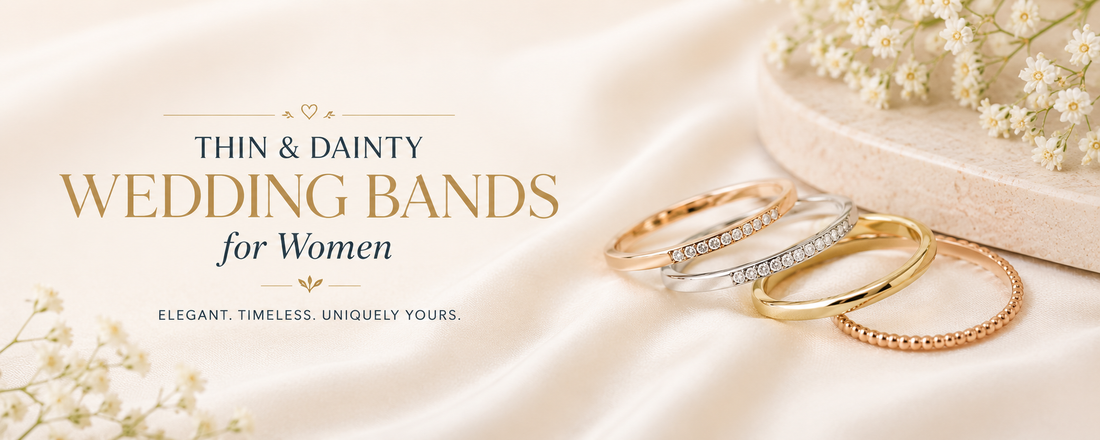
Thin & Dainty Wedding Bands for Women
Shopping, not reading?
Skip ahead and browse the full wedding band collection.
There's a reason the thinnest ring in the display case is often the one that sells out first. Thin and dainty wedding bands have become the default choice for brides who want a ring that stacks, layers, and disappears into everyday life rather than competing with it. If you've spent any time browsing engagement ring boards or scrolling wedding inspiration, you've seen the look: a slim, glittering band sitting flush against a solitaire, sometimes joined by two or three more just as slender. This guide breaks down exactly what "thin" means in millimeters, which widths and styles hold up to daily wear, how to pair a thin band with your engagement ring, and how to size a ring that has almost no room for error.
We work with brides at every stage of this decision. Some already know they want a 2mm pave band and just need help picking a metal; others are starting from scratch and aren't sure whether a delicate profile will even suit their engagement ring. Both situations come down to the same handful of questions: how narrow is too narrow, which style holds up best to daily wear, and how does a delicate ring survive decades on someone's hand. We answer all three below, using the same guidance our bench jewelers give shoppers in person.
What counts as a thin wedding band? In fine jewelry, a "thin" or "dainty" wedding band generally measures between 1.5mm and 3mm in width, compared to a standard band's 4mm-6mm. Anything under 2mm is considered ultra-thin. These narrow profiles are designed to stack, layer beside an engagement ring, or stand alone as a minimalist statement.
Why Thin Wedding Bands Have Become So Popular
A decade ago, most women's wedding bands were built to match the width of the engagement ring's shank, usually somewhere between 2.5mm and 4mm. Today, the trend has moved sharply toward narrower profiles, and it isn't just an aesthetic fad. There are three practical reasons thin bands keep climbing in popularity.
Stacking culture. The rise of ring stacking, meaning wearing an engagement ring alongside multiple wedding and anniversary bands, has changed what a "wedding ring" even means. A single thick band leaves little room for a stack. A thin 2mm or 2.5mm band, on the other hand, can sit beside an engagement ring and a slim anniversary band without the whole hand looking bulky. Many of our customers now buy a thin band specifically because they plan to add a second or third ring down the road.
Minimalism. Bridal style overall has shifted toward quieter, more refined silhouettes: smaller halos, thinner shanks, less ornamentation. A dainty wedding band fits that aesthetic. It reads as understated and elegant rather than heavy or ornate, which appeals to brides who want their ring to feel like jewelry they'd wear regardless of the occasion, not a piece reserved for "special" days.
Comfort. A thinner band is lighter and lower-profile, so it doesn't catch on gloves, clothing, or keyboards the way a wide, high-set band can. For women who work with their hands, nurses, chefs, teachers, anyone who types all day, a slim band is simply easier to forget you're wearing, in the best way.
There is also a budget angle worth mentioning upfront. A thinner band uses less precious metal, and in stone-set styles it typically carries a smaller total carat weight along its length, which often makes it more affordable than a wide band of comparable quality. That's not the primary reason most brides choose thin, but it's a welcome side benefit for anyone balancing a wedding ring budget against everything else a wedding costs.
The trade-off, which we'll cover honestly later in this guide, is durability. A thinner band has less metal to absorb daily impact, so metal choice matters more than it does with a standard-width ring.
Width Breakdown: What 1.5mm, 2mm, 2.5mm, and 3mm Actually Look Like
Millimeters are hard to picture on a screen, so here's what each width feels and looks like on the hand, based on what our jewelers see across thousands of fittings.
1.5mm — The Ultra-Thin Statement
At 1.5mm, a band is barely wider than a strand of thread. It's the thinnest width we recommend for a full eternity or pave band, and it's almost always worn as a stacking piece rather than a solo ring. On the hand, a 1.5mm band nearly vanishes visually; it reads as a line of light rather than a ring. It pairs beautifully with a delicate solitaire engagement ring but is not a good choice as a woman's only ring if she's hard on her hands, since there's very little metal to resist bending.
How it wears: because a 1.5mm band has so little surface area against the finger, any stones set into it sit very close to the finger's side, so they're more exposed to knocks than the same stones would be on a 2.5mm or 3mm band. We generally suggest this width for a second or third stacking ring rather than a primary band worn alone every day.
2mm — The Most Popular Thin Width
2mm is the sweet spot for most brides shopping "thin." It's slim enough to feel dainty and to stack cleanly, but it still has enough metal mass to be set with a continuous line of pave diamonds or worn comfortably as a standalone band. Most of the styles we'd point a first-time thin-band shopper toward, including the
 Featured pickCandelas Diamond Women Anniversary Wedding Ring
From $790.00
Featured pickCandelas Diamond Women Anniversary Wedding Ring
From $790.00
$1,456.00
Shop now at 2.00mm, sit right at this width.
How it wears: 2mm is narrow enough to look dainty in every photo but wide enough that a well-made pave setting holds its stones securely for years of normal wear. It's the width we'd recommend if you only want to buy one thin band and want it to work equally well solo or in a future stack.
2.5mm — The Everyday-Durable Thin Option
2.5mm is where "thin" starts to overlap with "practical." It's still narrower than a standard band but has meaningfully more metal than a 1.5mm or 2mm profile, which makes it a smarter choice for a bride who wants the dainty look but wears her ring every single day without taking it off for physical work. If you're torn between looking delicate and wanting a ring that won't need repair within a year, 2.5mm is often the answer.
How it wears: the added half-millimeter over a 2mm band makes a bigger practical difference than it sounds. Prongs sit deeper and the band as a whole resists bending noticeably better, which typically means fewer trips back to the jeweler for prong or shank repair over a lifetime of wear.
3mm — The Upper Edge of "Thin"
3mm sits right at the boundary between thin and standard. It's the widest we'd still call a dainty band, and it's a good landing spot for brides who love the slim aesthetic but have an active lifestyle, larger hands, or simply want a band that reads as more substantial next to a larger center stone. Channel-set styles, like the
 Featured pickJehane Channel Set Women Anniversary Wedding Band
From $1,560.00
Featured pickJehane Channel Set Women Anniversary Wedding Band
From $1,560.00
$1,805.00
Shop now, often use this slightly wider profile because the channel setting needs a bit more metal on either side of the stones to stay secure.
How it wears: of the four widths in this guide, 3mm holds up best to daily impact and tends to need resizing or repair less often, since there's enough metal in the shank to absorb minor bumps without deforming. If you love the thin aesthetic but have previously bent or warped a narrower ring, 3mm is worth a look before you rule out thin bands altogether.
Common Questions Shoppers Ask Before Buying Thin
Beyond width and style, a handful of practical concerns come up again and again with dainty bands. Will it look too plain on its own? Will it get lost next to a bigger engagement ring? Will it hold up if I never take it off? The honest answer to all three is that it depends far more on metal and construction quality than on width alone. A well-made 2mm band in platinum or 14K gold, with properly set stones and a sound shank, will outlast a poorly made 4mm band in a softer alloy. Width determines the look; metal and craftsmanship determine the lifespan.
It's also worth asking your jeweler how a band is constructed, not just how it looks in a photo. Cast bands, milled bands, and hand-fabricated bands can all look identical on a product page but wear very differently over a decade of daily use, and this distinction matters more as the band gets thinner and the margin for error shrinks.
Style Options Within Thin Bands
"Thin" describes the width, not the design, and there's more variety within narrow bands than most shoppers expect. Here are the four styles we sell most often in the 1.5mm-3mm range.
Plain (Polished) Bands
A plain thin band, with no stones at all, is the most understated option and the most durable of the four styles, since there's no setting to snag or wear down. It's a popular choice as a "true" wedding band that sits closest to the finger, with pave or eternity bands layered on top or below it. Affordable, timeless, and low-maintenance, a plain thin band is also the easiest of the four styles to resize later if your finger changes size.
Pave-Set Bands
Pave setting places small diamonds close together across the top of the band, held by tiny shared prongs, so the metal seems to disappear under a continuous sparkle. This is the most popular thin-band style we sell, and for good reason: it delivers a lot of visual impact from a very narrow profile. The
 Featured pickPaola Pave Set Women Anniversary Wedding Band
From $939.00
Featured pickPaola Pave Set Women Anniversary Wedding Band
From $939.00
$1,163.00
Shop now is a good example at just 1.90mm wide, and the
 Featured pickJimena Diamond Women Anniversary Wedding Band
From $610.00
Featured pickJimena Diamond Women Anniversary Wedding Band
From $610.00
$775.00
Shop now offers a more affordable pave option for brides working within a tighter budget.
Channel-Set Bands
Channel setting locks diamonds between two parallel rails of metal instead of exposed prongs. Because the stones are protected on both sides, channel-set bands are the most snag-resistant and durable stone-set style available in a thin profile, a meaningful advantage for anyone who wears gloves, works with their hands, or simply wants fewer trips back to the jeweler. Browse our Women's Channel Set Wedding Bands collection to see the full range, including the
Featured pickJehane Channel Set Women Anniversary Wedding Band
From $1,560.00
$1,805.00
Shop now mentioned above.
Milgrain Bands
Milgrain is a decorative technique where a jeweler presses a tiny beaded texture along the edge of the metal, giving the band a soft, antique-inspired outline. On a thin band, milgrain adds visual interest without adding width or bulk, which makes it a favorite for brides who want a vintage feel but still want the ring to stack cleanly with modern pieces. Because the beading sits on the very edge of an already-narrow band, it's worth asking your jeweler how deep the detail is cut so it holds up over decades of wear rather than polishing away too quickly.
Durability & Metal Choice for Thin Bands
This is the part of the thin-band conversation that doesn't get talked about enough: width and metal choice determine how a ring survives ten, twenty, or fifty years of daily wear, and thin bands have far less margin for error than standard ones.
A band's resistance to bending, warping, and wear comes down to how much metal is actually there and how hard that metal is. At 4mm-6mm, a band has enough bulk that even a moderately soft alloy will resist bending under normal use. At 1.5mm-2.5mm, there simply isn't as much metal to absorb an impact; a bump against a doorframe or a dropped weight can put a visible kink in a thin band made from a soft alloy far more easily than it would in a wider one.
That's why metal choice matters more with thin bands than with any other style. Platinum and 14K white, yellow, or rose gold are the strongest realistic choices for a 1.5mm-3mm band. Platinum in particular is dense and naturally resists deformation, which is why so many of our finest pave and channel-set thin bands are set in it. 14K gold is the workhorse choice: durable enough for daily wear, less expensive than platinum, and available in every color. We'd steer most brides away from very soft or unusually high-karat alloys in a thin profile specifically because they're more prone to bending out of round over time.
Our full gold vs. platinum guide goes deeper into cost, weight, and maintenance differences if you're deciding between the two. And once your thin band is on your hand, a little routine maintenance goes a long way; our ring care guide covers cleaning and inspection habits that catch a bent prong or worn setting before it becomes a lost stone.
Pairing a Thin Band With Your Engagement Ring
The most common question we get about dainty bands is whether they'll "look right" next to an engagement ring, especially a larger or more elaborate one. In practice, thin bands pair with almost any engagement ring style; the key is thinking about proportion and shape rather than trying to match width exactly.
For a solitaire or thin-shank engagement ring, a thin wedding band is a natural match. The two rings read as a cohesive, low-profile pair rather than fighting for attention. For a larger halo or a wider engagement ring shank, a thin band actually works in the ring's favor: it lets the engagement ring stay the visual centerpiece while still completing the "wedding set" look, and it leaves room to add a second stacking band later without the hand feeling crowded.
Curved or contoured thin bands are worth a look if your engagement ring has a low-set stone or a distinctive silhouette. A slightly curved band nests against the engagement ring instead of leaving a gap, so the two sit flush against each other on the finger. If you're still deciding on an overall band style before narrowing in on width, our Women's Wedding Bands: Styles & How to Choose guide is a good starting point, and if width itself is where you're stuck, the Wedding Band Width Guide covers proportion and hand-size considerations across every width, not just thin ones.
Sizing and Resizing Notes for Thin Bands
Sizing a thin band is a slightly more precise process than sizing a standard one, and it's worth understanding why before you order. A ring's finger-size measurement changes very slightly depending on band width; wider bands generally need to be sized a touch larger than thin ones to feel equally comfortable, because more metal surface contacts the finger. If you already own a wider ring in your correct size, don't assume a thin band in the same "size" will feel identical. Have it measured against your actual finger rather than another ring whenever possible.
Resizing is also more delicate on thin bands, particularly pave and channel-set styles. Because there's less metal to work with, a jeweler has a narrower margin when cutting and re-soldering the shank, and resizing a heavily pave-set band by more than half a size or two can be difficult without disturbing stones near the cut point. If there's a real chance your size will change, during pregnancy, significant weight fluctuation, or if you're between sizes, it's worth discussing with your jeweler before purchase rather than after.
Our ring sizing guide walks through how to measure at home and what to expect from the resizing process, including size limits for stone-set bands specifically.
Width, Best-For, and Price at a Glance
| Width | Best For | Typical Price Range |
|---|---|---|
| 1.5mm | Stacking with 2+ other rings; ultra-delicate look; light everyday wear | $400 - $800 |
| 2mm | Most popular all-purpose thin band; pairs with most engagement rings | $550 - $1,100 |
| 2.5mm | Daily wear without removing the ring; active hands; still reads as slim | $700 - $1,300 |
| 3mm | Channel-set styles; larger hands; brides who want "thin" but substantial | $900 - $1,500+ |
Prices vary with metal, diamond quality, and total carat weight; the ranges above reflect the styles we carry most often at each width, from a simple polished band to a fully pave-set piece like the
Featured pickCandelas Diamond Women Anniversary Wedding Ring
From $790.00
$1,456.00
Shop now.
An Expert Tip From Our Jewelers
If you're on the fence between two widths, our bench jewelers almost always recommend sizing up in width rather than down, especially for a bride's primary wedding band. A 2.5mm band still reads as thin and dainty in photos and in person, but it holds a prong tighter, resists bending better, and generally needs fewer repairs over a lifetime than a 1.5mm or 2mm equivalent. Save the ultra-thin 1.5mm-2mm widths for the second or third ring in a stack, where it's flanked and protected by the bands around it, rather than for the one ring you'll wear alone every day for decades.
One more habit worth building: have your thin band professionally checked once a year, the same way you'd get a car serviced. A quick inspection catches a loosening stone or a slightly thinning shank long before it becomes a lost diamond or a bent ring, and it typically costs far less than the repair it prevents.
Related Collections and Guides
Ready to see thin bands in person? Shop our Women's Thin Wedding Bands collection for the full range of 1.5mm-3mm styles, or narrow in on the Women's Channel Set Wedding Bands collection if durability is a top priority. For a broader look at every women's band style, width, and metal we carry, visit the Women's Wedding Bands hub, or explore the Women's Anniversary Rings collection if you're shopping for a second thin band to add to an existing stack.
If budget is part of the equation, our budget wedding bands guide breaks down how to get the look you want without overspending, and our Eternity Bands Guide is worth a read if you're considering a full eternity style rather than a half-set pave band. If comfort on the finger matters as much as width, our comfort-fit vs. standard-fit bands guide explains how interior shaping changes the way a thin band feels over a full day of wear.
Find Your Thin Wedding Band
Thin and dainty wedding bands aren't a passing trend; they're a genuinely practical answer to how women actually wear jewelry today: stacked, layered, and worn every day without a second thought. Whether you land on a 1.5mm stacking piece or a 3mm channel-set band built for daily wear, the right width comes down to how you'll wear it, what you'll pair it with, and how much day-to-day durability matters to you. Our jewelers are happy to talk through width, metal, and stacking questions before you order. Shop our Women's Thin Wedding Bands collection to get started, or reach out to our team for a personal recommendation.
Bestselling His & Hers Sets
View all


Talk to a Wedding Band Expert
Talk to a Wedding Band Expert
Have a question about sizing, metals, or engraving? Our specialists are happy to help — no pressure, just honest advice.
Send Us a Quick Question
Fill out the form below and one of our wedding band experts will get back to you within one business day.
Frequently Asked Questions
What width counts as a thin or dainty wedding band?
How do I make sure a thin wedding band fits correctly?
Are thin wedding bands durable enough to wear every day?
What's the difference between pave and channel-set thin bands?
How do I care for a thin, delicate wedding band?
How much does a thin wedding band typically cost?
Should I choose comfort-fit or standard-fit for a thin band?
Can I get a thin eternity band, or is eternity always wider?
Explore by Topic
Browse related guides, collections, and buying tips — organized to help you find exactly what you need next.