
Wedding Band Width Guide: What Every Millimeter Looks Like On Your Hand
Shopping, not reading?
Skip ahead and browse the full wedding band collection.
Stand at any jewelry counter long enough and you will hear the same hesitation from almost every customer: "I don't know if I want something thin or something with a little more presence." That hesitation is really a question about width — and width, more than metal, more than finish, more than setting, is the single measurement that determines how a wedding band actually reads on a hand. Two rings in the same 14K yellow gold, the same comfort-fit dome, the same polished finish, can look like entirely different pieces of jewelry if one is 2mm and the other is 8mm.
Width is also the measurement people search for obsessively and still feel unsure about after reading the answer. "What does a 10mm ring look like on my hand?" "Is 1.8mm too thin?" "What's a normal width for a men's wedding band?" These are not vanity questions. Width affects how a ring feels after ten hours of wearing it, how it looks stacked against an engagement ring, how it holds up to forty years of daily wear, and — very directly — how much the ring costs, because width is really a proxy for how much metal you are buying. This guide walks through every common width from 1.5mm up to 10mm and beyond, in plain, visual language, so you can picture the ring before it ever arrives at your door.
What width wedding band should I get?
Most women choose a band between 1.5mm and 4mm, and most men choose a band between 6mm and 8mm, but there is no universal rule. The right width depends on your finger size, how the band will be worn (alone, stacked, or paired with an engagement ring), your comfort preference, and your budget, since wider bands use more metal and cost more. Try on a range of widths in person before deciding — the difference between 5mm and 7mm is more noticeable on the hand than most people expect.
Why band width matters more than you'd think
It's tempting to treat width as a minor style detail, something you pick almost as an afterthought once you've settled on metal color and finish. In practice, width is doing more structural work than any other single spec on the ring.
Comfort and how the ring wears over time
A wider band contacts more skin, which means more surface area for friction, more material to feel when you make a fist, and more real estate for a comfort-fit interior curve to actually do its job. Thin bands under 3mm rarely feel like they're "there" at all once you're used to them — many wearers report almost forgetting they have a ring on. Bands at 7mm and above have a presence you feel with every handshake, every glove, every time you slide a hand into a pocket. Neither is right or wrong; it's a question of what you want to feel throughout the day.
Visibility and how the ring reads from across a room
Width is the main driver of how visually "loud" or "quiet" a ring is. A 1.5mm band on a hand is genuinely easy to miss in a photo. An 8mm or 9mm band announces itself even in a dimly lit room. If you want your wedding band to visually anchor your hand — especially if you're not pairing it with a large engagement ring or a lot of other jewelry — width, not stone size, is usually the more efficient lever to pull.
Cost: width is a metal-quantity decision
Every wedding band is priced largely by the weight of precious metal used to make it, and weight scales directly with width (and, to a lesser extent, with band thickness/depth). A 6mm band in 14K gold can easily use 40-60% more metal than the same design at 4mm. This is the single most common reason a "simple plain band" quote comes back higher than a shopper expects — they mentally priced the ring by its lack of stones, not by its width. If budget is a firm constraint, narrowing your width by even 1-2mm is one of the most effective ways to bring the price down without changing metal type. Our budget wedding bands guide walks through more cost-saving levers like this one.
Proportion: matching width to your hand
Width also interacts with hand and finger size. A band that looks substantial on a size 6 finger can look almost delicate on a size 13 finger, and vice versa. We'll cover proportion tips in more detail below, but the short version: wider hands and longer fingers can visually "absorb" more width before a band starts to look oversized, while narrower fingers show width more dramatically per millimeter.
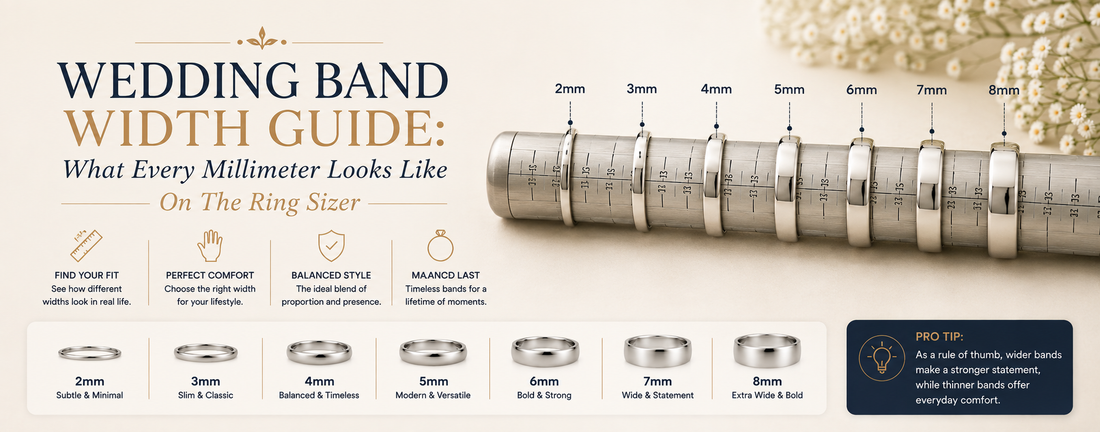
Wedding band width chart: mm-by-mm breakdown
Use this chart as a fast reference, then read the full descriptions below it for a real sense of how each width looks and feels on an actual hand.
| Width | Look & feel | Typical wearer | Price impact |
|---|---|---|---|
| 1.5mm | Delicate, thread-like, almost invisible alone | Women wanting a minimalist stacking band | Lowest metal cost |
| 2mm | Thin and refined, classic "dainty" band | Women, especially paired with a solitaire | Low |
| 3mm | Noticeable but still slim, versatile | Women wanting more presence; slim men's option | Low-moderate |
| 4mm | Balanced, a true "medium," reads as a real ring | Women wanting a statement band; slender men's band | Moderate |
| 5mm | Solid and grounded without being bulky | Men wanting understated width; bold women's choice | Moderate |
| 6mm | The classic men's default, confident but not flashy | Most men | Moderate-high |
| 7mm | Substantial, fills the hand visibly | Men with average-to-large hands wanting presence | High |
| 8mm | Bold, unmistakably a statement ring | Men who want their band to be a focal point | High |
| 9mm | Wide and architectural, dominates the finger | Larger hands, men wanting maximum presence | Very high |
| 10mm+ | Dramatic, near the practical upper limit for comfort | Large hands, bold personal style, statement pieces | Highest |
What every millimeter actually looks like on your hand
1.5mm — the whisper-thin band
At 1.5mm, a wedding band is closer to a fine chain than a traditional ring. On the hand, it reads as a thin line of metal, easy to layer under or stack against an engagement ring without adding visual bulk. It's the width jewelers reach for when someone says "I don't really wear rings, but I want something for my wedding day." Because it uses so little metal, 1.5mm is also one of the most affordable width options across every metal type. The tradeoff: on a larger finger, 1.5mm can look almost too subtle, and it will show its metal type (softness of gold, for example) more slowly than a thicker band because it has less material to begin with. If you're wondering whether 1.5-1.8mm is "too thin," it isn't — it's simply a deliberate minimalist choice, not a mistake. It looks especially at home in a stack, which is exactly the territory we cover in our thin & dainty wedding bands guide.
2mm — thin and classic
2mm is arguably the most popular width for a delicate women's wedding band. It's thick enough to feel substantial and secure on the finger, but still slim enough to sit flush against most engagement ring settings without competing for attention. On the hand, a 2mm band photographs cleanly — visible, but never bulky — which is part of why it's such a common choice for brides who want their engagement ring to remain the star. The
 Featured pickJimena Diamond Women Anniversary Wedding Band
From $610.00
Featured pickJimena Diamond Women Anniversary Wedding Band
From $610.00
$775.00
Shop now is a great example of this width done well: a refined ~2mm profile with diamond detailing that adds sparkle without adding visual weight.
3mm — versatile and quietly confident
3mm is the width where a band stops reading as "thin" and starts reading as a proper ring in its own right, while still staying comfortable for daily wear. For women, it's a popular step up from a 2mm band when someone wants a bit more visual weight, especially worn alone. For men who prefer a slimmer profile than the traditional 6mm default, 3mm is an increasingly popular choice — modern, unfussy, and easy to layer with other jewelry. The shows this width in a men's comfort-fit dome profile: substantial enough to feel intentional, slim enough to stay understated.
4mm — the true middle ground
4mm sits right at the midpoint of the width spectrum, and it shows. On a woman's hand, a 4mm band reads as a genuine statement piece — enough surface for texture, milgrain, or a hammered finish to actually register visually. On a man's hand, 4mm is on the slimmer end of the typical men's range, appealing to guys who want a band that clearly looks intentional and finished without the heft of a 6mm-plus profile. The is a good reference point for this width: a stepped-edge design at 4mm that reads as detailed and modern rather than plain.
5mm — grounded without being bulky
5mm is a width that works in both directions. For men who find 6mm slightly too heavy-looking, 5mm delivers most of the same visual confidence with a touch less material and a touch less cost. For women who want their band to make a real statement — especially worn solo, without an engagement ring — 5mm provides serious presence while still being wearable day to day. It's a common landing spot for people trying on a range of widths in the store and finding 4mm "a little light" and 6mm "a little much."
6mm — the classic men's default
If you asked a hundred jewelers to picture "a men's wedding band" with no other details given, a large share would picture something close to 6mm. It's the width that reads as confidently masculine without tipping into flashy, the width that looks correct with a suit cuff or a tool belt equally well. On the hand, 6mm fills the finger in a way that's unmistakably a ring — not a hint of one. It remains comfortable for most hand sizes and is the most commonly stocked width across men's collections for exactly that reason.
7mm — substantial, hand-filling presence
Step up to 7mm and the ring starts to visually anchor the whole hand rather than just the finger it's on. This is a popular choice for men with average-to-large hands who want their band to feel deliberate and weighty, both literally and visually. It pairs well with brushed or matte finishes, which tend to look more refined at wider widths than high polish can. If you've been searching "7mm ring on hand" wondering whether it will look too big, the honest answer is: on most adult male hands, no — it reads as confidently sized, not oversized.
8mm — a genuine statement width
By 8mm, the band is unambiguously a design statement. This is where detailed profiles — trinity knots, Celtic patterns, carved textures — really get room to breathe, because there's enough surface area for intricate work to remain legible rather than looking cramped. The
 Featured pickRohan Trinity Knot Mens Celtic Wedding Ring
From $1,255.00
Featured pickRohan Trinity Knot Mens Celtic Wedding Ring
From $1,255.00
$2,176.00
Shop now is a strong example: at 8mm, its trinity knot detailing has enough canvas to read clearly from across a room, something a 4mm band simply couldn't support. If you searched "what does an 8mm ring look like on hand," picture this: it's the width where people notice the ring before they notice the hand.
9mm — wide and architectural
9mm moves further into bold territory. On the hand, it feels closer to a piece of sculptural jewelry than a traditional slim band, and it's most often chosen by men with larger hands who want their wedding band to command real attention, or by anyone who simply loves the aesthetic of a wide, dominant band. Comfort-fit interior shaping becomes especially important at this width — a flat interior on a 9mm band can feel noticeably more restrictive across the knuckle than the same width with a comfort-fit dome.
10mm and beyond — the dramatic upper range
At 10mm and above, you're at the practical ceiling for a wearable, comfortable everyday ring. "What does a 10mm ring look like on my hand?" — picture a band roughly the width of a standard pencil, wrapped fully around the finger. It's dramatic, unmistakable, and best suited to larger hands and longer fingers where it has room to sit proportionally. Comfort-fit shaping isn't optional at this width — it's essential — because a wide band with a flat interior profile will feel noticeably tighter across the knuckle than its stated size suggests. 10mm+ bands also use meaningfully more metal, so expect a real price jump versus a 6mm equivalent in the same metal.
Width by gender: norms, not rules
It's genuinely useful to know what's typical, as long as it's not mistaken for a rule. Historically and in current buying patterns, women's wedding bands tend to cluster between 1.5mm and 4mm, especially when worn alongside an engagement ring, since a slimmer band sits more comfortably flush against a solitaire or halo setting. Men's wedding bands tend to cluster between 6mm and 10mm, reflecting both larger average finger size and a cultural association between width and masculinity in ring design.
But plenty of women choose 5mm, 6mm, or even wider bands, particularly when the band is worn solo or as a fashion-forward statement piece rather than a traditional pairing piece. And plenty of men choose 3mm or 4mm bands for a more minimalist, modern look, especially in professions where a bulkier ring is impractical. Our women's wedding band styles guide covers this in more depth for brides considering a wider or narrower path than the traditional default, and our men's collection spans the full range from slim to extra-wide for exactly this reason. Choose the width that matches how you actually want your hand to look and feel — not the width you assume you're "supposed" to pick.
Matching width to your finger size and hand proportion
Width doesn't exist in isolation from the hand wearing it. A few practical tips:
- Shorter or narrower fingers: widths above 7-8mm can visually shorten the finger and may feel disproportionate; 2-5mm tends to look more balanced.
- Longer or larger fingers/hands: can comfortably carry 7mm-10mm+ without looking oversized — in fact, a very thin band can sometimes look "lost" on a larger hand.
- Stacking with an engagement ring: keep the wedding band at or narrower than the engagement ring's shank width so it doesn't visually overpower the center stone; 1.5-3mm is the most common stacking range.
- Wearing solo (most men, and women who prefer a single band): you have far more freedom, since there's no second ring's proportions to balance against.
- When in doubt, try three widths side by side — most people find it far easier to choose by comparison than by mm number alone. A jump from 4mm to 6mm is more visually significant in person than the "2mm difference" sounds on paper.
Width and comfort-fit: how the two specs interact
Comfort-fit refers to a rounded, domed interior profile that curves slightly outward, versus a standard-fit band with a flat interior. The wider the band, the more this distinction matters. On a thin 2mm band, comfort-fit versus standard-fit is barely noticeable — there's simply not much interior surface for the shape to change. On a wide 8-10mm band, the difference is dramatic: a flat-interior standard-fit band at that width can feel noticeably tight across the knuckle, while a comfort-fit version of the identical stated size glides on and off far more easily, because the domed interior reduces the amount of metal that has to clear the knuckle at any single moment.
Practical takeaway: the wider you go, the more strongly we recommend comfort-fit — and many jewelers, including our own bench, will suggest sizing a wide comfort-fit band slightly differently than a standard-fit band of the same width. For a full breakdown of how these two interior profiles compare and which is right for your build, see our dedicated comfort-fit vs. standard-fit guide. And if you're not sure what size you currently wear, start with our ring sizing guide before ordering — width and size interact closely enough that it's worth getting both right together.
Width and price: how much does going wider really cost?
Because width is essentially a metal-quantity decision, the price relationship is fairly direct: a wider band in the same metal and design will almost always cost more, and the gap compounds with denser, more expensive metals. A 3mm-to-4mm jump might add a modest amount to a sterling or gold-filled piece, but that same jump in solid platinum can add substantially more, because platinum is priced by weight and is significantly denser (and pricier per gram) than gold. If you're comparing metals as well as widths, our gold vs. platinum guide and best metal for couples guide both cover how metal choice compounds with width to affect final price.
If you love a wide silhouette but need to manage cost, a few options: choose a lighter-weight metal (gold over platinum), select a hollow or channel-lightened construction where available, or consider a durable alternative metal like tungsten or titanium, which can deliver a bold wide look at a lower price point than precious metal of the same width — our tungsten vs. titanium guide covers that tradeoff in detail. Conversely, if budget is the primary driver, trimming width by even 1-2mm is one of the fastest ways to bring a quote down without changing metal type — see our budget wedding bands guide for more strategies like this.
Width comparison at a glance
| Category | Typical width range | Best for |
|---|---|---|
| Delicate / stacking bands | 1.5mm - 2mm | Layering, pairing with a solitaire engagement ring |
| Classic women's solo band | 2mm - 4mm | Everyday wear, balanced presence |
| Modern slim men's band | 3mm - 5mm | Understated, professional settings |
| Traditional men's band | 6mm - 8mm | Confident, classic masculine presence |
| Statement / wide band | 8mm - 10mm+ | Bold personal style, larger hands, detailed carved designs |
Expert tip from our bench
"The number one mistake we see is choosing width from a screen instead of a finger," says our team of master jewelers. "A ring that looks perfect in a product photo can feel completely different in person, because photos don't convey how a band interacts with your specific knuckle size, finger length, and hand shape. Always try on at least two widths on either side of the one you think you want — usually one step down and one step up — before you commit. And if you're between two widths, we generally recommend sizing up in width rather than down; it's easier to grow comfortable with slightly more presence than to wish you'd chosen a bolder ring after the fact. Comfort-fit interior shaping also becomes non-negotiable once you're above 7mm — don't skip it to save a small amount on the order."
Explore wedding bands by width
Whichever width feels right, you'll find it across our full range. Browse the complete Wedding Bands collection to compare widths side by side, or go directly to Men's Wedding Bands for the 5mm-10mm+ range typical of men's styles, Women's Wedding Bands for a full spectrum of widths and settings, or Women's Thin Wedding Bands if you already know you want something in the 1.5mm-3mm delicate range.
Ready to find your width?
The best way to choose a wedding band width is still to hold a few in your hand and see how they feel — not just how they look in a photo. Explore our full range of widths across every metal and finish, or reach out to our team for a personalized recommendation based on your finger size, hand shape, and how you plan to wear your band day to day. Whether you land on a whisper-thin 1.5mm or a bold 10mm statement piece, the right width is the one that feels like it was made for your hand — because in every way that matters, it was.
Bestselling His & Hers Sets
View all-
Ryan Trinity Knot Mens Celtic Wedding Band
$1,255.00From$941.25Sale -
Noah Hand Woven Mens Wedding Ring
$657.00From$492.75Sale


Talk to a Wedding Band Expert
Talk to a Wedding Band Expert
Have a question about sizing, metals, or engraving? Our specialists are happy to help — no pressure, just honest advice.
Send Us a Quick Question
Fill out the form below and one of our wedding band experts will get back to you within one business day.
Frequently Asked Questions
What does a 10mm ring look like on my hand?
Is 1.8mm too thin for a wedding band?
What is the most popular wedding band width?
How do I find the right wedding band width for my finger?
Does band width change how comfort-fit sizing works?
How much more does a wider wedding band cost?
What width wedding band works best for large hands?
Can a wide wedding band still be comfortable in platinum?
Explore by Topic
Browse related guides, collections, and buying tips — organized to help you find exactly what you need next.