
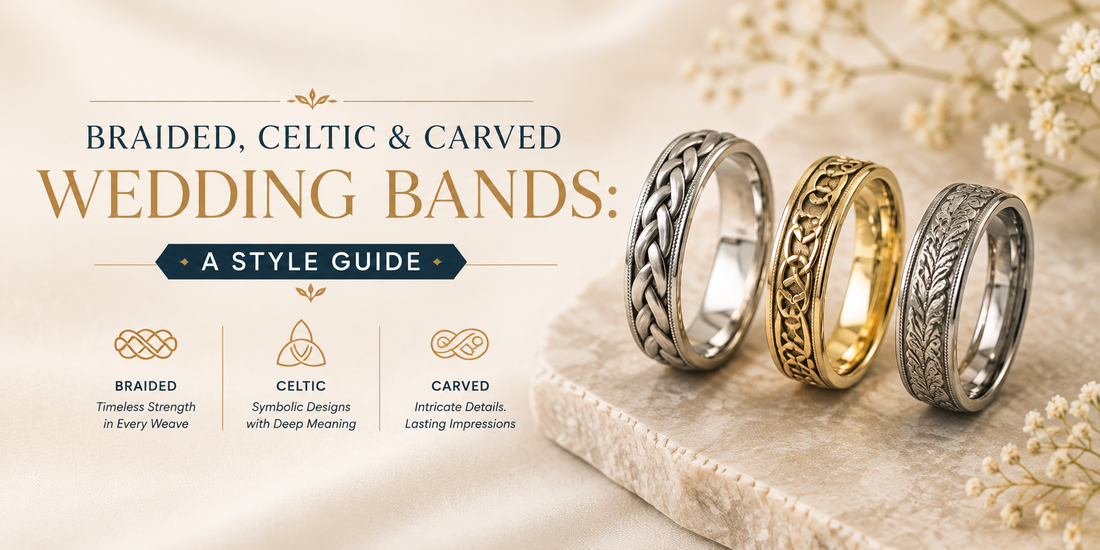
Braided, Celtic & Carved Wedding Bands: A Style Guide
Shopping, not reading?
Skip ahead and browse the full wedding band collection.
Plain, polished bands will always have a place in fine jewelry, but a growing number of grooms want a ring that tells a story on sight. Textured wedding bands — hand-braided metal, Celtic knotwork, and carved relief patterns — do exactly that. Each style carries its own craft tradition, its own symbolism, and its own set of practical trade-offs around durability and resizing. This guide walks through all three so you can choose the one that actually fits your hands, your heritage, and your daily life, not just your Pinterest board.
Below, we break down how each style is made, what it means, which metals hold detail best, and how sizing works differently for textured rings than for a plain comfort-fit band. We will also point you toward the exact collections and bestselling styles worth trying on first.
What Is a Braided Wedding Band?
A braided wedding band is a men's or women's ring made by weaving multiple strands of precious metal — usually two to eight — into a continuous braided or twisted pattern, then fusing and polishing them into a single durable band. The look references rope, cord, or interlaced hair, symbolizing two (or more) lives woven into one. Braided bands are prized for their dimensional texture, their resistance to showing everyday scuffs, and the way light catches each individual strand.
Hand-Braided & Woven Wedding Bands: How They're Made
A genuine hand-braided wedding band starts as several thin wires of gold, platinum, or palladium — often anywhere from three to eight strands depending on the design's complexity. A master jeweler braids these strands by hand, the same way you'd braid rope or hair, working slowly so the tension stays even across the entire circumference. Uneven tension is the difference between a braid that looks crisp and symmetrical and one that looks lopsided, so this step alone can take hours of skilled labor per ring.
Once the braid is formed, the jeweler fuses the strands at key points, shapes the woven rope into a circle, and solders it into a closed band. The outer surface is then refined: some braided bands are left with the individual strands slightly raised and tactile, so you can feel each woven cord under your thumb, while others are lightly compressed and polished so the braid reads as a smooth, continuous pattern rather than separate wires. Many designs pair a woven center with polished flat edges or a bevelled rail on either side, which frames the texture and makes the ring easier to pair with a suit cuff or watch band.
Because a braided band is essentially several strands of metal locked together rather than one solid mass, the engineering matters. A well-made hand-braided ring is soldered at multiple points along the braid, not just at the seam, so the strands can't shift or separate with wear. This is one of the biggest differences between a true hand-braided band and a cast imitation that only looks braided on the surface — a cast ring is a single molded piece with a braid-textured pattern stamped or milled into it, which is faster and cheaper to produce but doesn't have the same dimensional depth or the woven strength of hand-formed strands.
Are braided wedding bands durable? Yes — when hand-woven and properly fused, a braided band is comparably durable to a plain band of the same metal and karat, because the strands are soldered as a unified structure rather than left loose. The braided texture also has a practical advantage day to day: fine woven detail tends to disguise light surface scratches better than a high-polish flat band, since the eye reads texture rather than a mirror finish. That said, very deep, open braids with pronounced gaps between strands can be more prone to catching on gloves, tools, or gym equipment than a tighter weave, so if you work with your hands, ask your jeweler about a closer, more compressed braid pattern.
Two of our most requested hand-braided styles show the range within this category. The
 Featured pickCaden Mens Hand Braided Wedding Band
From $935.00
Featured pickCaden Mens Hand Braided Wedding Band
From $935.00
$1,456.35
Shop now uses a tighter, more refined weave with polished edge rails, giving it a dressier, more subtle presence — a good pick if you want texture without it dominating the ring. The
 Featured pickAlexander Mens Hand Braided Wedding Ring
From $1,346.00
Featured pickAlexander Mens Hand Braided Wedding Ring
From $1,346.00
$1,705.25
Shop now takes a bolder approach with a more pronounced, wider woven pattern that reads clearly as braided rope from across the room, which suits grooms who want the texture to be the main event.
Styling-wise, braided bands pair naturally with casual and rugged everyday wardrobes — denim, flannel, boots — but the better-made hand-woven styles, especially in 14K or 18K gold, look equally at home under a suit cuff. If you want the braid to feel more formal, look for a design with polished shoulders or a flat outer rail that frames the woven center, rather than a braid that wraps the entire band edge to edge.
Celtic Wedding Bands: Trinity Knots, Claddagh & Meaning
Celtic wedding bands are among the most symbolically rich options in men's fine jewelry, drawing on centuries of Irish and Scottish design tradition. Unlike a braided band, which is built from woven strands, a Celtic band is typically cast or hand-engraved with knotwork patterns cut or raised into the metal's surface — interlocking lines that have no beginning and no end.
What is a Celtic trinity knot ring? A trinity knot ring (also called a triquetra) features three interwoven loops with no start or end point, an ancient Celtic symbol most commonly read today as representing eternal love, or the union of mind, body, and spirit. In a Christian context it's also associated with the Holy Trinity, but its use on wedding bands today is primarily symbolic of unbroken, everlasting commitment — which is exactly why it translates so naturally onto a wedding ring, itself a circle with no end.
The claddagh is the other cornerstone Celtic wedding symbol: two hands clasping a heart, topped with a crown. Each element carries its own meaning — the hands represent friendship, the heart represents love, and the crown represents loyalty. Traditionally, the claddagh dates back to 17th-century Galway, Ireland, and how you wear it has historically signaled relationship status (worn on the right hand with the heart facing outward for "still searching," and on the left hand facing inward once married). On a wedding band, the claddagh motif is usually worked into the design as a continuous engraved or carved band rather than a standalone ring, so newlyweds get the symbolism in a piece meant for daily wear.
So why are Celtic wedding bands popular for weddings specifically, beyond general Irish heritage pride? A few reasons come up again and again with our customers. First, the knotwork itself is a built-in metaphor — an unbroken line is about as literal a symbol of "forever" as jewelry design gets. Second, Celtic bands let couples with Irish, Scottish, or broader Celtic ancestry incorporate real heritage into the most symbolic piece of jewelry they'll ever wear, which matters increasingly to couples who want their wedding details to mean something beyond aesthetics. Third, purely on design merit, knotwork patterns are visually intricate without relying on stones, so they suit men who want a distinctive ring but aren't interested in a diamond-set band.
Our men's Celtic wedding bands collection is built around this heritage. The bestselling
 Featured pickRohan Trinity Knot Mens Celtic Wedding Ring
From $1,255.00
Featured pickRohan Trinity Knot Mens Celtic Wedding Ring
From $1,255.00
$2,176.00
Shop now is our top-performing Celtic style — a bold, continuous trinity knot pattern carved around the full band, popular precisely because the symbolism reads clearly without needing an engraving to explain it. For something a little more understated, the
 Featured pickColin Celtic Knot Mens Wedding Band
From $1,096.00
Featured pickColin Celtic Knot Mens Wedding Band
From $1,096.00
$1,992.00
Shop now uses a narrower interlocking knot motif set against a polished or brushed background, which works well if you want the Celtic detail as an accent rather than the dominant design.
A quick note on terminology, since it comes up in searches often: a Celtic wedding ring for men and a men's Celtic wedding band refer to the same category — "ring" and "band" are used interchangeably by shoppers, though in the trade "band" typically implies a continuous style without a raised setting, which is how nearly all Celtic wedding designs are built.
Carved & Sculpted Wedding Bands
Carved wedding bands take a different approach to texture than either braided or Celtic styles. Rather than weaving separate strands or engraving traditional knotwork, a carved or sculpted band is milled, hand-chased, or cast with a relief pattern directly into the metal's surface — raised ridges, faceted planes, organic wave motifs, hammered textures, or architectural geometric cuts. The defining feature is depth: light and shadow play across the raised and recessed areas of the design, which gives a carved band more visual movement than a flat engraved pattern.
Carved styles are also where you'll most often see mixed textures within a single ring — a hammered or brushed carved center paired with polished bevelled edges, or two-tone metal combinations where a contrasting metal fills the recessed channels of the carving. This makes carved bands the most design-flexible of the three categories: some read as rugged and organic (think bark or wood-grain textures), others as sharp and modern (faceted, angular relief cuts), so it's the category to explore if neither the rope-like look of braiding nor the traditional knotwork of Celtic design quite matches your style. Our men's stylish & carved wedding bands collection spans both ends of that range, from subtle brushed relief patterns to bold sculpted designs.
How to Choose Between Braided, Celtic, and Carved
All three styles deliver texture and personality beyond a plain band, but they serve different priorities. If meaning and heritage matter most to you — Irish or Scottish ancestry, a symbol for eternal love you can point to and explain — a Celtic wedding band is the clearest choice, and the trinity knot or claddagh motifs give you built-in symbolism without needing an engraving. If you're drawn to the idea of "two lives woven into one" expressed literally in the ring's construction, a hand-braided band delivers that concept directly, and it tends to suit grooms with more casual, everyday style who still want a ring with real craftsmanship behind it. If you want a bold, sculptural look that doesn't reference a specific tradition — something more contemporary or architectural — carved and relief-pattern bands give you the most design range, including two-tone and mixed-finish options.
It's also worth trying all three in person or against your hand size if possible: braided bands tend to read as the most textured up close but the most subtle from a distance, Celtic knotwork holds a consistent, recognizable pattern at any distance, and carved bands vary the most in how bold they look depending on how deep the relief cut is.
Lifestyle is worth weighing too, beyond pure aesthetics. Grooms who work regularly with their hands — construction, mechanics, gym-heavy routines, outdoor trades — tend to do best with a tighter, more compressed braid or a shallower carved relief pattern, since deep grooves and open weaves have more surface area to catch on gloves, rope, or equipment. Grooms in office or client-facing roles often have more flexibility to choose a bolder, more dimensional texture, since their daily wear is gentler on the ring. None of this rules any style out entirely, but it's a useful second filter once you've narrowed things down by meaning and appearance alone.
Metal Considerations for Textured Wedding Bands
Not every metal holds fine detail the same way, and this matters more for braided, Celtic, and carved bands than it does for a plain polished ring. Platinum is the gold standard for fine detail retention — it's a dense, malleable metal that holds crisp edges in engraved and carved work for decades, and because platinum doesn't lose material when it wears (it displaces rather than abrades), knotwork and carved relief patterns stay sharp far longer than in other metals. 18K and 14K gold are close behind; both are soft enough to allow deep, precise engraving and hand-braiding work, with 18K holding slightly crisper detail over decades due to its higher precious-metal content, while 14K offers excellent detail retention with added everyday scratch resistance from its higher alloy content.
For couples who want maximum scratch resistance over fine detail, tungsten and titanium are worth understanding, though with a trade-off: both metals are extremely hard, which makes them very resistant to daily wear, but that same hardness means fine hand-engraved or hand-braided detail is harder to produce and typically relies on laser engraving or milling rather than traditional handwork. If long-term durability against scratches is the top priority for a textured design, our tungsten vs. titanium comparison guide breaks down which of the two holds up better for active, hands-on lifestyles. For a broader look at how gold and platinum compare across cost, durability, and appearance, see our gold vs. platinum guide.
One more consideration specific to couples choosing coordinated rings: if you and your partner are selecting bands together and want your metals to age and match consistently over the years, our best metal for couples guide walks through how different metal pairings wear over time.
Sizing and Resizing Notes for Textured Bands
Textured bands — braided, Celtic, and carved alike — are meaningfully harder to resize than a plain comfort-fit band, and it's worth understanding why before you order. A plain band can usually be cut, stretched, or have metal added and simply re-polished with the finish restored seamlessly. A braided band, by contrast, has its pattern woven around the entire circumference; resizing requires a jeweler to either add or remove metal at a single point and then carefully re-form and re-fuse the braid so the pattern lines up and the tension looks even — a task that requires real hand-braiding skill, not just standard resizing equipment. Celtic knotwork and carved relief patterns have a similar issue: the design repeats at a fixed interval around the band, so resizing by even half a size can throw off the symmetry of the pattern unless the jeweler carefully adjusts the design to compensate, which isn't always possible on a heavily engraved band without disrupting the knotwork's flow.
Practically, this means two things. First, get your ring size confirmed carefully before ordering a textured band — our ring sizing guide walks through how to measure accurately at home so you're not guessing. Second, ask about resizing limits before you buy; most textured bands can be adjusted within about half a size in either direction without visibly disrupting the pattern, but larger adjustments may require a full re-fabrication of the ring rather than a simple resize. If you know you want a fully custom width, metal, or pattern adjustment from the outset, our custom design guide covers how to work with our jewelers directly on a bespoke braided or Celtic band built to your exact size from day one.
Braided vs. Celtic vs. Carved: Quick Comparison
| Style | Meaning / Symbolism | Best For | Durability & Resizing |
|---|---|---|---|
| Hand-Braided / Woven | Multiple strands (lives) woven into one; rope and cord symbolism | Casual-to-refined everyday wear; grooms who want tactile, dimensional texture | Very durable when properly fused; resizing requires hand re-braiding, limited to small adjustments |
| Celtic (Trinity Knot / Claddagh) | Eternal, unbroken love (trinity knot); friendship, love, loyalty (claddagh); Irish/Scottish heritage | Couples with Celtic ancestry or anyone wanting built-in symbolism without stones | Durable in gold or platinum; resizing can disrupt knotwork symmetry beyond small adjustments |
| Carved / Sculpted | No fixed traditional meaning; personal expression through relief pattern and mixed textures | Grooms wanting a bold, modern, or architectural look, including two-tone designs | Durability depends on carving depth and metal; resizing limited by pattern repeat, similar to Celtic |
Expert Tip
Our jewelers' single most common piece of advice for textured bands: try the ring on for a full day before you commit to any engraving or customization, if your jeweler allows it. Braided, Celtic, and carved patterns all sit slightly differently against the skin than a smooth polished band — some grooms love the tactile feel underneath their fingers, while others find a very deep braid or carving pattern less comfortable for tasks like typing or gripping tools all day. A comfort-fit interior profile (rounded on the inside rather than flat) makes a meaningful difference in how a textured exterior actually feels in daily wear, so ask specifically whether the band you're considering comes in a comfort-fit version — you can read more about how that inner shape affects comfort in our comfort-fit vs. standard-fit guide.
Caring for Braided, Celtic & Carved Bands
Textured surfaces collect more everyday residue — lotion, soap, skin oils — in their recesses than a smooth polished band, simply because there's more surface area and more grooves for it to settle into. A soft-bristle brush (an old, clean toothbrush works well) with warm water and a drop of mild dish soap is usually enough to lift buildup out of a braid's channels or a carved pattern's recesses without abrasive polishing that could flatten fine detail over time. Our full ring care guide covers cleaning frequency and what to avoid for each metal type, which matters more for detailed textures than for plain bands since over-polishing can gradually soften crisp engraving.
Explore Braided, Celtic & Carved Collections
If a woven, rope-like texture speaks to you, start with our men's hand-braided wedding bands collection, home to both the
Featured pickCaden Mens Hand Braided Wedding Band
From $935.00
$1,456.35
Shop now and
Featured pickAlexander Mens Hand Braided Wedding Ring
From $1,346.00
$1,705.25
Shop now featured above. For Celtic heritage and trinity knot or claddagh symbolism, browse the full men's Celtic wedding bands collection, including the bestselling
Featured pickRohan Trinity Knot Mens Celtic Wedding Ring
From $1,255.00
$2,176.00
Shop now and the more understated
Featured pickColin Celtic Knot Mens Wedding Band
From $1,096.00
$1,992.00
Shop now. For bold relief patterns and mixed-texture designs, the men's stylish & carved wedding bands collection is the place to look. And if you want to compare every men's style side by side before narrowing down, our full men's wedding bands hub covers the complete range.
If you're shopping as a couple and want to coordinate a textured men's band with a complementary women's style, our matching bands for couples guide and women's wedding band styles guide are good next stops, along with our wedding band width guide if you're deciding how wide a braided or carved design should be on your hand, and our eternity bands guide if you're considering pairing a textured men's band with a diamond eternity style for your partner.
Ready to Find Your Style?
Whether you're drawn to the woven craftsmanship of a hand-braided band, the centuries-old symbolism of Celtic knotwork, or the sculptural boldness of a carved design, every ring in these collections is built by our jewelers to be worn every day for the rest of your life. Browse the hand-braided, Celtic, and carved collections, or reach out to our team for guidance choosing between them, custom sizing, or a fully bespoke design.
Bestselling His & Hers Sets
View all-
Noah Hand Woven Mens Wedding Ring
$657.00From$492.75Sale -
Ryker Hand Woven Mens Wedding Band
$946.00From$709.50Sale -
August Handmade Mens Wedding Ring
$1,065.00From$798.75Sale -
Axel Handmade Mens Wedding Band
$1,078.00From$808.50Sale


Talk to a Wedding Band Expert
Talk to a Wedding Band Expert
Have a question about sizing, metals, or engraving? Our specialists are happy to help — no pressure, just honest advice.
Send Us a Quick Question
Fill out the form below and one of our wedding band experts will get back to you within one business day.
Frequently Asked Questions
What is a braided ring men can wear every day without damage?
What is a Celtic trinity knot ring?
Are braided wedding bands durable?
What does a claddagh ring mean?
Can carved and Celtic wedding bands be resized?
Which metal holds fine engraving and carving detail best?
How do I clean a braided, Celtic, or carved wedding band?
Can I get a custom braided or Celtic wedding band?
Explore by Topic
Browse related guides, collections, and buying tips — organized to help you find exactly what you need next.